

Query fan-outs are one of the most talked-about elements in AI-Search, which makes sense considering the level of insight they can give us into why AI models mention certain brands or cite specific sources.
When Gemini 3 rolled out, we even put together some initial research with the details of the query fan-outs that Gemini was using:
-
-
- 10.7 average fan-out queries per prompt
- 95% of fan-out queries had 0 MSV
- 6.7 average words per fan out query
- 21.3% contained a year
- 26.4% of fan-out queries included a brand name in the search
-
While this level of insight into AI models is interesting - our next step is to identify the value.
Query fan-outs: Signal vs Noise
There's a lot of noise in AI-Search right now.
And while query fan-outs provide a level of insight into AI models we didn’t have for the majority of 2025, how can we actually filter the signal from the noise?
Here are the questions we've been trying to answer:
-
-
- Are fan-outs consistent enough to act on, or are they different every time?
- Gemini creates ~10 fan-out queries per prompt, does that mean my keyword list just got 10x longer?
- 95% of these queries have zero MSV, so where's the value?
-
To understand this, I set up a recurring pull of the 100 fan-out queries that we’ve been monitoring for Seer.
The fan-out queries were pulled from Gemini 3’s API twice each day for a week.
After 13 total runs, here were the key metrics from the analysis:
-
-
- 1,300 total prompts
- 8.52 average fan-out queries per prompt
- 11,029 unique fan-outs generated
- 4.5% organic page 1 visibility for seerinteractive.com
- 99% with 0 MSV
- 0.1% overall query similarity
-
“I’m already tracking 100 prompts, does this mean I need to track all 11,000 fan-outs too?”
Only 8 queries appeared in all 13 runs. That level of inconsistency makes it nearly impossible to track fan-outs the way we track SEO keywords.
Inconsistency doesn't mean zero value, it means the value is in the themes, not the individual queries.
Here are 6 ways that I’m thinking about using query fan-outs.
6 Ways to Leverage Query Fan Outs
1. Monitor themes, not exact-match fan-out queries
Only 8 queries appeared in every run, however, this was only checking for exact-match query fan outs.
I think of fan-outs the same way I think about how users actually search. It's different every time, but there may be themes that we would want to look into even further.
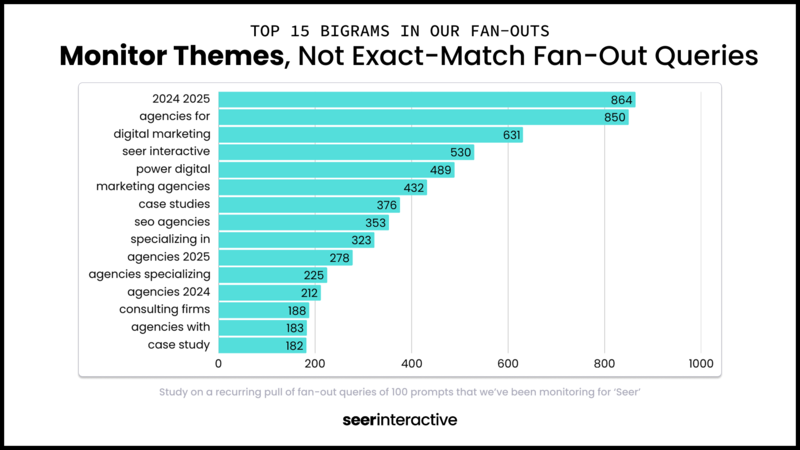
Rather than focusing on exact-match queries with minimal search volume, look at the themes in bigrams across your fan-out data.
In the example that we're looking at for Seer, we can see that the top bigram used is the years of “2024 2025”, signaling how necessary recent content is.
While this isn't surprising, considering we saw this in our initial Gemini 3 dataset and there have been multiple studies on the need of recent content for AI search visibility, the bigram that stood out was 'case studies' - which appeared twice in the top list.
Going back to how these LLMs may be searching more like an actual user, the search for case studies also signaled this. If I'm asking a prompt like, "What are the best SEO agencies?" Gemini is actually searching for trust signals and proof points similar to what a human would do.
By Looking at the themes, this can help me identify the type of content that I should be creating, rather than digging through thousands of 0 MSV fan-out queries.
2. Analyze how often your brand name is used versus competitors
If your brand appears in a fan-out query, it signals that the AI model has a semantic association between your brand and that prompt. A mention in the fan-out doesn't guarantee you'll appear in the output, but being in the consideration set lowers the barrier.
In our query fan-outs, “Seer Interactive” appeared in 530 of 11,029 query fan-outs. The top ‘competitors’ that were mentioned were:
- Tinuiti: 509 mentions
- Power Digital: 489 mentions
- Razorfish: 484 mentions
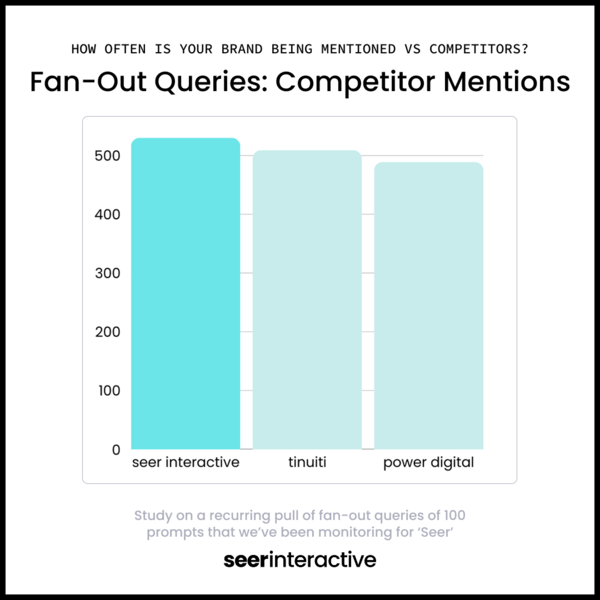
Now that we have a benchmark, the next step is to filter the data and see which categories have stronger associations.
For example, does Seer have a stronger connection to SEO-related prompts compared to another agency having a higher association with paid media?
This could help show the strength of that association, how volatile your AI visibility within a prompt set is, and the level of effort there may be to gain visibility for a specific category.
3. Review what partners, tools, or third-parties are mentioned most often
Partners, tools, and third parties were frequently mentioned in the fan-outs for prompts we're tracking. This could give us a signal of what Gemini “thinks” is relevant to your space.
Use this data to create partnership pages, integration guides, or case studies that demonstrate expertise and capture related search traffic.
The most mentioned related query fan-outs in our research were:
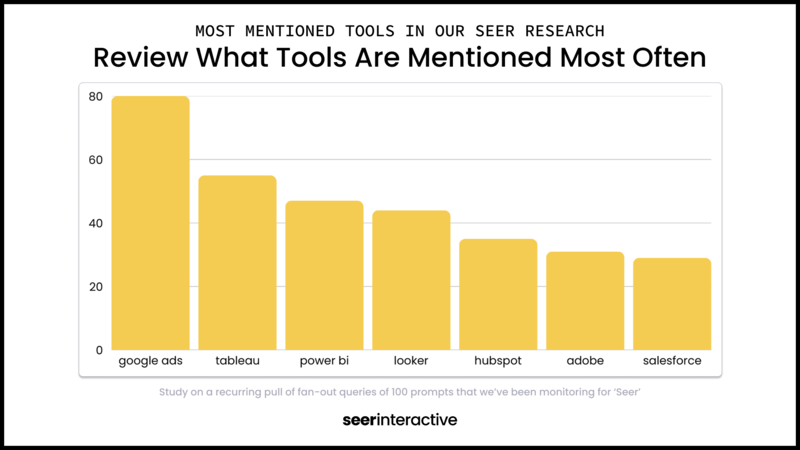
- Tableau: 48 mentions
- Power Bi: 41 mentions
- Looker: 40 mentions
- Hubspot: 32 mentions
- Adobe: 26 mentions
For prompts that we’re tracking like “What are the best analytics agencies?” Gemini is searching for information like agencies that specialize in Power BI'. This is a signal that we can highlight this our expertise in this area more prominently.
This information can also help with prioritizing PR and partnership opportunities. We recommend setting up an AI visibility tracker to monitor actual citations. But fan-out data also shows which platforms and sites AI models are searching for before generating a response.
4. Identify brand-queries that are used most often where you don’t have a dedicated page for
If Gemini searches for brand-specific information and can't find it on your site, it pulls from third parties.
Letting Gemini decide where to pull this information can lead to inaccuracies, brand misconceptions, or at the least a narrative that isn’t as exact as you would like. Creating dedicated pages gives you the most influence over what gets cited and ensures users get accurate information.
In our data "seer interactive industry awards and recognition" has been searched 17 times by Gemini and "seer interactive industries served" has been searched 13 times.
We don’t have a page or site section dedicated to this information, so Gemini is using third-parties like AgencySpotter, Clutch, and Bitscale to surface this information.
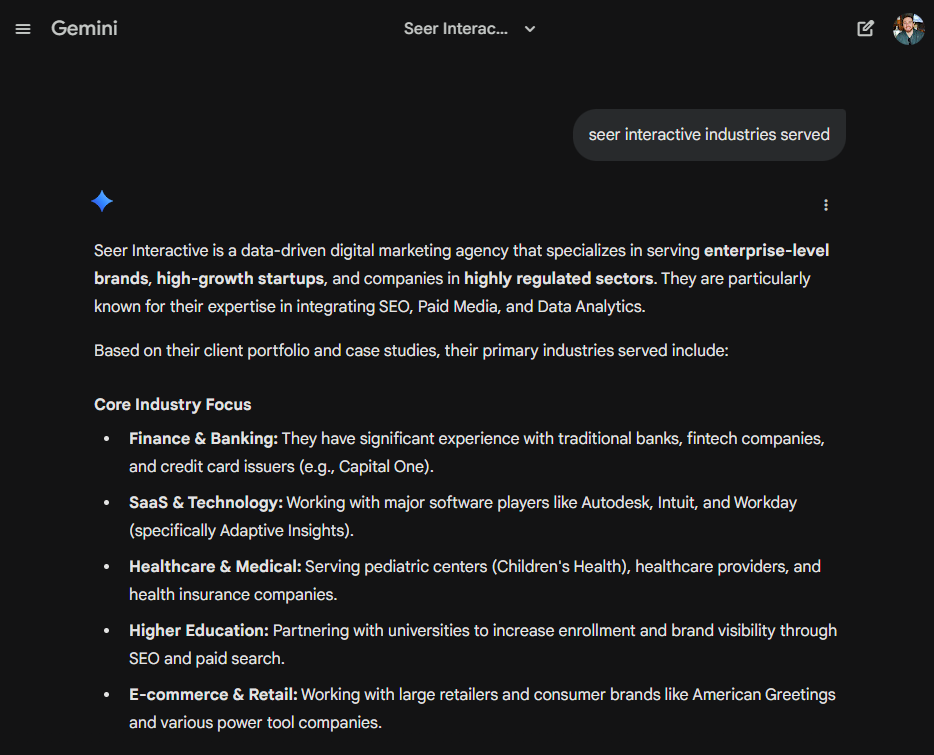
In our case, this generally does give an accurate depiction on the industries that we have experience working in. However, you should leverage any chance you have the opportunity to write your own narrative.
5. Discover high-volume fan-outs to create content for
Most of the query fan-outs have 0 MSV, but the ones that do have volume can represent a dual opportunity for SEO value and potentially AI visibility.
This is where we can bridge the gap for SEO teams who need traditional KPIs to justify AI-focused work.
In our data, 10 queries had 100+ MSV, appeared frequently as fan-outs, and we weren't ranking on page 1 of the traditional search results.
The most prominent of which was the query "what is generative engine optimization" that has been used 7 times and totals 1,200 MSV.
Transparently, our ‘What is GEO’ page could use a refresh so it makes sense why we’re on page 4 of the SERPs.
For the prompt generating this query "What are the best agencies for generative engine optimization?” we have 0% visibility over the past 2 months in Gemini.
My hypothesis is that if we increase our traditional SEO visibility for this fan-out query, we’ll increase our AI visibility for the respective prompt as well. The MSV value helps me prioritize the worth of the time and resources of this hypothesis.
If you target the right fan-out queries, you can increase your visibility - or at least validate whether this approach works.
- If I’m correct, our SEO and AI performance will improve.
- If I’m incorrect, we’ll still see performance gains from organic search.
💡 Stack rank your fan-outs by consistency + MSV. A query that appears in 80%+ of runs and has search volume is a much safer bet than a high-MSV query that only appeared once.
6. Identify which prompts are the highest priority to target for AI-Search visibility
Create a scoring methodology that works for you.
Total the MSV of fan-out queries appearing in 80%+ of runs, and add weight by your priority categories. This gives you a stack-ranked answer to: if I can only focus on 5 prompts, which ones?
Categorize your prompts thematically before prioritizing. Comparing "Tell me about Seer Interactive" against "What are the best SEO agencies" won’t be useful since they'll have completely different fan-out patterns. Group by theme first, then stack rank within each category.
Consistent monitoring is critical to keep a pulse on what actually matters.
With AI-Search changing daily, agility and prioritization are essential to separate signal from noise, and value from hype. We get it, it's noisy. If you're looking to get your arms around your strategy, let's talk.

.png)
.png)