

Google announced the release of Gemini 3 this week, and it came with some major advancements in reasoning, multimodal understanding, and agentic capabilities. But for digital marketers, the most important update is that Gemini 3 will power their AI Search systems, starting with AI Mode and eventually moving into AI Overviews.
TL;DR: The high level findings from our research:
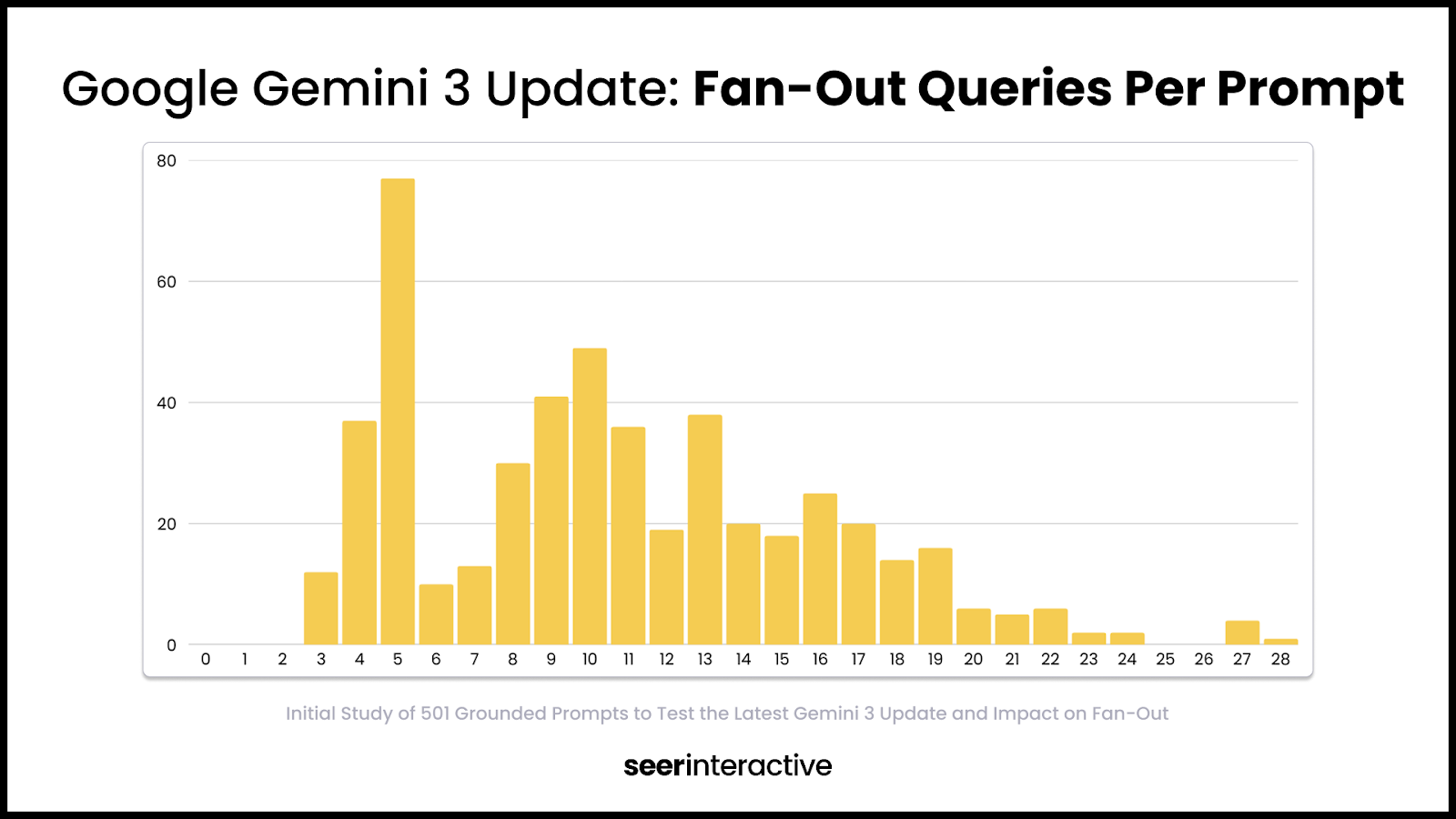
- 10.7 average fan-out queries per prompt
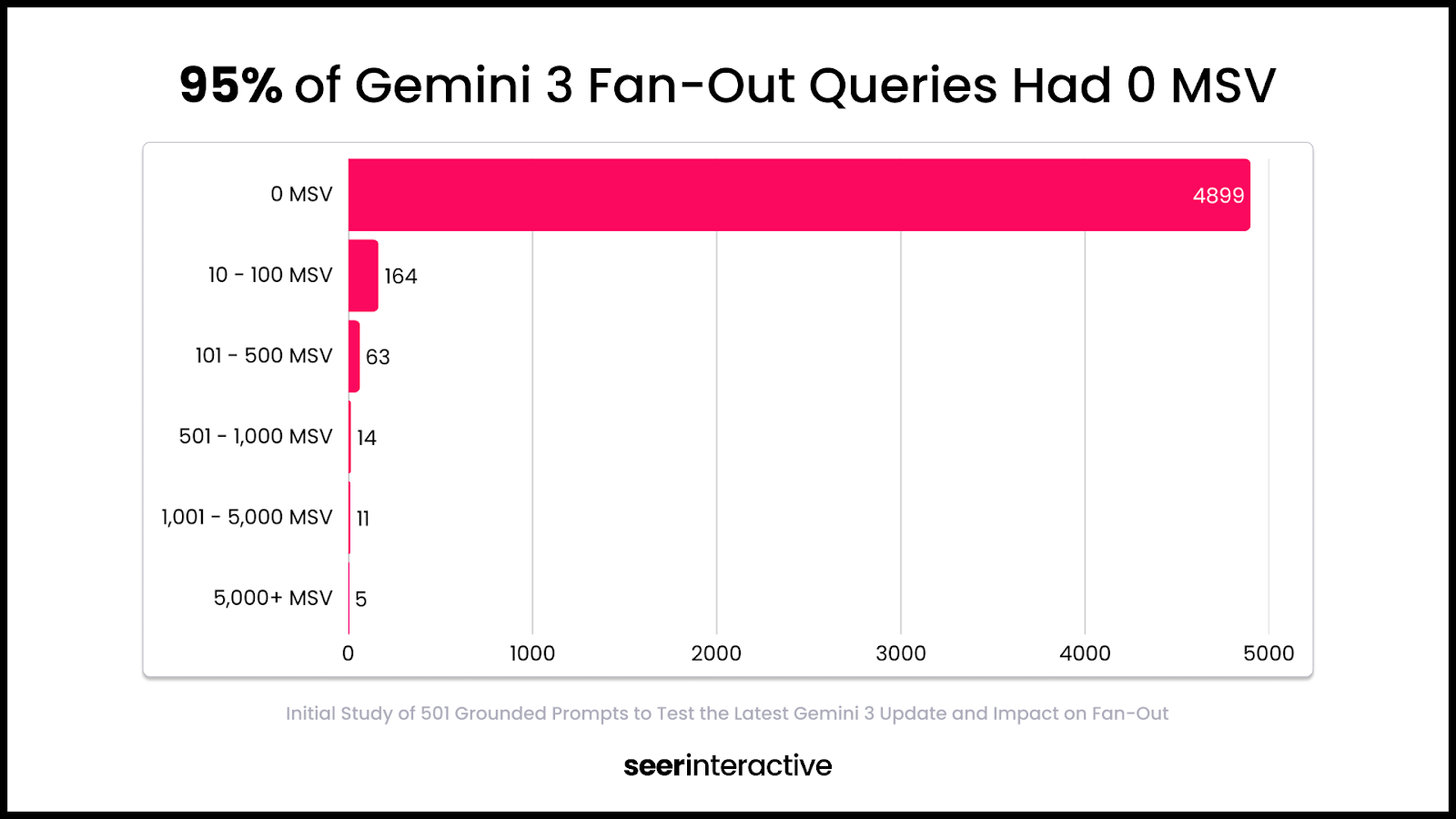
- 95% of fan-out queries had 0 MSV
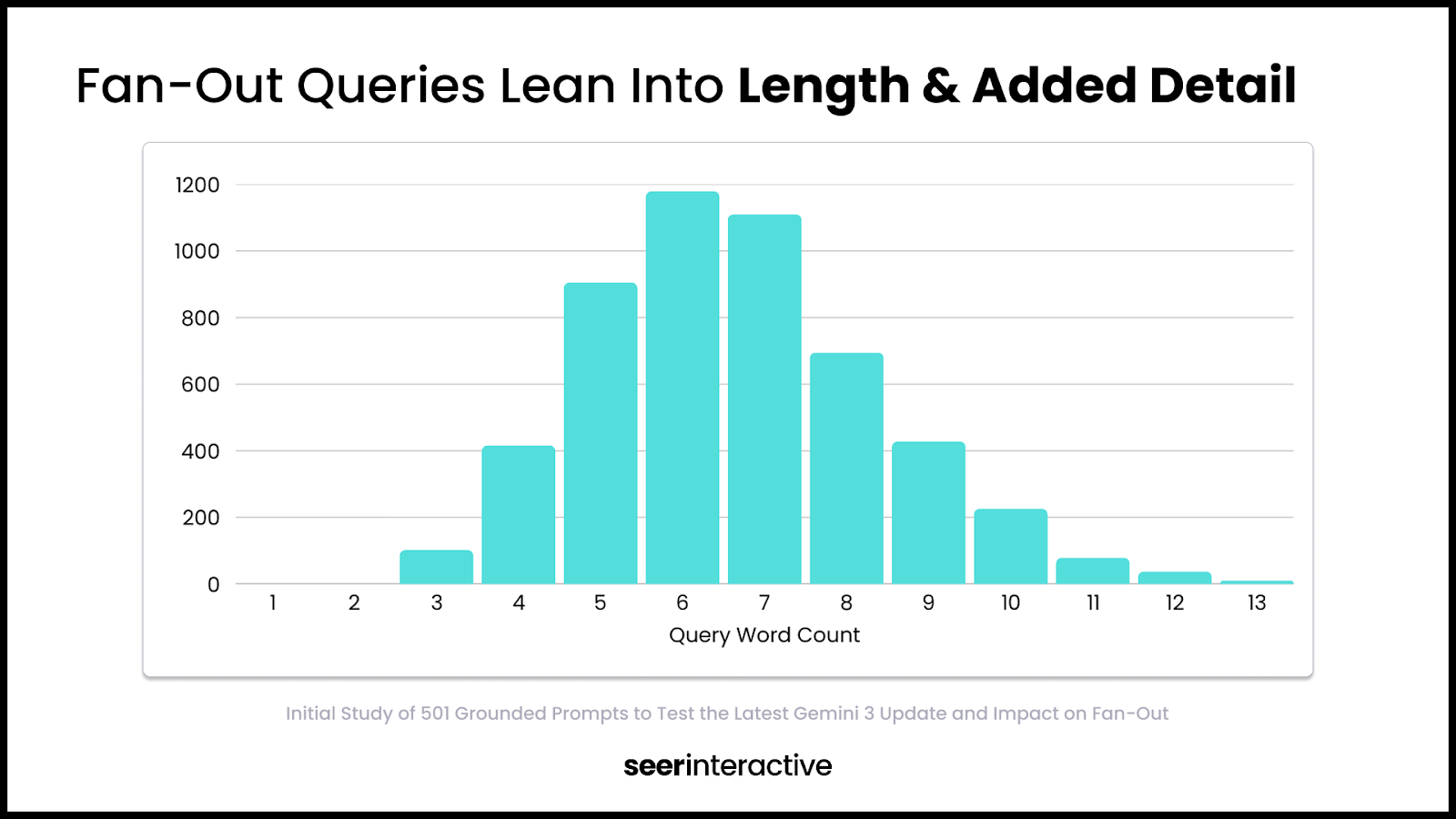
- 6.7 average words per fan out query
- 21.3% contained a year
- 26.4% of fan-out queries included a brand name in the search
As Gemini 3 becomes the engine behind AI search within the traditional Google search experience, understanding what types of fan-out queries are generated will be increasingly important for your SEO and AI visibility strategy.
With this update, Google highlighted that “Google Search’s query fan-out technique is getting a major upgrade.”
The concept of ‘query fan-out’ has been a hot topic ever since it was first used to describe how Google’s AI search systems break a user’s question into multiple sub-queries to gather supporting information.
Query fan-outs give us direct insight into what entities, themes, and relationships Gemini breaks a prompt into when using web sources. As we continue to advance AI Search strategy and reverse engineer these models to influence visibility, the patterns will guide those efforts by giving another hint related to ‘why’ these models highlight certain brands or cite specific sources.
Check out the full PDF detailing the fundamentals of AI Overviews and AI Mode in Search from Google.
Research Set Up & Methodology
To quickly put this to the test, I used the Gemini 3 API and ran a starting set of 501 prompts that we’re tracking regularly for Seer and clients. The prompt list contains questions like “Where can I find the top SEO services for large enterprises?” across multiple different industries to cast a wide net and surface initial patterns across topics.
Note: I forced grounding on all prompts that were analyzed. This means that each query was required to leverage Google Search so the API would return the fan-out queries for our research.
Since grounding was forced, this research won’t include insight into how often Gemini 3 naturally uses Google Search versus primarily uses its own training data.
For this research, I focused on the question: Whenever fan-out queries are used in Gemini 3, what do the queries look like and what patterns are consistently appearing?
A Closer Look at Gemini 3 Fan-Out Behavior
Fan-out queries per prompt
There was an average of 10.7 fan-out queries per prompt with the minimum of 3 and maximum of 28 fan-out queries from a single prompt.
For comparison, Gemini 3 has 5x the amount of queries that ChatGPT does when we look at a study Chris Long at Nextiv analyzed just last month.
The scale of these searches isn’t all that surprising given Google’s comment about using “more searches to uncover relevant web content.” But now we can actually see how much wider that net is. Compared to Gemini 2.5, query fan-outs are up 78%, jumping from an average of 6.01 in Gemini 2.5 to 10.7 in Gemini 3.
The scale of these fan-outs should be beneficial in 2 ways:
- For users actually relying on Gemini for information research or decision making, the wider range of sources should assist with the relevance and credibility of the outputs.
- For marketers, this will provide a much clearer read on the patterns and what themes the LLM identifies as important within your space. That guidance is something we really haven’t had a scaled view into and will assist in AI visibility tactics.
Words per fan-out query
There was an average of 6.7 words per fan-out query, ranging from 17 words at the high end to 2 words at the low end.
Here’s what the 17 word fan-out query looked like:
- Prompt: What composite deck boards should I get if I want the most realistic wood look possible?
- Fan out query: TimberTech AZEK Vintage Collection vs Trex Transcend Lineage vs Deckorators Voyage vs Fiberon Concordia realistic wood look
Long-tail search queries have traditionally been associated with users who are further along in their research process and are trying to make a more confident decision for their needs.
By the length of the fan-out queries, we’re seeing the same pattern from Gemini. The prompt isn’t just being rephrased, but the fan-outs are expanding into highly specific, long-tail variations of what a user may search if they were looking for more context.
Gemini is consistently looking for comparisons, attributes, and deeper information when checking web sources, giving us a clearer signal on what content to prioritize. It’s not enough to cover surface-level information, but content will need to include the specific details Gemini is searching for within your priority prompts.
Search volume of fan-out queries
95% of the queries Gemini generated for query fan-outs had 0 global search volume. While this doesn’t necessarily mean they have 0 demand, it does show how niche the queries are, which lines up with how detailed we found the long-tail queries to be in the previous section.
This means that most of the time, the queries generated by Gemini will not be common target keywords that we may be focusing on within marketing strategies.
Common themes in fan-out queries
There was only 1% overlap across the full fan-out dataset, so almost every query Gemini generated was unique. Knowing the scale and how hard to target these fan-out queries will be, understanding the common patterns that are being used will be critical for staying agile with your content strategy.
Dates (Specifically, Years)
2024 and 2025 were used in 21.3% of fan-out queries. This validates our previous data that tested the hypotheses of LLMs preferring recent content for prompts ranging from affordable home insurance to looking for an enterprise payroll software.
In discussions surrounding content recency, a question that comes up a lot is how LLMs ‘know’ whether content has been updated. We’ve typically thought about this the same way we think about traditional search - Google tracking page changes through its index and using it as a signal. But what we’re seeing in the fan-out queries suggests there’s another layer to this.
By explicitly including a year in the search queries, it’s actively looking for signals on the page itself that signal recency. Adding visible publish and updated dates may play an even bigger role in how your content gets surfaced - especially for LLMs like ChatGPT that don’t have as strong of an index yet and rely more heavily on what’s directly signaled on the page.
Brands
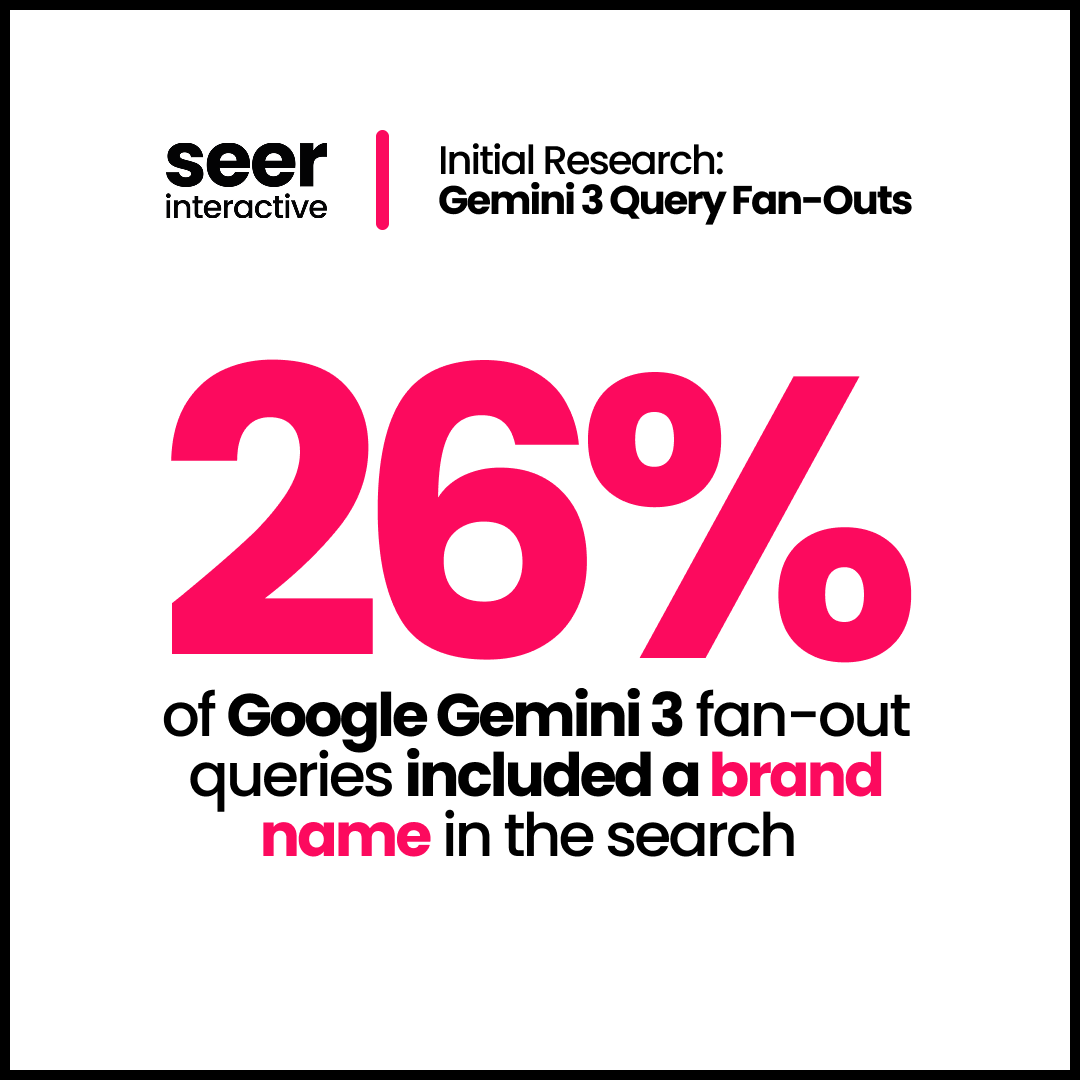
26.4% of fan-out queries included a brand name in the search.
This is a major data-point because having your brand mentioned in the fan-out query increases your likelihood of being cited in the LLM response and appearing as a citation.
Take this prompt for example: What is the best payroll software for bookkeepers?
Of the 16 fan-out queries, 4 included brand names:
- ADP wholesale payroll for accountants reviews
- Gusto vs ADP vs QuickBooks Payroll for bookkeepers
- Gusto vs OnPay vs ADP accountant partner program benefits
- ADP Accountant Connect partner program revenue share percentage
This signals that it isn’t even about what ADP has on their website or what third-party sites ADP is mentioned on, there’s a semantic tie from the prompt to that brand that automatically puts ADP in the consideration set.
To no surprise, ADP was immediately referenced in the prompt’s output.
This is great for ADP, but what about for brands that are vying for visibility for related prompts? Generally, this will mean there may be a higher level of complexity to gain visibility for these prompts.
For those cases where your brand isn’t being mentioned in the fan-outs but third-party sources are, this can give you further insight into where your brand needs to be visible in order to be included in the consideration set. Here are two examples:
- Prompt: Where can I find top UX design agencies for websites?
- Fan-out: Clutch best UX design agencies
- Prompt: What are the best agencies offering unified marketing platforms?
- Fan-out: top hubspot elite solutions partners
Related: Seer how LLMs can amplify brand misconceptions on third-party sites and how to address them.
Looking at these third-party brands at scale, along with what actual citations are being used for the prompts, will help prioritize potential partnerships or third-party placements for your brand.
For the other 73.6% of fan-out queries that do not include a brand name, begin monitoring the sites that are visible in the search results for those queries.
If your own pages (or direct competitors) are visible, that’s a sign that you have the opportunity to gain organic visibility and potentially be used as a citation. If those results are dominated by affiliates or third parties, that’s a signal of where you may want to build your brand partnerships to be visible where LLMs are searching.
What’s Next
Across our LLM studies, we’ve consistently found that the industry can influence how a model behaves. Because of that, our primary next step will be to scale this research and see how fan-out patterns shift across different verticals, where there are similarities and differences.
For now, here’s where we recommend focusing initial efforts:
- Monitor your own fan-out queries for the prompt that matter most to you.
The fastest way to understand how Gemini views your brand and industry is to generate those fan-out queries for prompts you want to be visible for. This will influence your own roadmap for AI visibility.
- Deepen your content beyond surface-level information
Are there any attributes, integrations, or comparisons for your topic that aren’t clearly covered on your site? Build out that branded, context rich content so LLMs, and users searching for those deeper details, have a better understanding of your brand.
- Build visibility across the third-party sources Gemini searches
I know that digital PR and brand mentions are consistently recommended to influence your AI visibility. What the fan-out queries, and citations, can assist with is prioritization. If review sites, industry news, or affiliates are consistently showing up, map out what small steps you can take to be visible and competitive in those environments.
- Benchmark your AI-referral traffic from Gemini
Gemini only accounts for 2.9% of all AI-referral traffic in our Seer client dataset. With Gemini 3’s expanded fan-out queries, benchmark your existing traffic to measure how these changes may affect sessions from the LLM in the coming months.

.png)
.png)