

TL;DR:
- There are actionable steps marketers can take today to prepare for agentic commerce
- Agentic commerce will impact all commercial activity on the Internet, not just the purchasing of physical products
- Marketers face uncharted territory which creates opportunities to get ahead of your competition
- There are three things every marketer should prioritize ASAP to future-proof their marketing efforts
Recently I had an aha moment about agentic commerce, or as Kevin Indig has smartly coined, “conversational commerce.”
My two-year-old got clip-on earrings for Christmas. Like most situations with toddlers, it started out cute and quickly became gross. She’d kept them on long enough to irritate her ear and the sores were in a tricky spot. I needed a very specific band-aid shape. I realized it was a great moment to use Gemini’s multi-modal search functionality.
The experience wasn’t perfect. It was clunky. The results were clearly influenced by what was easiest to pull from shopping feeds and the retailers were random websites I hadn’t heard of. It worked well enough to reveal the direction I needed, but at the end of the conversation, I said something that pained the marketer in me.
“Just find me something like this on Amazon.”
At that moment, I simply couldn’t handle the cognitive load of investigating a new website or going through a checkout process.
That is the shift that is upon us. It’s not enough to be seen. You must also be believed and be chosen.
I feel strongly that there’s a future where the solution doesn’t start and end with becoming an Amazon partner. Further, this impacts all brands who acquire customers through search - not just ecommerce.
Brands that embrace a variety of payment options, build trust with their customers, and prepare for conversational commerce have an opportunity to win. But, like winning in anything, it will take effort, discipline, and investment.
Types of Conversational Commerce to Prepare for in 2026
Before we walk through how to prepare for this shift, we need to align on what exactly this shift looks like.
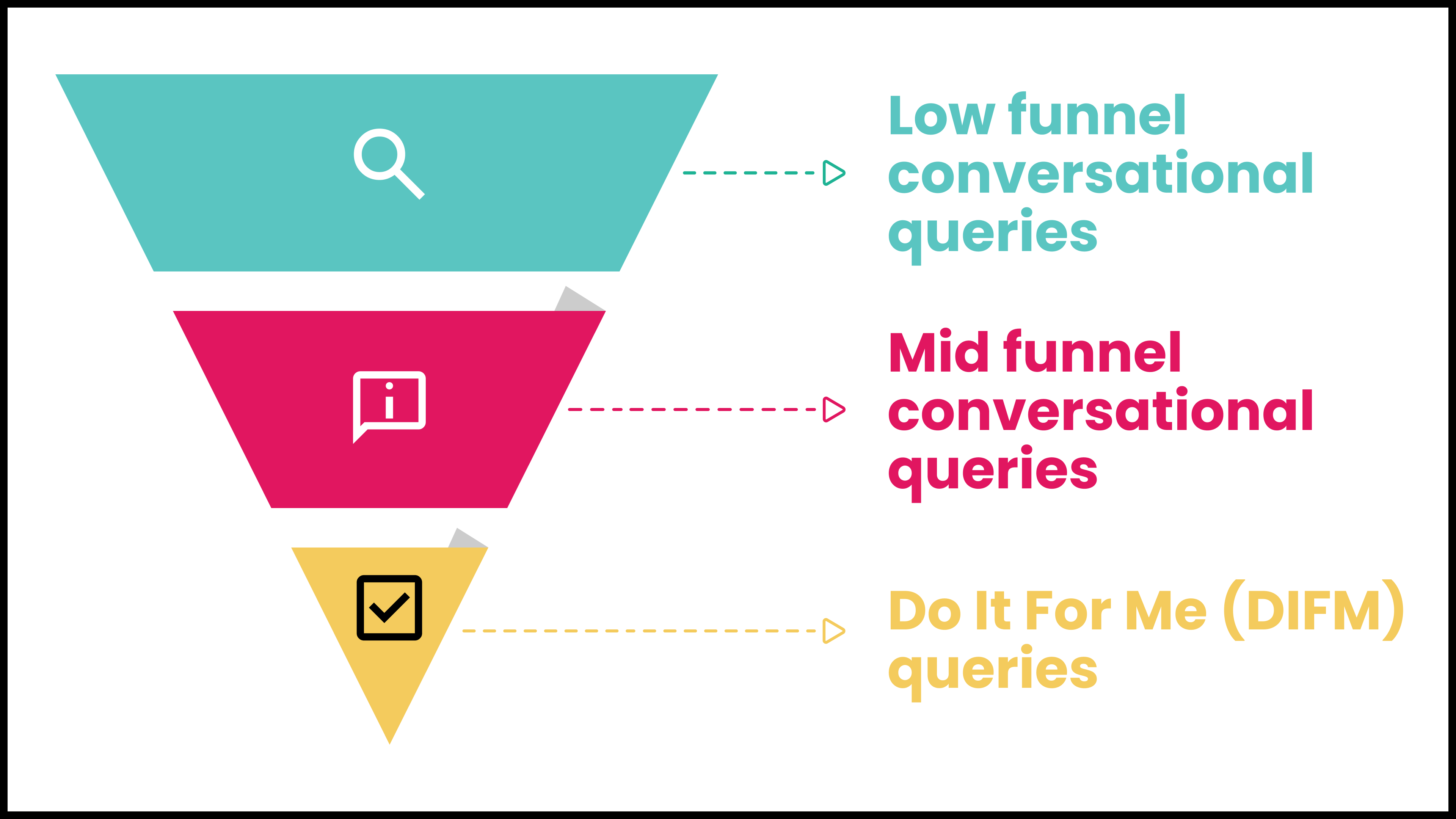
- Low-funnel conversational queries. These are the searches we’re most ready for. The user knows what they want. They provide more context in their prompt than the average search query, but it functions similarly. A grounding search is likely triggered, training data is referenced, and results populate. The first job to be done is to be seen.
- Mid-funnel conversational queries. The user doesn’t yet know what they want, but they know what problem they’re trying to solve and some criteria that separates the right answer from the wrong. This is basically deep research, which is executed by agents. Here we may see query fan-out leveraged to return a wide range of information from a wide range of sources, information synthesized and a recommendation made. Training data still serves as an input, but to what degree is uncertain. The job to be done is not just be seen. Hundreds of blue links will be “seen” by the agents researching the task. The job is to be seen and be believed.
-
Do It For Me (DIFM) queries. The user may or may not know what they want, but either way they’re comfortable assigning the task to an agent. Here the agent isn’t just pulling back data to form a response, it’s navigating websites, clicking through user experiences, and teeing up a filled shopping cart for the user to approve. The job to be done spans all needs now: you must be seen, be believed, and ultimately be chosen.
I don’t believe every brand will need to prepare for every type of conversational commerce flow in 2026. Generational differences will apply, industry nuances will factor in. The best way to understand what you may need to plan for is to ask your audience. Moderated user interviews that task your ICPs with going through these workflows and sharing their thoughts will help you establish your own brand’s priorities.
The 2026 Conversational Commerce Readiness Checklist
1) Audit your product data like it’s your storefront
AI needs comprehensive, well structured data to thrive. Product feeds will be important for the foreseeable future. By the way, this isn’t new. A reported 42% of customers abandon purchases due to insufficient product information. (source)
Think about this journey: I love this moisturizer, but it’s expensive—find me a cheaper dupe. Today, that’s possible with research and lots of clicks.
In the near future, that will become a single, magical action. An agent compares ingredients, reviews, pricing, availability, shipping speed, adds to cart, and checks out on your behalf.
When that’s the default experience, your product data feed is your shelf.
What this means in practice:
- Your feed and structured data must be complete and consistent (attributes, taxonomy, pricing, inventory, promos).
- Your definitions must be descriptive (color, material, fit, compatibility—whatever matters in your category).
- Your updates must be timely, and big feeds without a programmatic solution for monitoring, and alerting issues will be at a disadvantage.
Non-Ecommerce Proxy: Your “feed” is your offer catalog: what you do, who it’s for, what it costs (even ranges), constraints, locations, eligibility, outcomes.
2) Make faceted navigation a strategic asset, not a liability
Here’s a classic retail failure: someone searches for a black denim shirt and lands on a page full of blue denim shirts. The experience the user wants exists, but the site doesn’t reliably expose it.
Many brands hide facets or suppress filtered pages for a variety of legitimate reasons. In 2026, that approach can be costly.
Users are searching with an increasing level of detail about exactly what they are seeking in their first prompt, including the color, the brand, the size, the availability, and more. How well will your website accommodate those searches?
This is an area where even the most up to date best practices may not serve you. Brands with diverse product catalogs must:
- Treat facet exposure as an ongoing workflow, not a one-off project
- Ensure the ability to expose and create facets without friction exists
- Consider how conversational search impacts the need for different types of facets
This also brings up a hard truth many brands will need to reckon with: If you’re concerned that your existing website platform won’t allow this, you have two options: find a new platform or find a new acquisition strategy.
3) Fix speed and structure, because slow sites now negatively impact multiple audiences
If the site is slow, people lose patience and ultimately trust. It’s more severe in an agentic future. Humans sometimes tolerate friction. Agents can’t.
If the user flow is inconsistent, slow, or messy, the agent routes elsewhere. Remember, its job is to get the user to “yes,” not to protect your funnel.
Speed and structural integrity are now part of demand capture. Not hygiene. Demand capture.
In one test Seer ran, the results were eye opening:
- In 18 tasks across 8 product categories, the same retailer was the first site the agent navigated to in every single non-branded search: drills, vanities, toilets, building materials. Even when a competitor was stated as the preferred retailer, the agent still opened its preferred site first!
- Speed gaps were dramatic: in one category, the agent completed the task on the preferred retailer's site in half the time compared to its competitor (2:09 vs. 4:11). Faster task completion correlates with cleaner data paths.
- The "why" is structural: The preferred retailer had consistent product identifiers, predictable URL structures, and machine-readable data.
- Features built for humans can actively hurt agents: On the slower retailer's site, the agent was routed through a guided "help me find" wizard. This flow is designed for human decision-making, not programmatic access. It added time and steps. Agents need direct data access, not progressive disclosure.
4) Prepare for protocol-driven commerce (and expect a multi-protocol world)
You may have heard that commerce is shifting from “website-first” to “rails-first.” You may have then wondered what exactly that means.
Today, a user embarks on a digital journey and lands on a website. The website is where the transaction takes place.
Tomorrow, the transaction takes place on the journey.
Imagine a world where in order to charge your electric vehicle, you simply turn off the highway to a roadway that regenerates your battery while you’re still moving. Oh wait, you don’t have to imagine it, it exists!
Now, apply that experience to online shopping. The user can make purchases as they navigate the Internet without needing to detour to a checkout screen.
- Do a search (voice, text, image - whatever is easiest)
- Find the product or service (are the specs right?)
- Identify the seller (do you know them? Trust them?)
- Double click to complete the purchase
This means the priority order of your digital assets (your website, your product feed, your social profiles) is shifting in real time. Understanding who you’re selling to becomes critical. What % of your audience is behind the new tech adoption curve? What % of your audience is ahead? You’ll need to consider how all individuals want to transact with you and optimize accordingly.
Once you know the experience(s) you must serve, the question becomes how. How do you enable your website for this new world? The answer lies in the protocols.
The emerging protocol paths are taking form:
- OpenAI & Stripe’s Agentic Commerce Protocol (announced 9/29/25)
- Google’s Universal Shopping Protocol (announced 1/11/26)
- Google’s WebMCP (announced 2/10/26)
-
Cloudflare’s Markdown for Agents (announced 2/12/26)
5) Make completion frictionless — and test your workflows with agents, not just humans
This is where “agentic commerce” becomes more than a shopping story. This evolution spans every commercial action we take on the Internet:
- Booking travel
- Choosing a hotel
- Planning a family itinerary
- Finding the right laptop for your technical needs
- Scheduling a consult
- Submitting a claim
- Getting support resolved
These are journeys with branching paths. Customization is required. Tradeoffs are considered. Many moments exist where the user has to think. In 2026, you should assume more of that thinking will happen with an agent and eventually through an agent.
Once you’ve narrowed down your journeys, you can do some testing yourself. While nothing beats research conducted on your ICPs, you should know enough about what your audience needs to synthesize some early insights.
Here’s what I would do for quick and dirty insights:
- Identify a variety of tasks that represent the user journeys you’ve identified
- ~5-10 total journeys is a good sample
- Ensure they are representative of different product categories or ICPs as much as possible
- Modify those tasks with 1-3 versions:
- State your brand as the preferred brand (“Choose the right hotel for my family’s upcoming vacation to Washington DC. I prefer IHG hotels.”)
- State your competitor as the preferred brand (“Choose the right hotel for my family’s upcoming vacation to Washington DC. I prefer Hyatt hotels.”)
- State your need with no brand preference (“Choose the right hotel for my family’s upcoming vacation to Washington DC.”)
- Use an agentic browser like Chrome or Perplexity’s Comet to simulate those journeys
- Record the journey with a screengrab tool. Note: this will help you document time to complete the task.
- Watch the journey in full. Where does the agent start their search? Where do they seem to get stuck?
While this simulated user testing isn’t the end-all be-all solution, you’ll walk away with eyes wide open about the current state of advantages and disadvantages of both your website and your competition.
6) Reset marketing measurement expectations — top-down
This is the part that determines whether an organization will adopt or die. The reality is, marketing team structures need to change. That won’t effectively happen unless that change is mapped to new objectives and KPIs.
If leadership is still judging performance by a legacy scoreboard, teams will optimize for the wrong outcomes. Even worse, they’ll declare failure while customers are still buying—just through paths the reporting can’t see.
Nothing mobilizes an organization like resetting goals and aligning workflows and resources to those goals. This is the difference between “we’re experimenting” and “we’re transforming.”
Wil’s post articulates this need using our own website analytics data, and it’s a must read if you’re struggling to get buy-in on resetting goals.
7) Assign an owner to your digital reputation
This may feel like a bridge too far given all the work I have already assigned you. But it may be the most critical element on the list.
Reputation is now a distribution input that can accelerate your visibility, trust, and conversion OR cut your digital strategy down at the knees. Brands that invest heavily in this element will be far more likely to win where it matters - Be Chosen.
In a world where every possible option can be surfaced in seconds, your reputation becomes a critical factor that even the best marketing can’t mask.
The reality is, this reputation needs to be cultivated. Even the best brands have critics. Brands that win in 2026 and beyond will have a mechanism in place to ensure that those critics don’t define the narrative of your products and services.
If you are not managing what’s being said about you on third parties (reviews, communities, forums) then you’re letting the ecosystem define you. That has grave implications for your ability to acquire customers via AI search and traditional search.
Organizations with sophisticated marketing programs will need a dedicated owner here.
8) Run a phased plan so you don’t drown in a 100-item list
You need a plan that matches your business model, and considers the fact that you likely had a mile long to-do list before you started reading this. Your brand’s agentic readiness is not a quick fix, it’s a multi-phased cross-functional initiative.
An enterprise retailer with a massive inventory may need to prioritize feed quality and taxonomy above all else.
A smaller D2C brand might win by fixing checkout friction and making the path to purchase ridiculously clean.
A service business might need to prioritize clarity: who they’re best for, what outcomes they drive, and how to qualify the right people quickly.
If you don’t phase it, you’ll do a little of everything and none of the things that move outcomes.
The Three Non-Negotiables I’d Start With
If you only do three things in 2026, I’d prioritize:
- Reputation as a critical path: If you don’t own how the market describes you, you’ll be quietly excluded from recommendations—often before the user ever reaches your site.
- Reset measurement expectations: The old scoreboard will cause organizations to misallocate resources and optimize for the wrong incentives.
- A phased plan: Your broad set of next steps are straightforward, but the exact order in which you implement these steps will vary depending on your audience, your business model, your overall marketing program, and your resources.
Everything else becomes attainable once these are addressed.
If you'd like help building your marketing strategy for agentic commerce, contact us to learn what Seer can do for you.

.png)
.png)