
Self-serving listicles have been one of the most visible and prevalent tactics for brands to gain visibility and citations in AI Search.
You know the ones we’re talking about - where you search for something related to the “best SEO agency” or “best payroll software” and, to no one’s surprise, the site writing the listicle mentions itself first.
Listicles have been used as a quick win for brands to increase their AI citation ownership, drive the narrative for their own brand and products, and own some of the perception of competitors.
But now our analysis shows AI models are finally beginning to shift away from this tactic.
To look into this, we analyzed over 2 million citations across a consistent set of prompts that we've been tracking from November 2025 through February 2026.
In this timeframe, we found that ChatGPT listicle citations decreased 30% from December 2025 to January 2026.
While this stat only represents a month, there are other signs indicating a larger shift.
Analysis methodology notes:
- We categorized any URL containing “best” or “top” as a listicle
- We only analyzed prompts that were consistent in ChatGPT and AIO throughout the entire time period
Key takeaways:
- Listicles accounted for 16.6% of 2M ChatGPT citations over the previous 3.5 months
- ChatGPT listicles declined by 2.3pp over this time period
- 13 of 16 industries are experiencing declines in ChatGPT listicle citations
- Wikipedia and Reddit are replacing listicle citation share
- The subset of listicles that did grow over this time period follow a consistent formula of recency, comprehensiveness, external validation, and structure
ChatGPT Listicle Citations Decreased -30% From December 2025 to January 2026
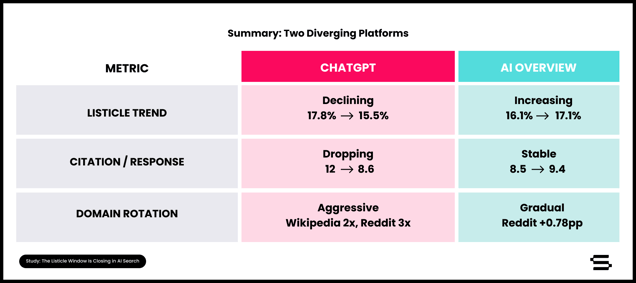
Across the 2 million ChatGPT citations analyzed on consistent prompts, listicle citation rates declined steadily from November through January:
- November: 17.8%
- December: 17.2%
- January: 15.5%
- February: 16.7% (partial month)
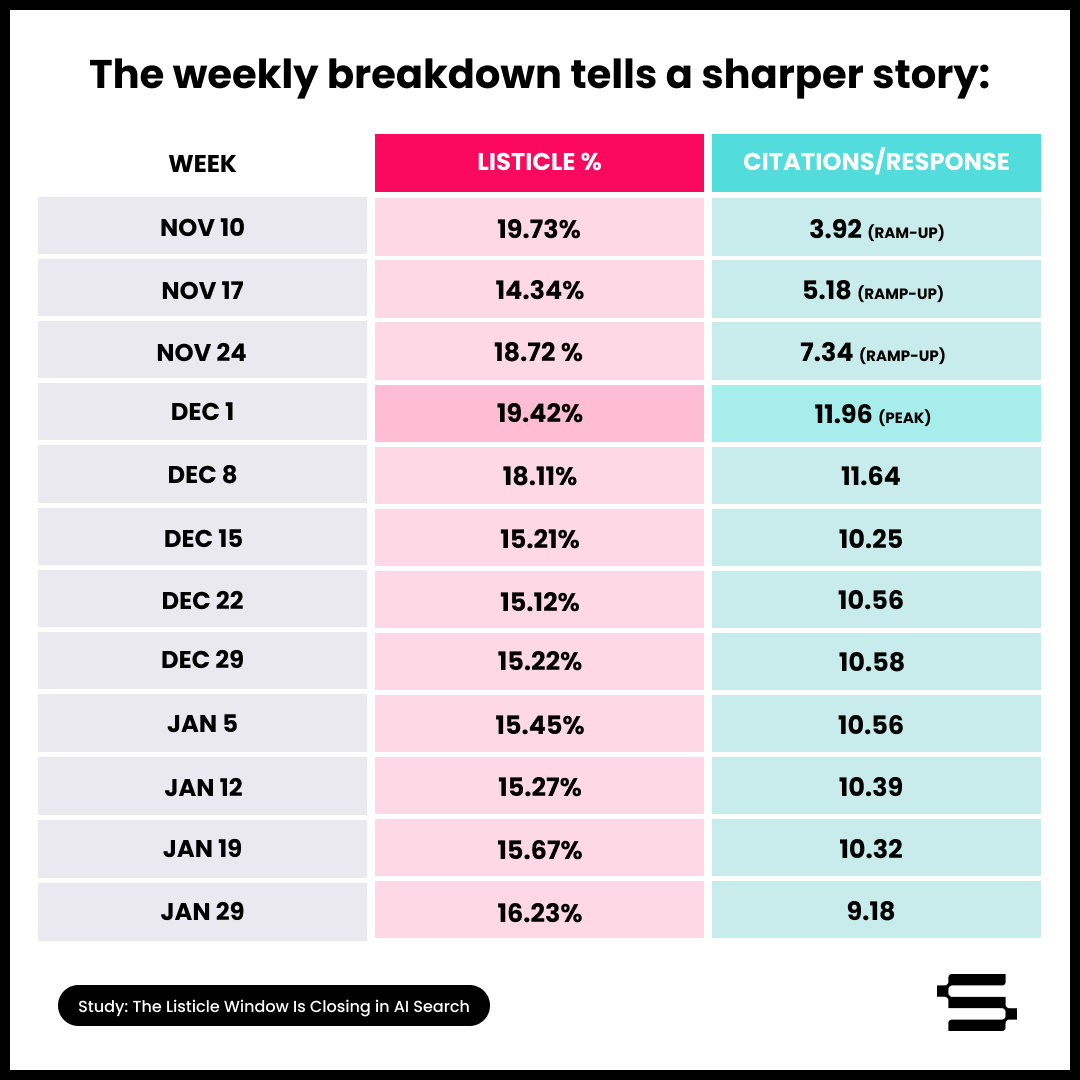
Even with the prompt mix fully controlled, ChatGPT’s listicle reliance dropped 2.3 percentage points from November to January.
At the same time, ChatGPT began decreasing the amount of citations per response
In November, ChatGPT began ramping up the citations per response, increasing from 3.9 to 7.3 citations/response by the end of the month.
Citations per response peaked at 11.96 during the first week of December, which also saw the second-highest weekly listicle rate (19.4%).
From that peak, citations per response gradually declined through January, ending at 9.18 per response - a reduction of 23%.
ChatGPT is becoming more selective in its citations
From December to January, overall ChatGPT citations decreased 22.7% (931K total citations vs 719K) .
Listicle citations declined even faster at -30% (160K vs 111K) - indicating that ChatGPT disproportionately cut listicle sources over other citation types.
13 of 16 Industries Saw Listicle Rates Drop
.png?width=636&height=636&name=The%20Listicle%20Window%20Is%20Closing%20in%20AI%20Search_ChartTwo(1).png)
Industries with a strong consumer or comparison focus such as Outdoor & Sports, Automotive, Marketing & Consulting, and Technology & Software have the highest overall listicle citation rates.
In our prompt set, these industries also have the highest amount of awareness prompts such as “What are the best…” — which historically drive higher listicle rates.
Surprisingly, we're seeing ChatGPT and AI Overviews move in opposite directions on the exact same prompts (listicles in AIOs are trending up or staying flat).
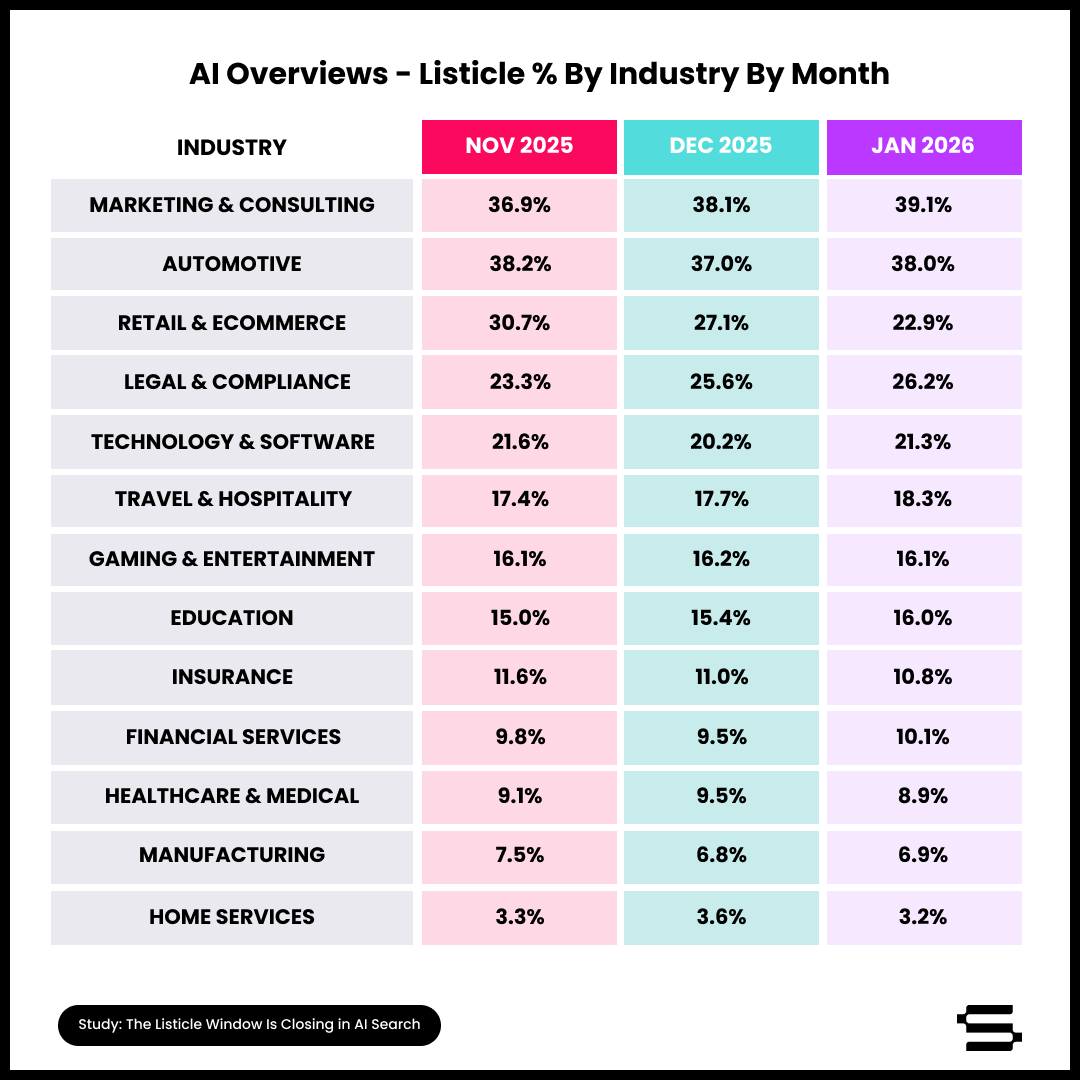
Industries like Education decreased in listicle citations by 4.8pp in ChatGPT, but are steadily increasing in AI Overview citations.
User-Generated Content and Wikipedia Are Replacing Listicles
.png?width=636&height=358&name=The%20Listicle%20Window%20Is%20Closing%20in%20AI%20Search_ChartFive%20(1).png)
Wikipedia was the single biggest domain gainer in 10 of the 16 industries we analyzed, nearly doubling its overall citation share from 3.6% to 5.9%. In Gaming & Entertainment and Nonprofit, Wikipedia's citation share more than doubled.
Other gainers:
- Reddit nearly tripled its share overall, but saw the largest increase in the Outdoor & Sports vertical
- Editorial/UGC sources like LinkedIn, Yelp, Reuters, and The Verge
- Trusted review sites like G2 and Capterra increasing
SEO listicle publishers, press releases, and institutional sources are seeing the sharpest decreases in citations
While no single source is losing significant presence, a mix of listicle publishers are seeing a steady decrease in ownership:
- Forbes (-0.36pp),
- NerdWallet (-0.08pp),
- SoftwareAdvice (-0.21pp),
- FitSmallBusiness (-0.10pp),
- BobVila (-0.11pp)
This Is a One-Month Comparison, But Other Signals Indicate a Trend
For the first time, we’re seeing real consistency between major AI models and traditional search engines in how they’re handling scaled listicle content. Both are beginning to pull back on how they were rewarding these pages throughout 2025.
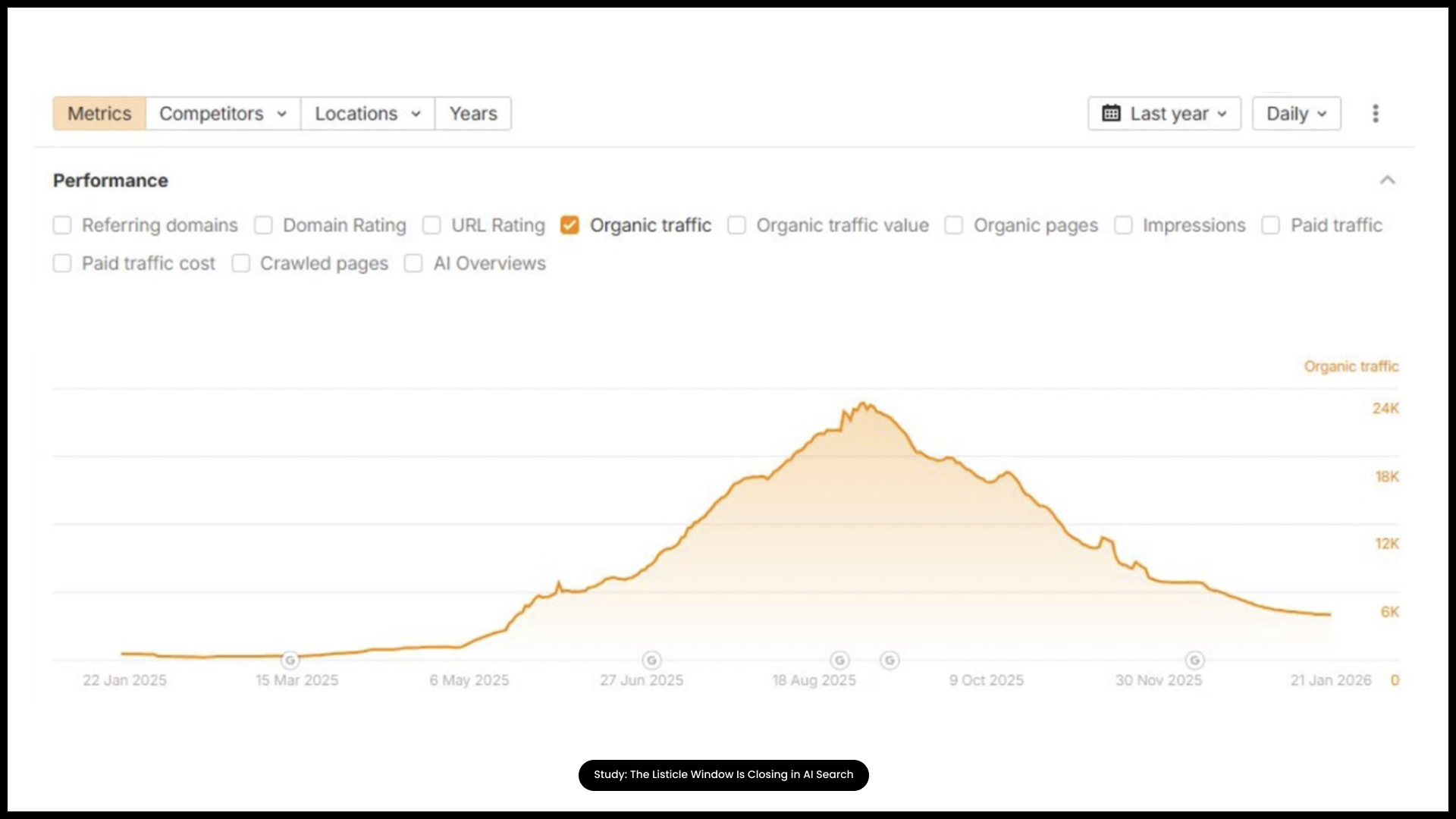
We’ve seen multiple examples of sites that scaled “best of” content quickly, experienced traffic spikes, and are now seeing that content decline in the same time period as we’re seeing listicle citations drop. Here’s an example of organic traffic from one such listicle site:
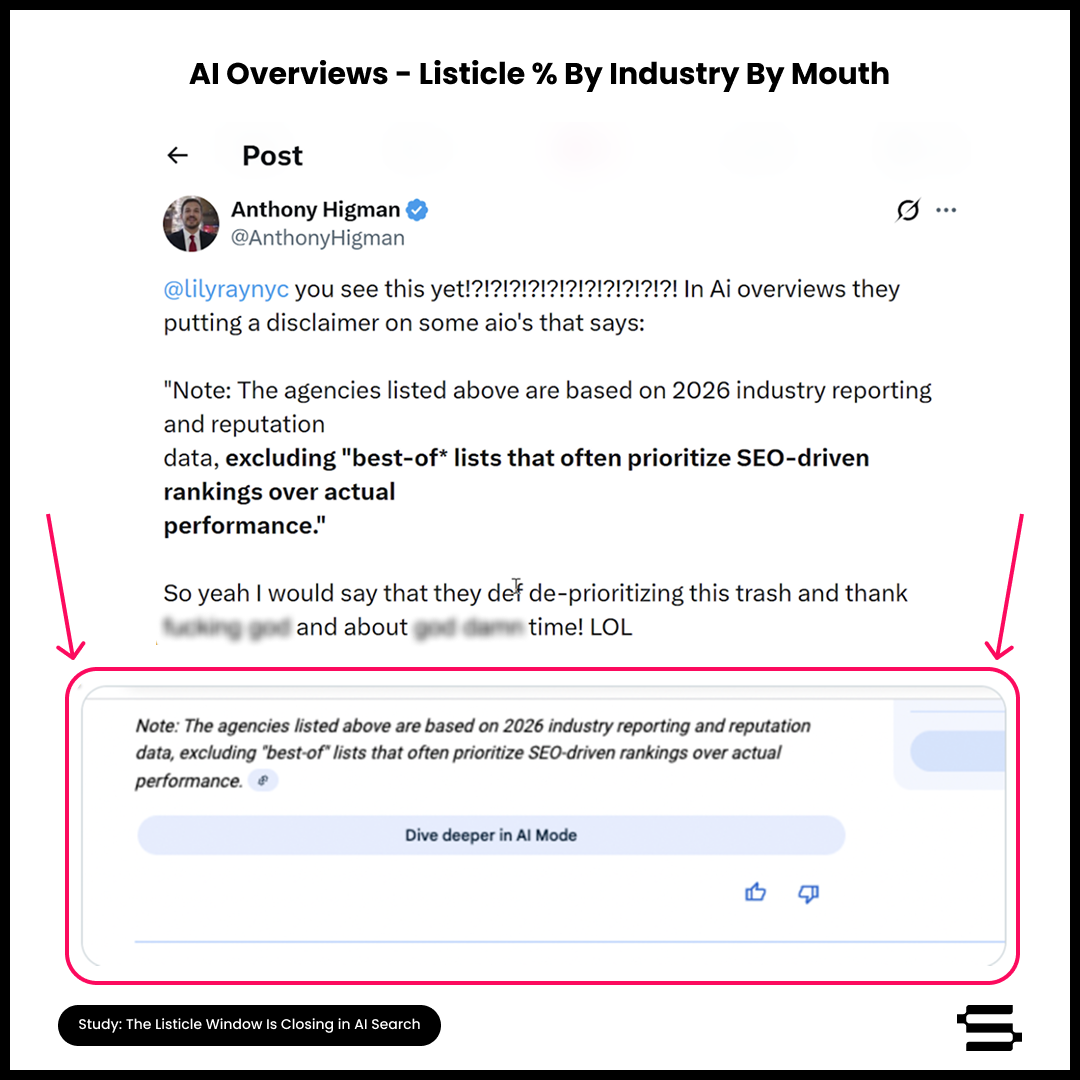
Anthony Higman recently surfaced a disclaimer inside an AI Overview tied to an agency list query. We’re not seeing this directly impact our dataset yet, but it’s a signal worth paying attention to.
Listicles Aren’t Inherently ‘Bad’
While our analysis has broadly focused on the self-serving, SEO-driven listicles, not all listicles are inherently bad. They can provide valuable information for audience , so there will likely continue to be a place for this type of content in a digital strategy.
People like listicles. AI models like the format of listicles. So what’s the path forward?
Characteristics of Listicles Growing in AI Citations
From December to January, while overall listicle citations dropped 30%, we identified 78 listicle URLs that grew citations against this trend, and 46 of those were still accelerating into February. In a sampled comparison of the top ‘survivors’ vs. ‘decliners’, these were the top characteristics:
1. Content freshness
Content freshness is well documented at this point, and we broadly understand the importance of AI brand visibility and recent content. Listicles were no different — there was a strong purge of pages that had been published from 2020-2025 and previously cited consistently.
Conversely, content including ‘2026’ on-page began growing.
Example: G2’s Best Remote Desktop Software decreased in ChatGPT citations 73% in January 2026, despite a strong methodology and topical authority.
The Estimated Traffic (via Semrush) to the page also declined -37% in January 2026 after steadily increasing in Q4 2025.
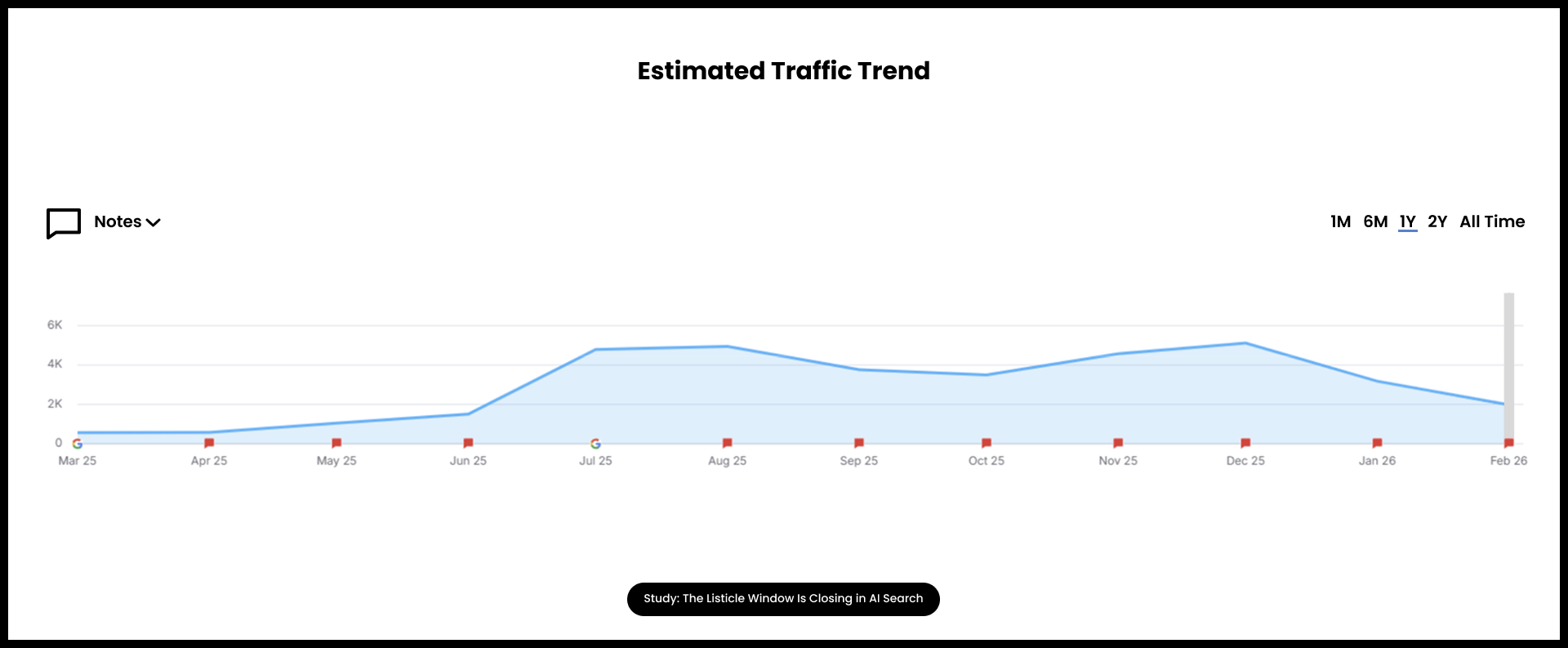
Takeaway: Fresh content is of the utmost importance for comparison pages that are highlighting pros and cons of brands. This is true in traditional search and AI Search. The latest shift in citations indicates that ChatGPT is also making adjustments to prioritize this content further.
2. Comprehensiveness
The listicles declining in citations were commonly listing 5-8 products or brands, while the growing pages listed 10-20 options. We also found a common theme of thinner comparison content in the declining listicles.
Example: Research.com's Best Contract Lifecycle Management Software has a comprehensive list of options, statistics, and trends within the page.
Takeaway: The concept of ‘Information Gain’ is an important one for listicles to be successful. What are you providing that cannot be found on a similar page?
Include unique content that’s comprehensive and complex for others to recreate. It’s not just about mentioning more options, but being thorough with those selections.
3. Data validation & methodologies
The listicles growing the most in AI citations over the period included external signals (like G2 ratings or government data) or thorough methodologies to validate their reasoning. Pages including detailed methodologies were accelerating the fastest into February 2026.
Example: Life Story Research's Best Decking Rankings includes a disclosed sampling of 3,926 respondents and a transparent ranking methodology.
Example: Inventive's RFP Software page ranks themselves as #1, but has a heavy focus on G2 ratings, Gartner, and trend data.
Takeaway: Backing your claims up with verifiable information will provide those trust signals that AI models love when using external sources and lessen the opinionated-bias of self-serving listicles.
4. Structured format
All of the sample listicles that were growing in AI citations had a clear format using numbered lists. The standardized sections often included features, pros/cons, pricing, and ‘best for’ content.
Example: Each of the pages listed above.
Takeaway: This clear, parseable content is table stakes for a listicle to be cited by ChatGPT.
How to Secure Quick Wins for Your Brand
1. Focus on prompts that trigger web search
Identify and prioritize the prompts that are retrieving information in real-time from external sources. These will be the elements that you can influence in the short term.
Don’t assume work is wasted if you’re not moving the needle yet.
This work may actually be helping you build a moat. Even if you aren’t seeing immediate retrieval wins, long-term authority can influence model training behavior.
2. Use Reddit as a credibility check
Take your target query (like ‘seo agencies’) and search for relevant Reddit threads. Analyze what brands are being mentioned most often by real users and then compare that to brands featured in a listicle.
Then ask:
- Are we aligned with actual user sentiment?
- Are we excluding popular brands?
- Are we over-ranking ourselves?
3. Follow the formula of a ‘good’ listicle
There are ways to make sure listicles are hitting the center of a Venn diagram for humans and AI search. When creating a listicle, ensure:
- The content is fresh and up to date
- You have a comprehensive list of options and are thorough in each comparison
- You’re using data-backed research or disclosing your methodologies for the rankings
- You follow a structured format of a numbered list for each option
4. Prioritize content that is beneficial for humans, not just AI
Avoid low-quality listicle production as a shortcut for AI visibility. The time and resources that are being used here can inhibit work that may have a longer-standing impact.
As ChatGPT becomes more selective with its citations, we’re going to continue monitoring who’s winning and losing visibility in these shifts. In the meantime, our recommendation remains to focus on your audience. Identify what matters the most to them and then build your AI Search strategy from there.
Want help figuring out where to focus your marketing efforts when it comes to AI search? Contact us to learn more.

.png)
.png)