

This post was originally published in August 2024 and refreshed in February 2026.
TL;DR
Generative engine optimization (GEO) is the work of making your brand visible and accurately described in AI answers from ChatGPT, Gemini, and AI Overviews.
-
GEO isn’t replacing SEO. It builds on the same signals, but AI answers change by platform and prompt, so rankings and clicks can’t measure it alone
-
In Seer client data, over 80% of AI-driven traffic went to pages updated in the past two years, and only 3.6% to pages older than four
-
Seer measures GEO with AI Signal Rate, Answer Accuracy Rate, and AI-Influenced Conversion Rate
This guide explains how GEO works across each type of AI search experience and walks through Seer’s five-stage testing framework, from hypothesis to test and control groups.
It’s Just Modern SEO — or Is It?
Generative AI search is changing the way people find answers to their questions, with a lot less friction. For now, not having cluttered layouts and typing in your natural language are some of the biggest pros of using Generative AI vs traditional searching in Google.
At Seer, we’ve always been in the “helping people get answers" business — and that includes helping you understand how Generative Search Optimization compares to traditional Search Engine Optimization.
What Is Generative Engine Optimization?
Generative Engine Optimization (GEO) focuses on improving visibility and accuracy of your brand in AI-driven platforms and answers, like ChatGPT, Gemini, Google’s AI Overviews, Claude, and Perplexity.
GEO can go by many names, including Artificial Intelligence Optimization (AIO), Answer Engine Optimization (AEO), and Large Language Model Optimization (LLMO). We think of these acronyms as largely interchangeable and use GEO internally.

Generative Engine Optimization Is an Extension of SEO
As a refresher, Search Engine Optimization (SEO) is the practice of improving your website’s content, structure, and visibility so it can be discovered and ranked by search engines like Google.
At its core, SEO helps people find brands when they’re actively searching for answers, solutions, or expertise.
Similar But Different: SEO Helps Inform GEO
In SEO, our primary goal is to optimize a website and surface the right content to people searching for solutions in search engines. There's more to it than that, but at the end of the day, we're driving people directly to our website from search.
When it comes to GEO, showing up in AI-generated answers is influenced largely by the same signals that power strong SEO.
We’ve run the tests ourselves and confirmed: there is overlap with what helps in SEO and GEO, but the level of influence can vary by industry and AI platform.
You Optimize for Search Engines, You Influence AI
GEO is broader than “website optimization.” The goal is (quite literally) to make something a part of the conversation. Conversational search and traditional search are familiar, but different. The inputs are similar, but the output of generative AI is less structured and varies more than a traditional SERP:
- Search engines: Parse content and match it to people’s queries, then serve it up as a kind of dealer’s choice of where to go next
- LLMs: Ingest content to learn and use their understanding of entities to generate responses and recommendations; but they don’t directly return the content they were trained on
Sure, an LLM may cite a source in a response, but many answers are a remix of the data they have available. LLM responses depend on their training data, and honestly there's very little information out there about those data sources.
A New Era of Search & Discovery
Organic is seeing channel diversification for the first time in more than 15 years.
Think of the different LLMs like different ad platforms: advertising is advertising, but targeting works slightly differently on LinkedIn, YouTube, Meta, and traditional search.
Organic channels are entering a similar era. It's all "optimization," but the models respond to tactics differently.
Here’s a breakdown comparing how different types of AI search experiences work and the impact on GEO:
How Training Data Works in GEO
Generative AI systems surface information in different ways. Some rely heavily on the data they were trained on, while others retrieve and reference live web content when generating responses.
Today, most AI-powered search and answer experiences blend these approaches. Models may use training data to understand a topic, while pulling in recent or authoritative sources to support their answers.
For brands, this means visibility isn’t about optimizing for a single system or data source. Instead, GEO focuses on making content that’s easier for AI systems to understand and accurately represent regardless of how a specific platform generates its responses. That means using clear language, consistent messaging, and authoritative sources.
The Age and Source of Training Data Matters
While we’re able to monitor the external sources and citations that AI models use when responding to prompts, sometimes the models don’t use external sources at all.
In these cases, the models are primarily using their training data. These knowledge cutoffs matter — if a model isn’t searching the web, the information it has might be a full year old. Gemini 3, for example, was released in November 2025, but the training data cut-off is 11 months prior.
There’s also a third layer to consider beyond training data and live search: caching.

As certain questions may get asked repeatedly and models gain confidence in their responses, AI models may rely less on live retrieval and use validated, cached answers or context.
We can still work to ‘influence’ training data inclusion, but this is a longer-term play as there’s no guarantee when new models or updates will be released.
Certain queries give answers in training data, which requires long-term brand-building work. Other AI models run searches to augment the results with fresher perspectives, which functions more like traditional SEO.
Monitoring which prompts are using citations more or less often will help you understand the level of influence GEO will have for your brand’s AI performance.
What Are the KPIs for GEO? How Do Those Success Metrics Differ from SEO?
SEO success metrics include things like: rankings, traffic from Google, click-through rates (CTRs), monthly search volumes (MSV), and conversions.
Those SEO metrics don't work in a GEO world.
Rankings vs. Visibility
There are no steady rankings in GEO. You can search for a phrase right now, and five minutes later get a different answer for the same query. This is why you need to run queries multiple times to see how much brand variance exists.
Traffic
With Generative Engines, searchers are getting answers without ever visiting your site.
Searchers can do so much research in the Generative AI “search engine” that they might just search for your brand at the end. This is why you need to be tracking brand search and traffic to your homepage, case studies, product pages, etc. from ChatGPT, Perplexity and others.
When an AI system processes your content, it goes through three distinct phases:
- It decides which pages to reference
- It accesses the content itself
- It summarizes that information for the user
This is fundamentally different from traditional search engines that simply match and display content. The goal shifts from being found to being understood and referenced accurately by the AI.
Determining Opportunity Size
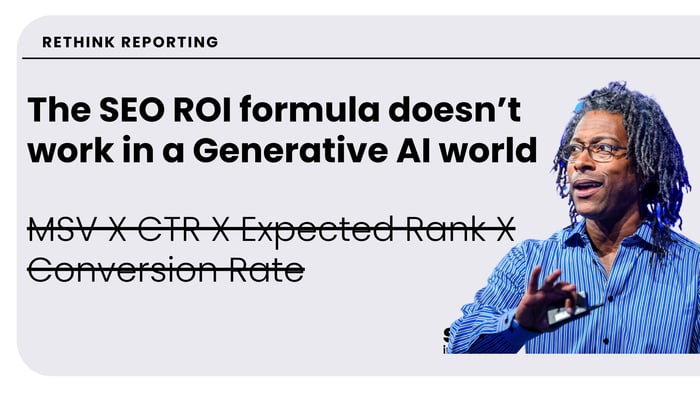
CTRs and MSVs are gone (or rather, they still exist, but they’re not reliable metrics for measuring success anymore).
Before when clients asked “how much should I invest in SEO?” you did the math:
Searches per month x expected rank x CTR x some conversion rate
Today that math just doesn’t work with Generative Engines.
A holistic search marketer should also be thinking about the impact to paid search. We've seen impact on CTRs when AI overviews show up on Google as well.
Seer's GEO KPI Framework: Be Seen, Be Believed, Be Chosen
AI search is reshaping how people find brands, judge credibility, and ultimately make decisions. To track this evolving buying journey, we developed a simple but powerful framework.
1. Be Seen
Are you visible when AI tools answer questions in your category?
2. Be Believed
Does AI represent your brand accurately and credibly?
3. Be Chosen
Are AI-influenced interactions driving business impact?
Check out our breakdown of How to Measure Brand Performance in the Age of LLMs for a practical framework.
The 3 Core KPIs Every Brand Should Track
Before we dive in, it’s worth saying that our KPI recommendations aren’t one-size-fits-all. These KPIs should be considered, challenged, and adopted only if they’re actually meaningful for your brand. If they don’t fit, scrap them and build a framework that does.
With that said, here’s where we see KPIs in the age of AI search heading:
1. Be Seen: AI Signal Rate
Definition: How often your brand is mentioned in AI-generated answers for queries in your category.
2. Be Believed: Answer Accuracy Rate
Definition: How accurately AI systems represent your brand, measured through a structured rubric.
3. Be Chosen: AI-Influenced Conversion Rate
Definition: The conversion rate among users or sessions influenced by AI-surfaced content.
Seer’s GEO Methodology
To meet these KPIs, we recommend focusing your GEO efforts on three core pillars:
- Market Intelligence: Identify where AI search opportunities exist in your industry and how your customers are actually using these platforms
- Strategic Plays: Develop your unique AI search advantage by experimenting with content changes and tracking visibility in AI models
- Competitive Execution: Be precise, prioritize impact over buzz, and focus on tasks that can help you build a long-term advantage over competitors
So how do you turn these pillars into an actionable strategy? We use a five-stage testing framework that moves from hypothesis to measurable impact.
_1.png?width=636&height=636&name=Seer_Generative%20Engine%20Optimization%20(GEO)_1.png)
1. Form a Hypothesis
Start with intelligence, not assumptions.
Identify where AI search opportunities exist in your category. Analyze AI model responses, evaluate which sources are being cited, and layer in competitive research. Monitor shifts in visibility, response formats, and market behavior.
From there, form a hypothesis about what’s influencing AI visibility and inclusion.
2. Validate That Hypothesis with Existing Data
Don’t throw ideas at the wall. Experimentation not grounded in data will just drain your time and resources.
Pressure-test your hypothesis using real performance data before scaling effort.
For example, this framework is how we identified content recency as a core GEO driver in February 2025. We observed that many AI citations were less than 6 months old. When we validated against client data, we found:
- Over 80% of AI-driven traffic went to pages updated within the past two years
- Only 3.6% of AI-referred traffic went to pages older than four years
3. Pinpoint Your Test Opportunities
You don’t want to run tests for the sake of it. The goal is to be strategic and learn how to make your brand stand out in AI search.
Prioritize experiments based on:
- Alignment with brand focus areas
- Estimated impact
- Required effort
If a test takes a month to stand up and doesn’t support a priority initiative, it’s probably not your best move. Failing fast is just as important as quick wins.
4. Launch Test & Control Group
Unlike traditional SEO, GEO and AI search don’t offer deep historical benchmarks. That makes controlled testing even more important.
Create clear test and control groups so you can isolate performance shifts and minimize external bias.
5. Analyze Performance Shifts
Measure results against the KPIs aligning with the goals of the tests, such as:
- AI visibility and citation coverage
- AI-referred traffic
- Engagement metrics
- Conversion performance
From there, categorize outcomes into three buckets:
- Successful - Scale what’s working
- Unsuccessful - Pause and reallocate resources
- Inconclusive - Continue monitoring, you may need more time or a larger sample size
Remember, no one is a GEO expert and the goal isn’t to prove your hypothesis correct. The best analysts are focused on learning through testing to build a sustainable competitive advantage.
How Does Modern SEO Translate to GEO?
Implementing a GEO framework doesn’t mean you should discard your SEO tactics. So how do you know which tactics are worth continuing and which to retire?
Let’s consider the four categories of SEO — On-Page (Content), In-Page (Technical), Off-Page (Authority), and User Experience (Engagement) — and break down how each of these SEO functions translates to GEO:
On-Page (Content Marketing)
- How it impacts SEO: Your website is the destination, and your content is the trail people follow to find it through traditional search engines. Your unique content establishes your contextual relevance for search engines. Googlebot is somewhat limited in its ability to crawl and index web pages - it can be finicky in what it can/can’t understand. It understands written text best, and you need to make sure all the pieces of the technical SEO puzzle are in place to allow that to happen (more on that below).
- How it impacts GEO: Think of your website as the data feed that trains the LLM but is not the destination to the people who are searching. Many LLMs are multimodal and can “search” in several forms; you can literally scan a room with your phone and every LLM today can pretty much see what you see, and you can talk to it in real time.
In-Page (Technical SEO)
- How it impacts SEO: Your website needs to be structured so search engines can easily crawl and index your content, especially important information that searchers will see on your site.
- How it impacts GEO: Remember that there are three types of Generative Engine Answers. When your customers are leveraging search in AI models, your data needs to be findable and ingestible by LLMs. Many of the traditional SEO rules apply. For example, structured data is the GEO equivalent to SEO-friendly site architecture. Make sure you allow GPTbot to crawl your site, and utilize Schema markup to make it easier for LLMs to understand your content.
User Experience (Engagement)
- How it impacts SEO: SEO experts have long suspected that signals like click-through rate and bounce rate are factored into Google’s algorithms. Google has repeatedly denied that. But thanks to the search documentation leak and trial exhibits over the last year, we finally have our proof. User experience and on-site engagement impacts SEO performance.
- How it impacts GEO: This is where we have the least amount of information, but let’s play this out…Google has always sent users to other sites, and as such could use the data crumbs left behind as signals. If you click on a link, go to a website, and come back to Google’s search engine really fast, then over time Google might assume you didn’t find your desired answer. I don’t see anything like that showing up in Perplexity or SearchGPT just yet.
Authority (Off-Page) + Our Correlation Study
- How it impacts SEO: Officially, links. Pseudo-officially, brand mentions across the web (this old post on co-occurrence from Bill Slawski does a great job breaking this down). These are the main ways you build authority in SEO — think PageRank and proxies for PageRank like Domain Rank metrics.
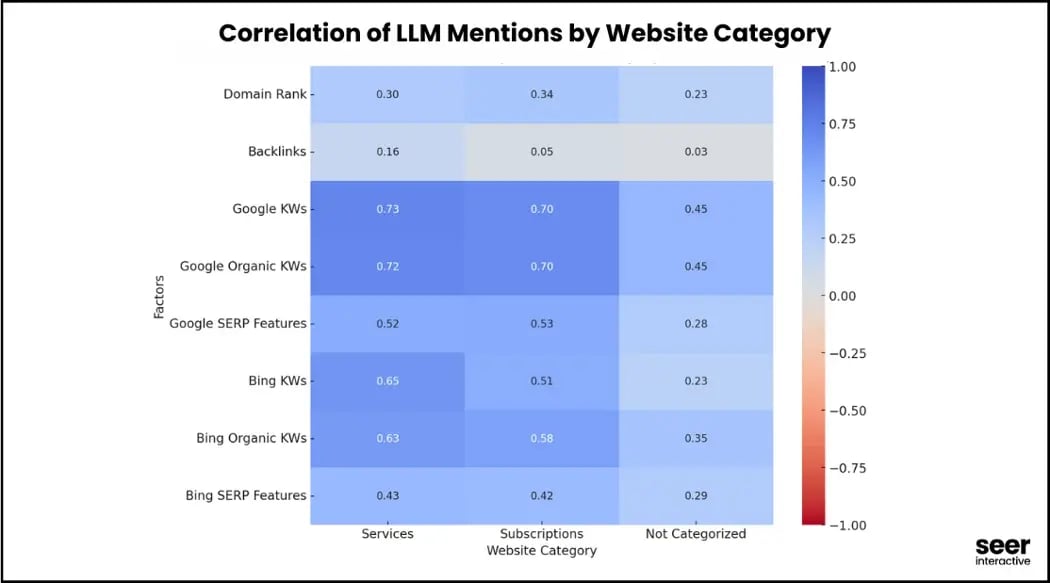
- How it impacts GEO: We looked at hundreds of thousands of data points and found which SEO factors do or don’t influence visibility in LLMs:
Wait, These Look Pretty Similar...
And that leads us to our point: GEO is modern SEO. Modern SEO is GEO.
The highest-level goal of any search marketing program is to be present wherever your audience is searching. You want your customers - wherever they are - to find you. You want to pull them in, give them what they need, and give them such a great experience that they tell others about it (and maybe even write a review).
Seer Is Testing and Measuring How to Influence Generative AI for Our Clients
As the saying goes, you can't improve what you can't measure. We’ve put our money where our mouth is in R&D to measure and learn how to influence generative AI results. Here’s a short list of what we’ve been cooking up:
- We were one of the first to release a way to track your brand mentions in ChatGPT. We’ve now partnered with Scrunch to provide AI tracking for all of Seer’s clients.
-
We’ve incorporated AI Overview data into SeerSignals to analyze their impact on Paid and Organic CTRs.
-
Seer has created multiple different AI products and workflows that are blending automation with human expertise, such as the AI Interview System and the Persona Page AI Builder.
-
Our team has created a wide range of AI Studies, that have been cited on Forbes, eMarketer, and other publications, to help brands and marketers navigate this changing search landscape.
-
We’re consistently sharing experiments and case studies of what we’re finding is influencing AI responses, including using our own site as a testing ground.
As we navigate the shift from traditional search to the broader realm of generative AI, the goal remains the same — to connect with audiences in meaningful ways.




.png)
.png)