
We’re back with v3 of our AI Overview CTR study. If you’re new here, check out our February 2025 and September 2025 AIO CTR studies.
In our September study, we predicted a continued decline, but the data is leveling off. Here’s what that means for you.
This study includes a full-year analysis of 2025 across 53 brands, 5.47M tracked queries, and 2.43 billion organic impressions, plus Q1 2026 actuals. The Q4 2025 data informed a model that predicted the decline of CTRs continuing into 2026. So far that declining trend in 2026 has turned the other way.
Analysis Published: April 2026; Data range: January 2025 to February 2026 (actuals); March 2026 (projections) Published by Seer Interactive R&D
A year ago AIOs were relatively ambiguous for marketers. Clicks started to disappear and there were what seemed like constant fluctuations of where they’d show and why. Seer’s original study was born from a desire for information at all. Any answer or direction could help us make sense of what was changing.
Now we have a full year of data spanning a larger pool of brands, the target of this analysis is shifting from early discovery to seeking out patterns. As with other studies of this nature, the data is directional, looking at trends to inform when acting as a marketer makes sense and how to start digging into your own data to make smart decisions while AI changes how your customers find answers.
What’s Changed Since Our Q4 2025 Projections?
After publishing the original CTR & AIO analysis in February 2025 and our September 2025 update, 2025 was a year of near-continuous CTR compression on AIO-affected queries. Our model predicted that decline would continue into 2026
But then in January and February 2026, it didn’t. In some cases by more than 2.5 percentage points. While we’re not back to pre-AIO CTRs, and don’t expect to be, the decline has slowed and that indicates we may have passed the worst of the period after a new Google SERP change and are starting to see a leveling out or what might be the “new normal”.
The New Methodology for 2026 AIO CTR Data
This is the third installment in our ongoing reporting on the impact of AIOs and marketing performance, but the research data set has grown both in volume of queries, brands, and we’ve expanded our research across different types of queries.
Our first two posts analyzed a specific subset of informational queries, the ones most vulnerable to AI Overviews, tracked across 42 brand organizations. This report is a significant data expansion. We're now looking at 5.47 million tracked queries and 2.43 billion organic impressions across informational, transactional, and commercial intent. The directional findings between the intent categories are consistent, and the new intent data tells a story we didn't have before.
A Note on Terminology
Throughout this report we use three AIO status labels:

- No AIO: Google does not show an AI Overview on this SERP. A pure Google product decision, independent of any brand's SEO.

- AIO - Brand Not Cited: Google shows an AI Overview, but the tracked brand's domain isn't linked within it. The AIO exists; the tracked brand just isn't in it.

- AIO – Brand Cited: Google shows an AI Overview and the tracked brand's domain is cited and linked within it. This is where SEO, content quality, and domain authority directly influence outcomes. An increase in this segment may reflect good agency work: new content, improved authority, stronger topical relevance. We don't attribute changes in this bucket to Google alone.
Methodology
From January 2025 through February 2026, we tracked 53 brands across paid and organic search, using only search terms with complete data across every month. That’s 5.47M queries, 2.43B organic impressions, 296.9M paid impressions.
Every query in this cohort has consistent, comparable data across the full window. Only search terms where SERP Trends data, paid data, and organic data are all complete across every month of 2025 are included. We classify intent by SERP features. AIO status is a static label from the most recent SERP snapshot, applied retrospectively across all months. The forecast methodology applied is the OLS linear regression on 12 months of 2025 data per segment. No seasonality adjustment. Treat March 2026 projections as directional floors, not predictions.
Read the full methodology here.
AIO Organic CTR Rebounds 85% in Two Months — Closing the Gap with Non-AIO Queries
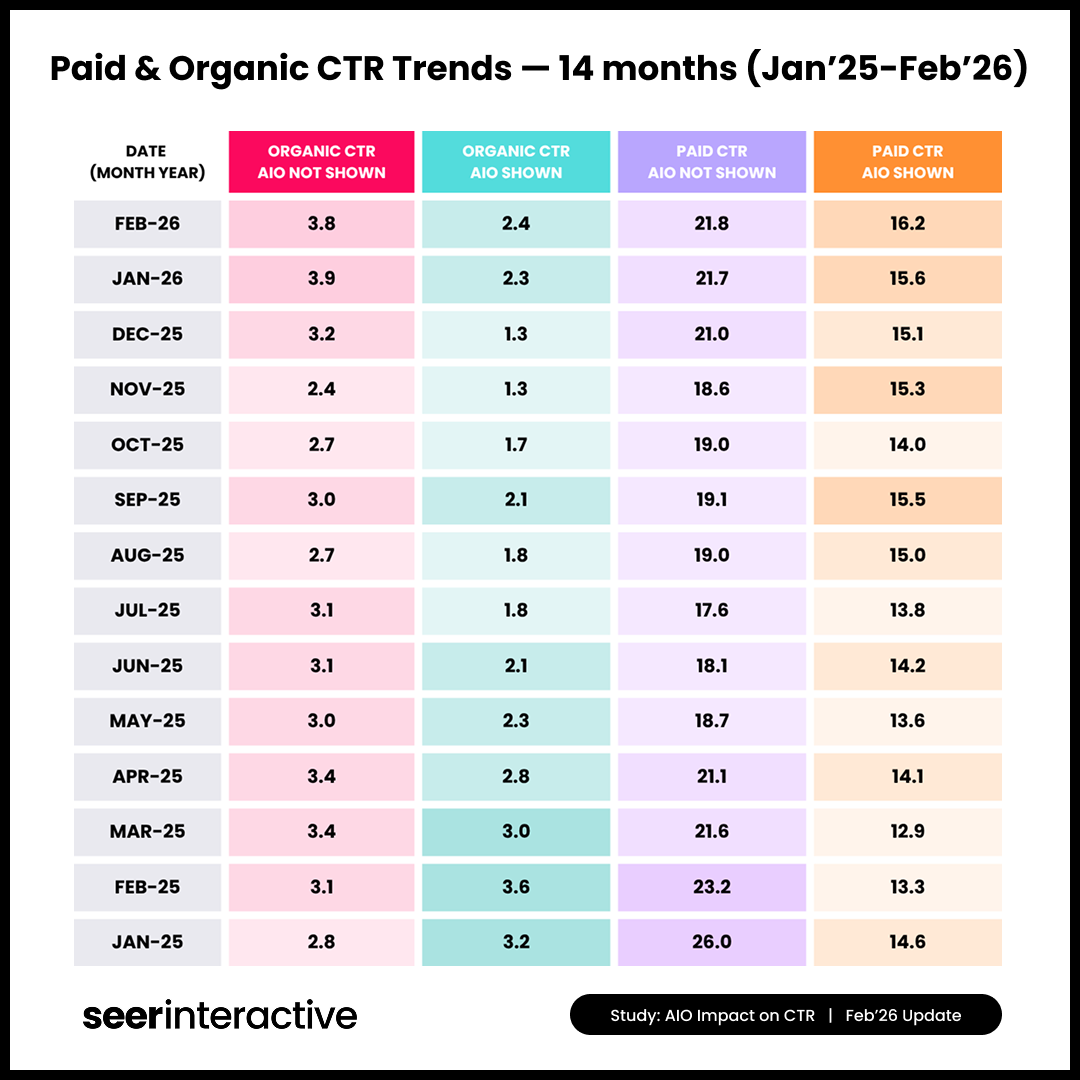
After 18 months of tracking CTR decline across AI Overview queries, something unexpected happened in early 2026: the trend reversed. Organic CTR on AIO-present queries climbed from a floor of 1.3% in December 2025 to 2.4% in February 2026. The decline didn’t level, but instead bounced back a little, and is closer to the January’25 CTR of 3.2 than the December’25 floor.
Key takeaways:
- Organic CTR when an AIO is shown saw a significant recovering in early 2026, climbing back up to 2.4, an 85% increase from the 1.3 December CTR – the lowest in the last 14 months
- Organic CTR when an AIO is not shown increased by a full percentage point from January 2025 at 2.8% CTR to February 2026 at 3.8% CTR
- Paid CTR when an AIO is not shown continued a steady decline from January 2025 at 26%, decreasing to 21.8% in February 2026, ~16% decrease
- Paid CTR when an AIO is shown however increased over 2025, starting the year at 14.6%, to now 16.2%, that’s considered relatively stable, but the trend is slowly, consistently up
You can see the full data table here.
The 7 Most Important Things We Found
Before the full breakdown, here's what your boss (and your boss’s boss) will want to know.
1. The 2025 CTR decline did not extend into 2026.
Every single informational and transactional organic segment beat our model's projection in both January and February 2026. The model forecasted continuous decline, but the data shifted significantly in just the first two months of the year.
So what? We aren’t suggesting you forecast growth or recovery based on only Jan-Feb 2026 data.. Instead: look for where stability is emerging, understand citation status (as in: whether you’re mentioned) as a driver, and place smarter bets on where we’re starting to see predictability.
2. Brands with citations saw lower CTRs than previous periods, but not because clicks decreased .
CTRs for brands with citations steadily decreased starting in March 2025. We were alarmed until we realized it wasn’t a click decline issue. Impressions more than doubled while clicks stayed flat. That means more queries earned citations, not necessarily that existing citations stopped working. Always look at clicks and impressions separately before calling something a problem.
So what? Measurement methodology matters. But the bigger insight is that brand engagement may still be happening via the AIO citation itself, we’re seeing live that links can simply trigger other google searches, impressions and clicks on your domain aren't the whole picture. Brand reach is happening on off-property.
3. Queries without an AIO present ended 2025 with higher CTRs than when they started.
‘No AIO’ organic CTR improved from 2.8% in January 2025 to 3.2% in December 2025.Since then, it climbed to 3.8% by February 2026. Of those, informational queries alone brought in 901M impressions. The informational queries that Google doesn't put an AIO on are increasingly the queries users actually click through on with CTRs on climbing from 2.9% to 4% by the end of 2025. That's a content and targeting opportunity.
So what? Non-AIO queries represent topics Google isn't choosing to easily summarize yet — that's a signal to double down with a unique POV and value while the window is open.
4. Transactional queries with an AIO and a tracked brand citation doubled organic CTR (0.7% in January 2025 to 1.7% in December 2025)
After a lumpy year for transactional queries where AIOs were present and brands cited, with CTRs bottoming out at 0.62% in September of 2025, the CTRs climbed significantly in November and December, closing the year at 1.65% CTR on those AIO queries.
So what? If you started to give up on transactional queries where an AIO was present, there may be some value worth defending when you’re able to get a brand citation.
5. Paid Search CTR is the most steady and predictable.
Our projection model estimated impact to Paid CTR on informational queries when an AIO was present and the brand was cited within 0.09 percentage points in January 2026. It missed organic search CTR by 0.6 to 2.6 percentage points across every segment. Paid behavior in 2025 was genuinely linear and stable.
So what? Model your own paid data, and determine if you can leverage as an anchor for forecasting. Treat organic as a separate conversation with wider error bars and more frequent check-ins. When presenting to leadership, name the asymmetry explicitly. Having confidence in which channel you can predict and which you can't is itself an advantage.
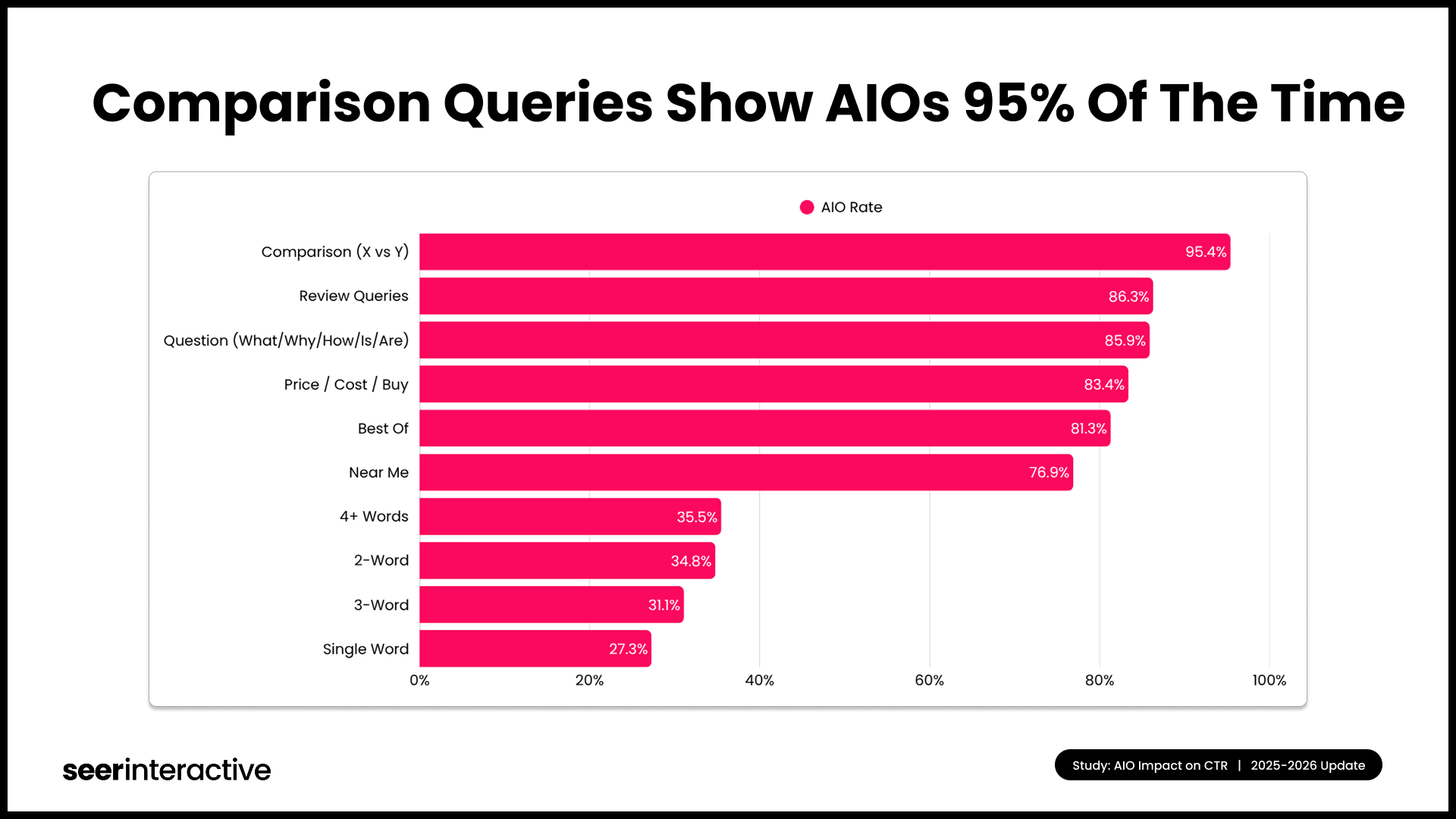
6. Comparison and question queries trigger AIO on more than 85% of informational searches. Across 30,842 tracked informational queries, comparison queries triggered AIO 95.4% of the time (267 of 280 queries) and question-format queries triggered AIO 85.9% of the time (1,214 of 1,413 queries).
So what? If you're writing informational content in question or comparison format, assume an AIO will appear and optimize for citation, reach, and authority.
7. Being cited in the AIO delivers +120% more organic clicks per impression versus when you are not cited. But it still underperforms No AIO by -38%. A citation is an advantage relative to everyone else on the same AIO-present SERP. It's not a return to the pre-AIO baseline.
So what? Use this insight as a guiding benchmark, use your own data to make decisions. While citations will almost certainly drive more clicks, non-AIO queries will almost certainly drive even more clicks. The question is - what are those query segments doing for your brand and your bottom line? Start there, then execute accordingly.
Not All Search Types Are Equally Exposed to AIO.
Think of AIO as a heat map across your search program. The temperature varies dramatically depending on where you look.
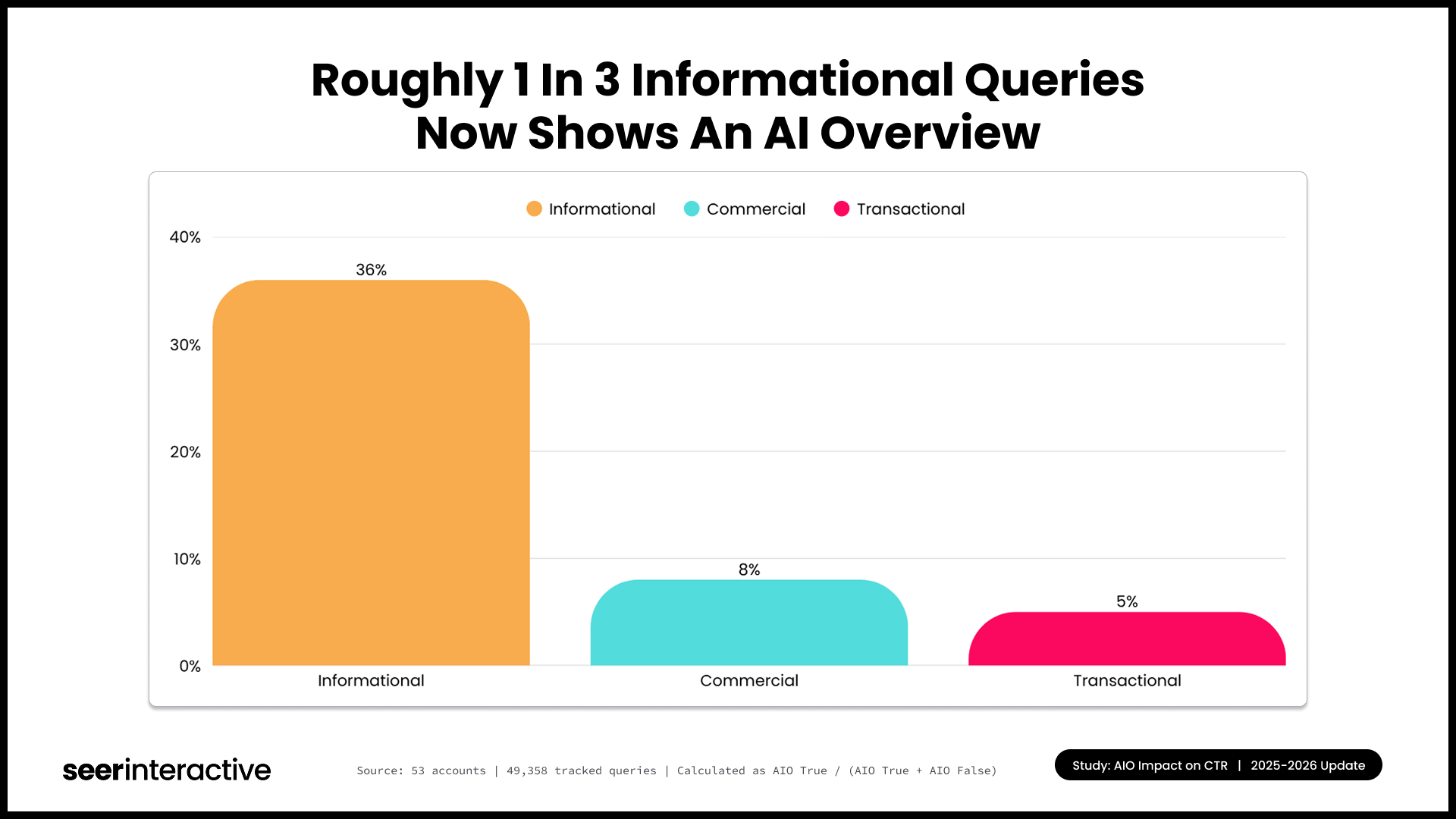
Queries are classified by intent types, and how prevalent AIOs are in the results varies. Informational queries show an AIO 36% of the time, while commercial queries show AIOs 8% of the time and transactional queries show AIOs 5% of the time.
You can see the full data table here.
Roughly 1 in 3 informational queries now shows an AI Overview.
There is a 7x gap between informational queries showing AIOs and transactional queries showing AIOs, with transactional queries coming in at just under 1 in 20 Transactional is just under 1 in 20. We’ve been tracking these AIO trends in finance, and this 7x gap is significantly higher than what we found for informational vs transactional terms there (around 2x gap).
Makes sense: Google built AIO to answer questions in fewer clicks. Informational SERPs are exactly where AIO thrives: a user asks "how does X work," and Google synthesizes the answer from multiple sources right at the top.
Transactional SERPs work differently. When someone searches for a local plumber or a specific product, the Shopping Box or Maps result is the answer. AIO isn't competing with that; it's complementary at best, irrelevant at worst.
Commercial and Other intents sit in a similar range at roughly 8% each. Whether that ~8% holds or drifts higher as Google refines how it handles brand evaluation queries is one of the things we're watching closely in Q2.
How do you use this data to plan? Intent is an important filter for understanding your AIO exposure. If your organic program is heavily informational, a third of your queries are operating in AIO territory. If you're primarily transactional, you have meaningful protection at current levels. Your risk and exposure here is dependent on your search strategy.
So Which Queries Exactly Are Most Likely to Trigger an AIO?
Knowing that ~36% of informational queries show an AIO is useful. Knowing which informational queries are most exposed is actionable.
We analyzed 49,353 distinct queries using pattern matching on query text combined with our SERP feature-based intent classification.
You can see the full data table here.
Key Takeaways:
- Comparison queries are your highest-risk category. At 95.4% AIO rate, nearly every "X vs Y" informational query in this study has an AI Overview. If your content strategy relies on comparison pages for organic traffic, that traffic is almost certainly AIO-affected.
- Volume matters: In our study, though not the highest AIO rate, question queries generated 85.9% across 1.4 Million impressions. When making a plan, displaced organic clicks are a significant factor to consider.
- The unexpected: Informational queries containing “near me” showed AIOs 76.9% of the time. Local-intent searches are typically associated with maps and local packs, so that fact that nearly 4 in 5 of “near me” informational queries are showing AIOs suggests that Google is layering AI Overviews on top of local SERPs. This may differ greatly by industry, but is worth monitoring closely.
- Don't assume short queries are safe. Single-word informational queries still trigger AIO 27.3% of the time, and that’s across 25M organic impressions. The idea that broad, short queries are less AIO-affected is not supported by this study.
How Is CTR Affected by Channel?
In February of 2025 we hypothesized that: AI Overviews will significantly affect CTRs for both organic and paid search, and that the impact will vary based on (1) the query type and (2) AI Overview brand citations.
As of September of 2025, with two more quarters of data, we confirmed, and expanded on that: AI Overviews suppress CTR, particularly for informational queries, and particularly for pages that appear in the AIO but aren't cited as a source.
In 2026 the suppression was real and confirmed, however in early 2026, something shifted. CTRs stabilized and in some segments even started to reverse, particularly where AIO presence is highest.
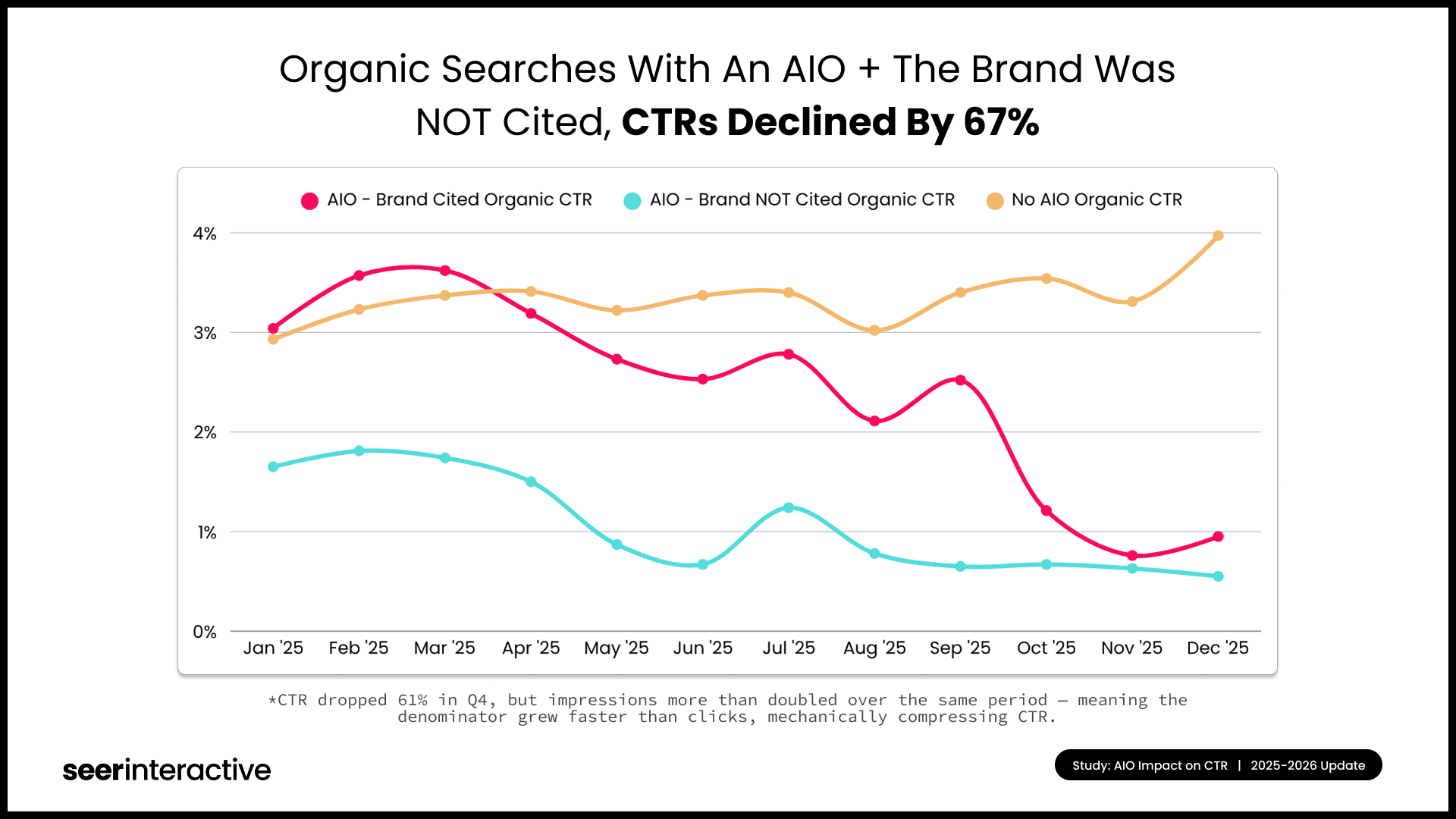
What the data below makes clear is that AIO presence isn’t the mover, whether or not a brand is cited in that AIO is. Throughout all of 2025, being cited in an AIO delivered 2–5x the organic CTR of not being cited, even as those CTRs compressed.
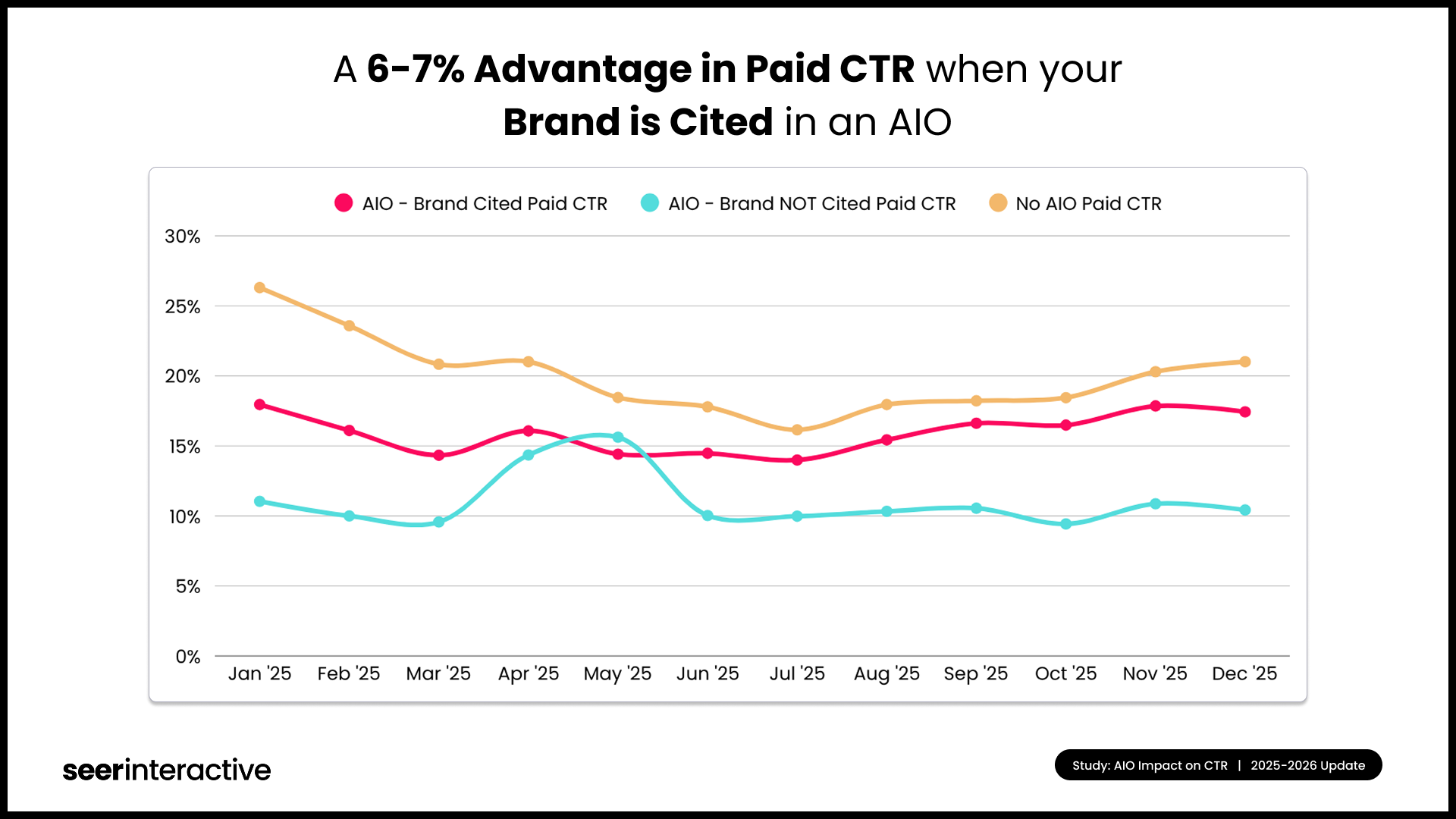
On paid, the citation premium never disappeared either: a 4+ percentage point advantage that persisted every single month in 2025.
You can see the full data table here.
- Organic searches that surfaced an AIO and the brand was not cited, CTRs declined by 67% over 2025 across 311M organic impressions. That's approximately 13,000 fewer organic clicks for every 1 million impressions.
- In the same cohort when a brand was cited, those CTRs held comparably well to when the brand wasn’t cited, until there was a steep drop off in Q4. We double click into that cliff here.
- The odd finding: On searches where no AIO was present, organic CTR improved over the course of 2025 from 2.93% in January 2025 to 3.97% in December. Our best hypothesis is a selection effect: as AIO captures the answer-seeking, low-engagement queries, what's left in the no-AIO bucket skews toward higher-intent users who are actually going to click something. If your organic strategy hasn't identified and prioritized these queries yet, start there.
On paid: Brand-Cited paid CTR held between 13.99% and 17.95% all year with no meaningful decline. Whatever AIO is doing to organic results, it is not doing the same thing to paid ads. Paid and organic are operating in different environments on the same SERP, and you should plan accordingly.
How CTRs Behaved Over 2025 for Transactional Queries
We expanded our query analysis in 2026, and while transactional queries represent a smaller share of this dataset than informational, the stakes per click are higher. So interpret these trends directionally rather than as a definitive benchmark. But these are worth monitoring.
Transactional Intent Queries: Small AIO presence, Significant Impact to High Commercial Intent Opportunities
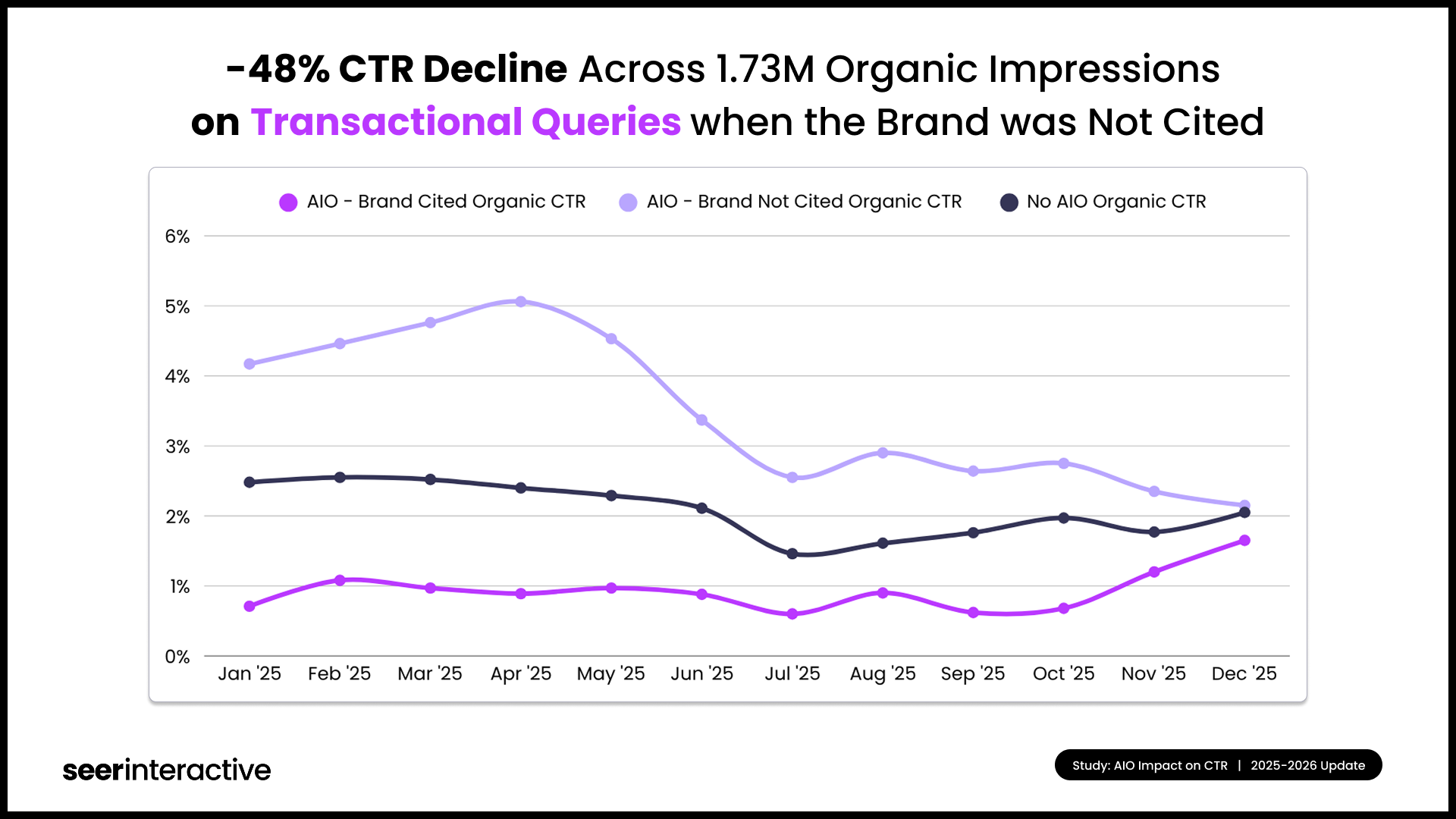
Key takeaways on Click Through Rates for Transactional Queries with AIOs in 2025:
- Not-Cited organic CTR fell nearly in half, from 4.17% to 2.15%
A -48% decline across 1.73M organic impressions. On transactional queries, where every lost click carries real commercial intent, that could be a red flag for many brands. - Cited organic CTR stayed low-to-lumpy all year, but started climbing in Q4
brand Cited organic CTR spent most of 2025 below 1%, then climbed to 1.65% in December. That Q4 movement sets up the 2026 recovery story directly.
Why should you care? Transactional queries carry higher commercial intent, which means lost clicks likely had more conversion value per impression than the informational losses.
A note on commercial intent queries. There wasn’t meaningful AIO exposure, but we’ll continue to monitor the impacts of AIOs and CTRs on these queries. We believe there’s opportunity for impact in 2026. However, it is significant to note that: Commercial No AIO organic CTR declined meaningfully in 2025 without any significant AIO exposure. AIO is not the only force compressing organic CTR. Something else is happening in commercial SERPs.
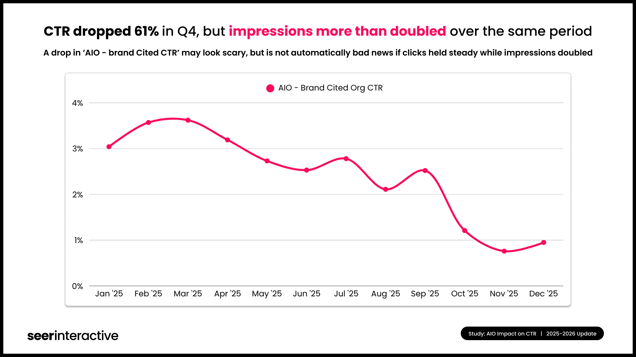
Organic CTRs where a Brand was Cited Dropped by -61% from Q3’25-Q4’25. But Maybe Not Why You Think.
Our month-over-month detection flagged October 2025 as the single largest organic CTR drop in the dataset. Informational AIO - Brand Cited fell -52.1% in one month. November followed with another -36.8% drop.
The raw numbers:
Here's what we know for certain: clicks were essentially flat in October, moving from 398K to 400K. Impressions more than doubled, from 15.8M to 33.1M. CTR compressed because the denominator grew far faster than the numerator.
Here's where we have to be honest about what we don't know: because AIO - brand Cited means the brand's domain is linked inside the AI Overview, a surge in impressions here could mean brands earned citations on more queries, potentially as a result of new content published or stronger SEO performance on their end. It could also reflect changes in how the AIO algorithm selects sources. We can't attribute the October–November impression surge to either cause without account-level investigation.
What this means for your strategy: A drop in AIO - brand Cited CTR is not automatically bad news. If clicks held steady but impressions doubled, your content earned more citations. If clicks also fell, that's a different story. Always look at clicks and impressions separately before drawing conclusions from CTR alone.
Being cited in the AIO delivers +120% more organic clicks per impression versus when you are not cited.
But it still underperforms No AIO by -38% in informational queries. A citation is an advantage relative to everyone else on the same AIO-present SERP. It's not a return to the pre-AIO baseline.
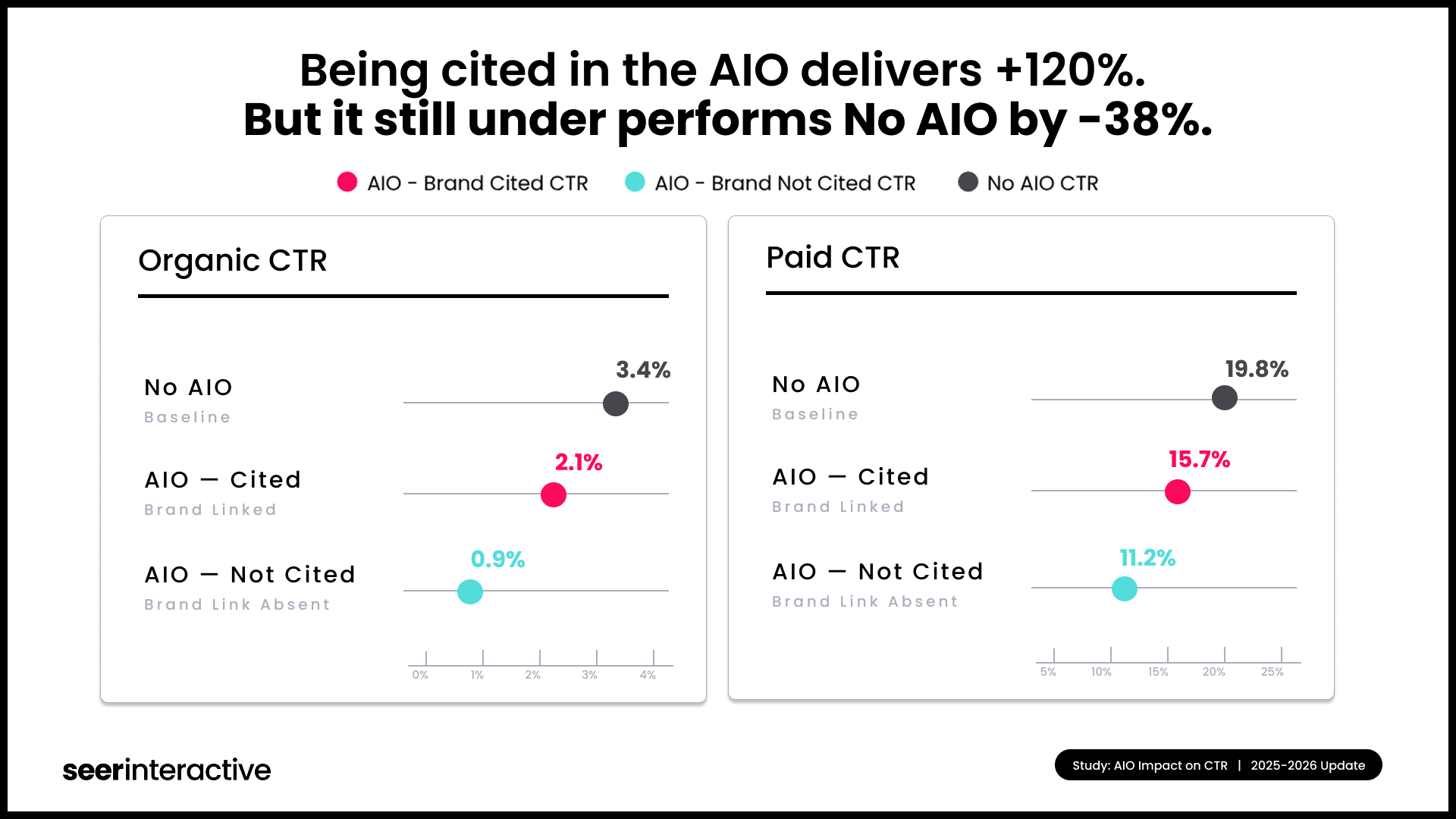
Here's the click math that actually matters. For every 1,000,000 organic impressions on informational queries:
-
-
- No AIO present: ~33,500 organic clicks
- brand Cited in an AIO: ~20,743 organic clicks
- AIO present, brand is NOT Cited: ~9,445 organic clicks
-
The Model Predicted Down and to the Right, But We Might Be Getting Some (Dare We Say?) Stability in 2026
We built OLS linear regression models on 12 months of 2025 data and projected impressions, clicks, and CTR forward into Q1 2026. Then we compared those projections to actual January and February 2026 data.
The model was excellent at predicting paid CTR, and systematically underestimating organic CTR, in the most interesting direction possible.
Remember, the asymmetry is the strategic insight. Paid is predictable because it's structurally depressed and stable. Organic is unpredictable because it's still being shaped by the AIO landscape, impression volume shifts, and signals we can't fully model yet. If you're trying to understand where AIO is actually affecting your business, look at your organic data.
What Does This Mean for Your Strategy?
I'm a VP / CMO, What Do I Do?
Last year we were operating under a prevailing assumption: decline is inevitable, plan accordingly.
The 2026 data is disrupting that a bit: CTRs are recovering in segments that were written off, transactional queries bounced back sharply, and the relationship between AIO presence and organic performance is more dynamic than a straight-line model predicted.
That cuts both ways. There's more upside available than last year's trends suggested, but you can't extrapolate 2025 into 2026 as a planning assumption either. The strategic implication for leadership is simple: your own data is the strategic input.
Aggregate benchmarks will mislead you. The brands that move intentionally, understanding their specific AIO exposure, citation status, and where their CTR is recovering versus still declining will have a material advantage over those still waiting for the dust to settle.
| Original Guidance | Updated Guidance |
|---|---|
| Updated
Assume AIO will suppress organic CTR for informational content
|
Before your team reallocates budget away from AIO-heavy queries, pause. A CTR drop isn't automatically a signal to pull back. Your brand may be showing up in the answer without earning the click. That's a different kind of win in the context of AIOs. Leverage your data, invest for brand reach where it makes sense, and optimize for site content where there's the biggest opportunity for meaningful visibility and engagement. |
| Still Valid
Invest in earning citations in AIO to protect organic performance
|
For most brands, many business-impacting queries are surfacing AIOs. These are often your most important informational queries, the ones that define your category presence. So funneling efforts away from where they are appearing, not an option. The data is clear: when an AIO appears, being cited is the best CTR position available, outperforming uncited in every single month in this dataset. |
| Updated
Paid is relatively insulated from AIO organic effects
|
Of all the channels in this dataset, Paid Search held up the best. Paid CTR on AIO-present queries stayed in a consistent 13–16% range throughout 2025 and into 2026. The gap between AIO-present and no-AIO paid CTR persisted all year, but both held. What that tells leadership is that paid search is your most predictable lever in search right now. The next question is where the strategic opportunities to allocate those funds are. |
| Updated
Transactional intent is less exposed to AIO than informational
|
Transactional queries have the lowest AIO exposure in this dataset at under 5%, but many transactional queries carry real purchase intent. And that loss and risk, while smaller, is still something to monitor. Tracking the data and risk here will be a key element in your search data strategy so you can stay nimble if there are similar dips over the course of 2026. |
| Updated
Monitor no-AIO queries as a control group
|
No-AIO queries are moving from control group to competitive opportunity. That no-AIO pool skews towards users who are actually going to click and there's not a universal answer to the question they're trying to answer — an opportunity to differentiate with value. Informational no-AIO organic CTR improved from 2.93% to 3.97% across 901M impressions in 2025. These are the queries your content team should be actively identifying and doubling down on. |
| New
Informational content programs face the highest AIO exposure
|
If your organic program was built around informational content — the how-tos, the comparisons, the what-is questions — you're operating in the highest AIO-exposure territory in this dataset. Comparison queries trigger an AIO 95% of the time. Question-format queries, 86%. The question for leadership is whether your brand is showing up as the trusted source inside those answers, or whether you're funding content that's building someone else's advantage. |
I'm a Search Consultant or Content Marketer, What Do I Do?
The practitioner takeaway from 2025 is more nuanced than "AIOs are bad for traffic." The data shows that citation status, query format, and intent type are doing more work than AIO presence alone. And for the first time, we have enough data to see exactly where the exposure is, which content formats are highest risk, which query types still drive clicks, and where citation optimization will move the needle most. The levers haven't changed, but there is a competitive opportunity there for the taking.
| Original Guidance | Updated Guidance |
|---|---|
| Still Valid
Prioritize earning citations in AIO for informational content
|
Optimizing for (valuable, relevant) AIOs is the right call, and the most high-leverage thing you can do. Being cited delivers +120% more organic clicks vs. not being cited on the same SERP. Treat citation optimization as a core deliverable, not a nice-to-have. |
| Still Valid
Track organic impressions and clicks separately, not just CTR
|
Tracking impressions and clicks separately is now essential, not just good practice. A CTR drop in Brand-Cited could mean you earned more citations on new queries (impressions up, clicks flat). A click drop with stable impressions is a different diagnosis entirely. Don't conflate them. |
| Major Revision
Commercial queries are relatively safe from AIO
|
Commercial queries are not safe from AIOs and need to be audited separately. Commercial No AIO organic CTR declined meaningfully in 2025 with minimal AIO presence. Something else is compressing commercial CTR and we don't fully know what. |
| Updated
Build content that answers AIO-style questions
|
Build content that earns a citation. Appearing on an AIO SERP without being cited is losing ground. The goal is not to answer the question. The goal is to be the source Google points to when it answers the question. |
| Updated
Use paid to cover organic losses on AIO-heavy terms
|
Depending on your CPAs, consider reallocating paid dollars to lower-funnel or non-AIO query sets where paid efficiency is stronger. Paid CTR held up on informational terms, but it's held up at a persistently low level. This remains a reasonable hedge, but have an honest conversation about CPA. |
| New
Comparison and question-format pages need a GEO audit now
|
Start with comparison and question-format pages in your GEO audit. These are triggering AIO at 95% and 86% respectively. If your brand has significant organic traffic from these formats, citation optimization isn't a future initiative. It's overdue. |
Three Bets for Q2–Q3 2026
Three specific, measurable bets based on what we’re seeing in the data. We'll check these in the next report.
Bet 1: The Organic Recovery Holds Through Q2 2026 (We start to see stabilization)
- Watching: Informational No AIO organic CTR | Current value: 4.91% (February 2026)
- The bet: Stays above 3.97% (December 2025 level) through June 2026
- Why it matters: Confirms the recovery is structural, not a January/February seasonal bounce. If it holds, the framing shifts from damage control to opportunity capture for no-AIO query clusters.
Bet 2: Transactional Queries with an AIO and Brand is NOT Cited, Recovery Holds
- Watching: Transactional AIO - brand Not Cited organic CTR | Current value: 4.21% (February 2026)
- The bet: Stays above 3% through April 2026
- Why it matters: A full recovery followed by a re-collapse would confirm the Q1 bounce was seasonal. Holding above 3.00% would suggest something structurally improved.
Bet 3: AIO Does Not Meaningfully Expand Into Transactional Intent
- Watching: Transactional AIO prevalence | Current value: 4.9%, 6.1% on question-format transactional queries; 1.5% on near-me transactional
- The bet: Stays below 10% through Q3 2026
- Why it matters: Transactional queries are where the money is. If Google pushes AIO into Shopping and Local SERPs, the revenue impact for Google themselves would dwarf anything we've seen in informational.
Full Methodology (Appendix)
Primary dataset: Paid and Organic CTR (aggregated paid + organic + SERP Trends data)
Secondary dataset: AIO Impact – Paid and Organic CTR (search-term-level granularity). Used only for the query-type AIO prevalence analysis in Section 2, filtered to Feb 2026.
Cohort pre-filters applied to all queries:
- Has SERP Trends Data (Latest SERP Month) = TRUE
- Paid Has All 2025 Months = TRUE
- Organic Has All 2025 Months = TRUE
In-scope cohort: 53 accounts | 5,471,127 distinct queries | 2.43B organic impressions | 296.9M paid impressions
SERP Feature Intent classification:
- Informational: Answer Boxes / Featured Snippets, Calculator, Dictionary, Interesting Finds, Knowledge Graph, News, Recipes, Salary Pack, Track a Package, Unit Converter
- Navigational: Sitelinks
- Commercial: Popular Products, Refine By
- Transactional: Directions, Events, Job Pack, Local, Map Results, Shopping Box
- N/A (not intent-bearing): Ads, Guided Search Filters, Images, Organic, People Also Ask, People Also Search For, Podcasts, Related Searches, Video
Classification uses the most recent SERP snapshot applied retrospectively. Compound intents (Commercial-Informational, Commercial-Transactional) are bucketed by their primary label.
AIO status definitions:
- Brand Cited: AIO Present = TRUE and AIO Owned = TRUE. Changes in this segment reflect both Google's AIO logic and SEO and content performance. Not attributable to either party alone.
- Not brand-Cited: AIO Present = TRUE and AIO Owned = FALSE.
- No AIO: AIO Present = FALSE. A Google product decision.
AIO classification is static from the most recent SERP snapshot, applied retrospectively.
CTR calculation: SUM(Clicks) / SUM(Impressions) × 100 from raw totals. Pre-computed CTR fields are never averaged.
Forecast methodology: OLS linear regression per segment (Intent × AIO Status), monthly index 1–12 = Jan–Dec 2025. Floor: 0.0001% minimum CTR. No seasonality adjustment.
Known caveats:
- Commercial No AIO organic CTR figures for 2025 are directional. The precise January 2025 starting value varies between 5.69% and 6.82% depending on how compound intents are grouped. Values are shown as approximations.
- The Informational AIO - Brand Not Cited aggregate CTR (0.94%) is materially influenced by one account representing 47% of that segment's impressions at 0.20% CTR. Excluding that account, the aggregate is approximately 1.61%.
- The Informational No AIO improvement trend (+36%) is genuine across the cohort but is partly shaped by two accounts (Salomon, MongoDB) representing 35% of segment impressions. Excluding them, the improvement is +31%.
What we can and cannot claim:
- We can report the correlation between AIO status and CTR outcomes across a large, multi-account cohort.
- We can quantify the click-volume impact of CTR differences at scale using per-1M-impression translations.
- We can report query-type AIO trigger rates across 49,353 distinct queries.
- We cannot claim causation. Higher-authority brands are also more likely to be cited.
- We cannot attribute brand-Cited impression changes to Google vs. brand SEO performance without account-level investigation.
- We cannot track AIO in real time. The static label is a known limitation.
- We cannot make precise March 2026 predictions. The linear model demonstrated it underestimates in recovery environments.
Data Tables Referenced:
| All Queries: Organic CTR when an AIO is not shown, Organic CTR when an AIO is shown, Paid CTR when an AIO is not shown, and Paid CTR when an AIO is shown | ||||
|---|---|---|---|---|
| Month | Organic CTR — AIO Not Shown | Organic CTR — AIO Shown | Paid CTR — AIO Not Shown | Paid CTR — AIO Shown |
| February 2026 | 3.82% | 2.36% | 21.85% | 16.21% |
| January 2026 | 3.88% | 2.33% | 21.72% | 15.62% |
| December 2025 | 3.16% | 1.31% | 20.96% | 15.14% |
| November 2025 | 2.45% | 1.33% | 18.60% | 15.32% |
| October 2025 | 2.74% | 1.72% | 19.01% | 14.01% |
| September 2025 | 2.99% | 2.14% | 19.14% | 15.48% |
| August 2025 | 2.70% | 1.77% | 19.04% | 14.98% |
| July 2025 | 3.07% | 1.81% | 17.61% | 13.78% |
| June 2025 | 3.07% | 2.06% | 18.06% | 14.17% |
| May 2025 | 3.03% | 2.35% | 18.67% | 13.63% |
| April 2025 | 3.44% | 2.76% | 21.10% | 14.06% |
| March 2025 | 3.45% | 3.03% | 21.64% | 12.86% |
| February 2025 | 3.15% | 3.56% | 23.23% | 13.34% |
| January 2025 | 2.75% | 3.19% | 25.98% | 14.64% |
| Query types (Informational, Commercial, Transactional) and average AIO prevalence | |
|---|---|
| Search Query Intent | Average AIO Prevalence |
| Informational | 36% |
| Commercial | 8% |
| Transactional | 5% |
| Source: 53 accounts | 49,358 tracked queries | Calculated as AIO True / (AIO True + AIO False), excluding NULLs | |
| Types of Queries Impact AIO Rate | ||
|---|---|---|
| Query Type | AIO Rate | Org Impressions |
| Comparison (X vs Y) | 95.4% | 79,436 |
| Review queries | 86.3% | 21,221 |
| Question (what/why/how/is/are) | 85.9% | 1,408,843 |
| Price / Cost / Buy | 83.4% | 192,911 |
| Best Of | 81.3% | 105,279 |
| Near Me | 76.9% | 188,606 |
| 4+ Words (general) | 35.5% | 3,513,670 |
| 2-Word | 34.8% | 32,598,962 |
| 3-Word | 31.1% | 9,935,297 |
| Single Word | 27.3% | 25,042,440 |
| CTR by AIO Presence and Brand Citation Status | ||||||
|---|---|---|---|---|---|---|
| Month | AIO — Brand Cited Org CTR | AIO — Brand Not Cited Org CTR | No AIO Org CTR | AIO — Brand Cited Paid CTR | AIO — Brand Not Cited Paid CTR | No AIO Paid CTR |
| December 2025 | 0.95% | 0.55% | 3.97% | 17.43% | 10.42% | 21.01% |
| November 2025 | 0.76% | 0.63% | 3.31% | 17.85% | 10.87% | 20.30% |
| October 2025 | 1.21% | 0.67% | 3.54% | 16.48% | 9.43% | 18.44% |
| September 2025 | 2.52% | 0.65% | 3.40% | 16.62% | 10.55% | 18.22% |
| August 2025 | 2.11% | 0.78% | 3.02% | 15.43% | 10.33% | 17.95% |
| July 2025 | 2.78% | 1.24% | 3.40% | 13.99% | 9.98% | 16.15% |
| June 2025 | 2.53% | 0.67% | 3.37% | 14.47% | 10.03% | 17.79% |
| May 2025 | 2.73% | 0.87% | 3.22% | 14.41% | 15.62% | 18.45% |
| April 2025 | 3.19% | 1.50% | 3.41% | 16.07% | 14.35% | 21.01% |
| March 2025 | 3.62% | 1.74% | 3.37% | 14.33% | 9.57% | 20.83% |
| February 2025 | 3.57% | 1.81% | 3.23% | 16.10% | 10.00% | 23.58% |
| January 2025 | 3.04% | 1.65% | 2.93% | 17.95% | 11.04% | 26.30% |
.png)


.png)
.png)