

Key Takeaways
- We hypothesized that Google AIOs appear less often for “higher stakes” finance topics — this was not the case
- Instead, we found AIO presence of finance topics correlates to query intent (i.e. educational, transactional, advisory)
- Where and how users educate themselves (whether using Google Search or experts/external resources) impacts AIO presence
- Understanding what drives query intent is vital to approaching content strategically
How AI Search Is Changing the Finance Industry
Developing content strategy for finance used to be pretty straightforward. Finance topics are dense, which means people have questions that need answering. A little keyword research, a lot of copywriting, you were golden.
Except now, AI aggregates those questions before you have a chance to get eyes on your website. Right? So, we should pivot our finance content strategy to AI Search optimization. Right?
Maybe! But in order to make intentional and effective changes to strategy, we first need to confirm how and when AIOs are showing up for these topics. Here’s how I started out thinking about it:
- My gut was that AIOs would be prevalent for many finance topics, but not all
- I suspected AIOs prevalence would be correlated to how “serious” a finance topic is
- If I was right, we’d approach content differently for “high stakes” services and product
My hypothesis: AIOs answer the majority of finance questions, aside from higher-stakes questions where Google would not want to be on the hook for financial advice gone wrong.
It's likely obvious, but this isn’t out of nowhere. My hypothesis was inspired by Google’s EEAT guidelines help evaluate the credibility of a site’s content, specifically for “Your Money or Your Life” (YMYL) topics— AKA more sensitive topics like personal health, finances, safety, and individual well-being.
Data and Methodology
I looked at 2,967,582 unique keywords across 191 finance categories — everything from banking, insurance, and mortgages to investments, lending, and other specialized services.
For the sake of analysis, I grouped those 191 topics into five tiers. To do this, I (well, Claude and I) created a scale of which topics deemed most to least impactful to one’s financial well-being:
- Tier 1: Most impactful (topics dealing with larger sums of money, bigger investments, longer time periods for investments, and business transactions)
- Tier 2: High impact
- Tier 3: Moderate impact
- Tier 4: Low impact
- Tier 5: Least impactful (topics with small amounts of money and minimal impact to one’s finances)
| Tier | Examples of Topics Included |
| Tier 1 | 4O1(k)s, Hedge Funds, Investment Banking, Wealth Management, Wills & Living Trusts |
| Tier 2 | Bankruptcy Law, Disability Insurance, Mortgages, Loans, Life Insurance |
| Tier 3 | Bonds, Business Finance, Car Insurance, Credit Cards, Stocks |
| Tier 4 | Banking, Pet Insurance, Scholarships & Financial Aid, Grants, Home Appliance Financing |
| Tier 5 | Coupons & Rebates, Check Printing, Finance, Sweepstakes, Loyalty Cards & Programs |
Was I Right? Actually, No.
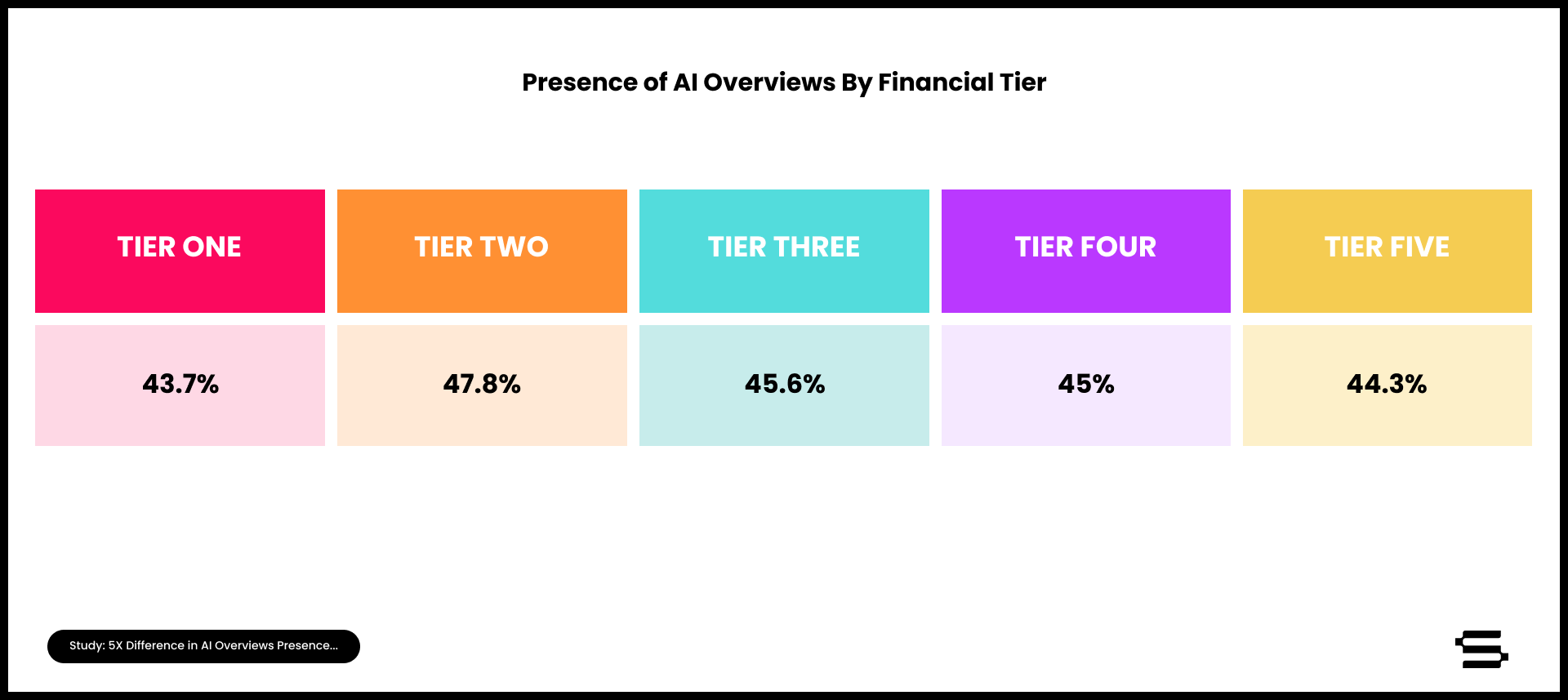
My hypothesis was wrong. Tier 2 (high impact to one’s financial well-being) had the highest occurrence of AI Overviews, while Tier 1 had the lowest occurrence.
Range across tiers varied by only a few percentage points (from 43.7% to 47.8%). The pattern was non-linear and unpredictable, showing little statistical significance and disproving my hypothesis.
So Was This A Useless Exercise? No, There Are Other Notable Patterns Between Finance Topics and AIO Presence
Looking back, I think I was trying to sniff out a hypothesis that made for a good headline. I mean, I am a marketer after all.
But the reality is: the patterns we found are straightforward. But I think there’s still value here. And I think the headline is still pretty good :)
1. AIOs Appear Most Often for Educational and Informational Queries
The data showed a strong correlation between query intent and AIO presence. I know, “duh”. But trust me, there’s good stuff here as we weave it all together.
(Claude and) I grouped queries into the following types:
- Educational ("how/what"): "how do reverse mortgages work", "what is whole life insurance"
- Informational ("does/can"): "can you get a mortgage with bad credit", "does disability insurance cover unemployment"
- Comparison/Research: "reverse mortgage vs home equity loan", "best high yield savings accounts"
- Transactional ("rates/apply"): "commercial mortgage rates today", "apply for business loan"
- Advisory ("should I"): "should I get a reverse mortgage", "is wealth management worth it"
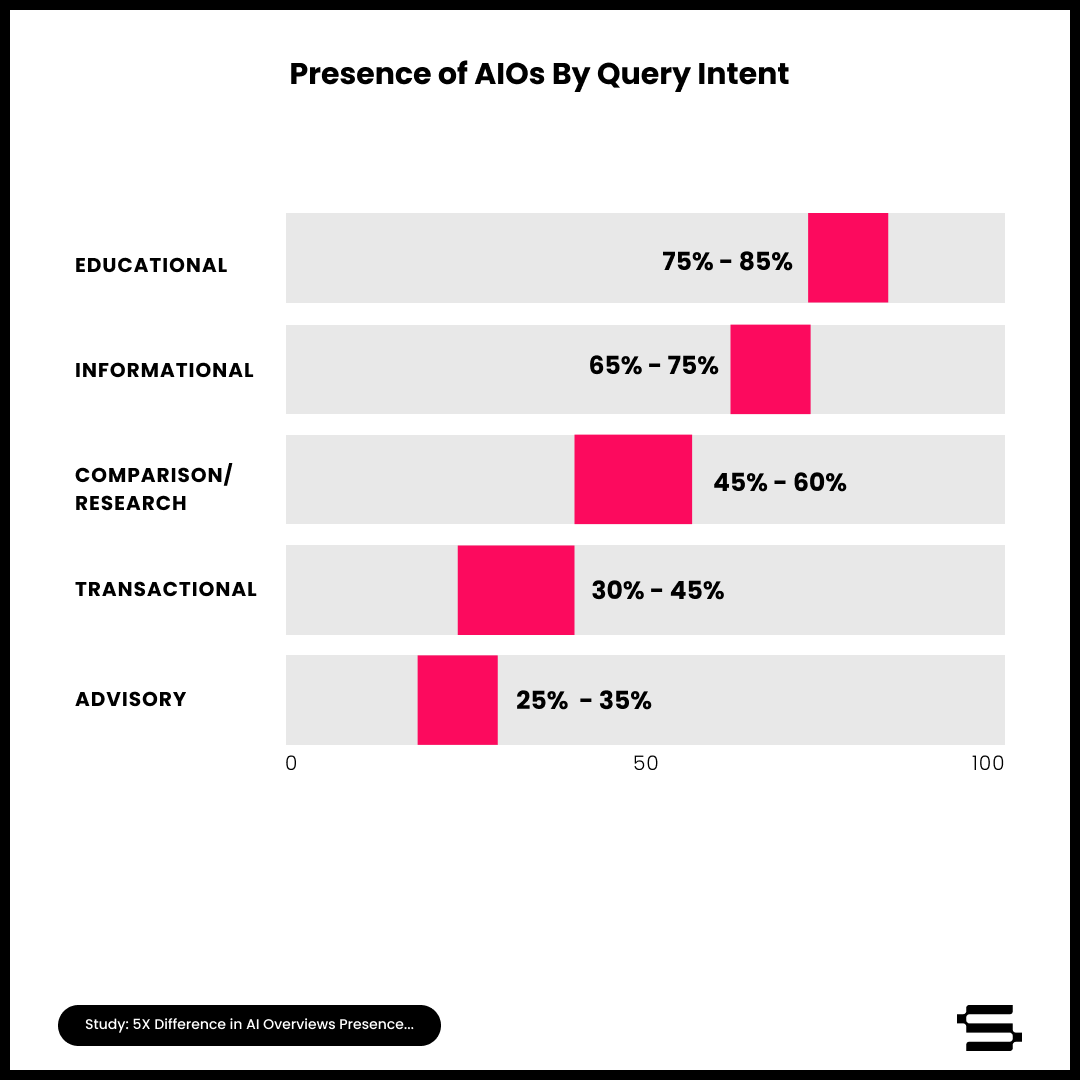
My analysis revealed that educational and informational queries were most likely to show AIOs, while advisory queries were the least likely. Google will frequently show AI Overviews for more straightforward questions, but is more likely to send you to other sites for queries that require personalized advice or real-time transactions.
2. Understanding The Intent Breakdown of a Topic Is Key
Like I said, top-of-funnel/educational intent triggering AIOs is far from groundbreaking. But the concept becomes more interesting (and valuable) when you layer topics back in here. My takeaway: It’s important to remember that not all topics have the same breakdown of query intent.
Let’s look at the topic of mortgages as an example. Reverse mortgages and commercial mortgages were both categorized as having a “high impact” level of financial risk. Despite this similarity, I found a 5x difference in the likelihood of AIOs showing up for these two topics due to query intent:
- Reverse mortgages (includes queries like "what is a reverse mortgage", "how does it work", "what happens when you die"): Show AI Overviews for 82% of queries
-
Commercial mortgages (includes queries like "commercial mortgage rates today", "broker near me", "compare lenders"): Show AI Overviews for 17% of queries
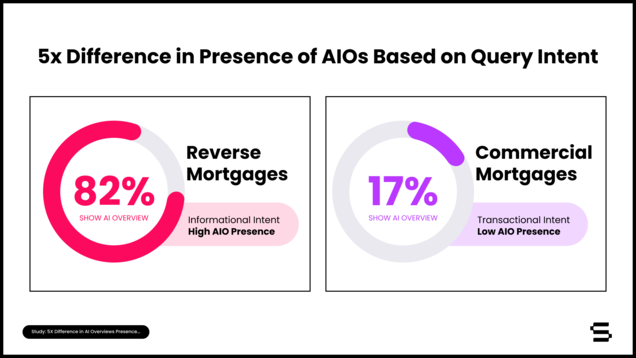
Why? Queries related to reverse mortgages tended to be educational and informational (“how”/”what”), while queries related to commercial mortgages were more transactional and advisory (“rates”).
So, to me, this is where you should focus data analysis to influence strategy. Industry-specific data isn’t good enough. In this case, even line-of-business-specific data isn’t good enough!
3. Where and How Users Educate Themselves Impacts Likelihood of AIOs
The final pattern I noticed (and this is related to both findings above) is that AIOs are more likely to appear when users are able and willing to educate themselves using Google Search (or may not have another source to turn to).
Conversely, AIOs appear less frequently for topics that often require additional education outside of Google (i.e. such as relying on a trusted expert or advisor).
As a result, AIO presence also correlates to how familiar someone is with a topic before they start searching on Google. Insurance topics are a great example of this.
For more common types of insurance like car and homeowners insurance, the occurrence of AIOs is low. This may be because this type of information is culturally embedded — many people learn how to drive a car in their teens, and know you need car insurance if you have a car. Therefore, “better known” insurance topics include more transactional and advisory queries.
| High AIO = Education Happens In Google Search | Low AIO = Education Happens Elsewhere |
| Reverse mortgages (82%): Complex product, seniors must conduct thorough research and be aware of scams | Commercial mortgages (17%): Business owners learn from their CPA/banker |
| Credit scores (71%): Confusing topic with robust coverage, people want explanations | Wealth management (27%): High-net-worth individuals use advisor referrals, not Google |
| Disability insurance (67%): Usually offered through job, employees may want to be informed (before having a sensitive conversation at work) if given limited information | Homeowners insurance (34%): Homeowners learn from broker during mortgage process |
| Pet insurance (64%): No agent channel, people research online | Car insurance (38%): Most people already know what it is (learned from parents/DMV/ insurance agents) |
How to Apply These Findings to Your Content Strategy
As usual, start with your audience and your data. Do you know how and where your audience is educating themselves on your services? Do you know how much this varies by line of business/product? Your content strategy (for any industry) moving forward will depend on this understanding.
Tips for Learning Where Your Audience Education Happens
Understand your audience:
- Start with existing data: Mine chat logs, reviews, analytics, and PPC data using automation tools to find patterns before investing in new research
- Combine what and why: Layer quantitative data (analytics, recordings) with qualitative insights (interviews, feedback) to understand user motivations
- Observe real behavior: Watch actual users interact with AI tools and search, replacing assumptions with evidence-backed insights
- Decode the "why" behind prompts: Analyze how users phrase questions and what triggers action
- Connect across channels: Integrate findings with SEO, paid media, and analytics for strategies that evolve with changing search behavior
You should also consider leveraging Sparktoro (a tool we use extensively here at Seer). Sparktoro pulls websites, search engines, YouTube channels, social media networks, and podcasts that your website visitors are visiting. Use this data to better understand where they go for advice and education (and at what stage of their journey).
When Education Happens in Google
Whenever your audience is using Google to learn about your services (especially as a first step), then you should expect a high presence of AI Overviews.
Based on my analysis, this will include categories like reverse mortgages (82%), credit scores (71%), pet insurance (64%), and disability insurance (67%).
Focus on creating content that is likely to be cited in AIOs. Pay attention to structure and formatting on the page, and off-page focus on building a community (somewhere like LinkedIn, TikTok, or Reddit, depending on your brand).
| Your Strategy | Metrics to Track |
|
|
Why this strategy works: You're meeting your audience where they research (Google) early and, ideally, converting them into owned audiences who bypass Google for future interactions.
When Education Happens Elsewhere
If your audience chooses (or is required) to educate themselves in person or via other channels, you should have fewer AIOs to contend with. Per my analysis, this will include categories like wealth management (27%), commercial mortgages (17%), car insurance (38%), and business banking (41%).
Your content strategy should prioritize owning the transactional search space, and ideally you’ll also focus on showing up where education actually happens.
Build content for users who are actively shopping or ready to buy (like comparison tools or rate calculators). Get your brand in front of users at whatever channels they use to learn. For example, in the commercial mortgage space, you could increase your visibility in industry publications and focus on building CPA referral partnerships.
| Your Strategy | Metrics to Track |
|
|
Why this strategy works: You won’t waste time or effort fighting for visibility where your audience isn’t looking or doesn’t trust. Instead, you'll position your brand to be visible when users are shopping and making decisions.
Ready to build out your strategy for AI Overviews and AI search? Contact us to get started.
Methodology note: This data was collected in October 2025 from Seer Signals SERP tracking and focused on desktop US searches. Our research was validated by independent findings from Seer Interactive's banking client work (Dec 2024).

.png)
.png)