
We analyzed 90,000 gift-related prompts across Gemini, AI Mode, and AI Overviews.
The growing usage of AI platforms has been a consistent conversation throughout the year, with ChatGPT surpassing 700M weekly active users in September and Gemini reaching 650M monthly active users in October.
Considering that rate of growth, we wondered how people's habits are changing so far?
We have some data from OpenAI highlighting that the fastest growing application of ChatGPT is ‘information seeking’, growing from 14% to 24% in July 2025 compared to the previous year (via their September 2025 consumer report).
Since this category included a subset of “Purchaseable Products”, we could assume that a higher percentage of people are using AI tools for their holiday shopping this year. This time last year, we were barely seeing any citations from ChatGPT and Gemini, and the traffic marketers were seeing from these platforms was even smaller.
With these changes affecting traditional search and the future of search, it has me thinking about the impact on holiday shopping this season - and the e-commerce experience moving forward.
The Fragmented Experience
For the first time in nearly two decades, we’re seeing real fragmentation in the search experience. Marketers are no longer optimizing primarily for traditional Google Search while giving lower thought to Bing or Yahoo.
Now we have a search landscape with multiple different AI platforms, each worth paying attention to.
As adoption grows and the capabilities of these platforms expand, I believe we’re going to see a shift in e-commerce retail that surpasses even the explosive growth of the last decade.
In 2000, e-commerce sales represented 3.46% of total retail sales in the U.S. From 2010 to 2020, the e-commerce share of retail sales increased 131% (via Capital One Shopping Research).
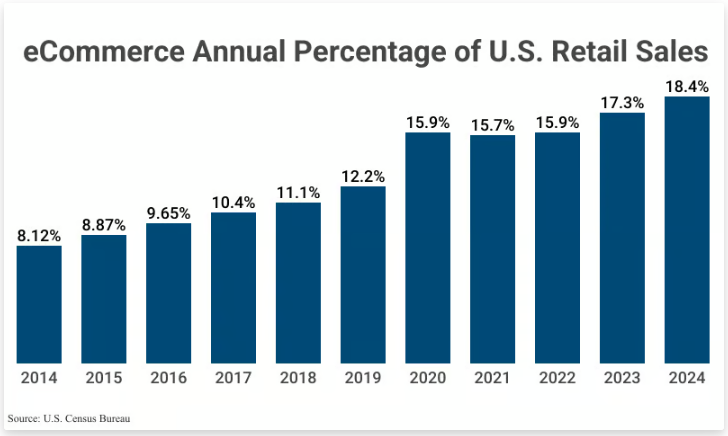
The data from Capital One Shopping Research also makes it clear that consumer behavior is already changing thanks to AI:
- The AI retail market hit $10.8B in 2024 and is projected to reach $31.2B by 2028 - a 30.5% annual growth rate
- 82% of consumers prefer a chatbot over waiting 15 minutes for a human
- 88% of online shoppers interacted with chatbots in 2024
There have already been plenty of studies comparing ChatGPT, Perplexity, and other AI platforms, which makes sense given that they’re all built by different organizations.
But what about Google’s ecosystem and the three separate search experiences that now exist within the same organization?
Google has rolled out three different search-focused AI experiences in the past 20 months: AI Overviews in traditional search, Gemini as an AI chatbot, and AI Mode as a more conversational search experience.
To understand how much these experiences can differ for users, we analyzed the variance in their citations and results.
The Data - Variance in Experiences
We gathered the group of 90,000 prompts through Semrush’s Keyword Magic Tool and leveraged Scrunch to capture the outputs and citations of each prompt.
Breakdown of Citations on Google AI Platforms
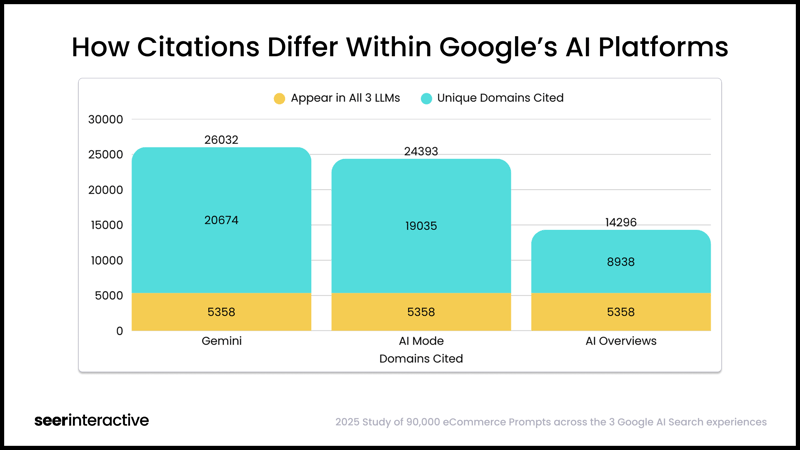
- Total unique domains cited:
- Gemini - 26,005
- AI Mode - 24,393
- AI Overviews - 14,296
- Only 11.9% of cited domains appear in all three LLMs (5,358 out of 45,136 total unique domains)
This data clearly shows there are major differences in how each platform is factoring, prioritizing, and pulling sources.
It’ll be interesting to test this data again, as Gemini 3 is meant to integrate more into the AI Mode experience - but as of now the platforms are still acting as completely separate entities.
This is why it’s so difficult to recommend for brands to ‘just’ increase their brand mentions on websites used in LLM citations.
Even looking at the domains cited most often by each platform, there wasn’t that much of an overlap - Reddit was the only domain in the top 5 of each platform’s citations.
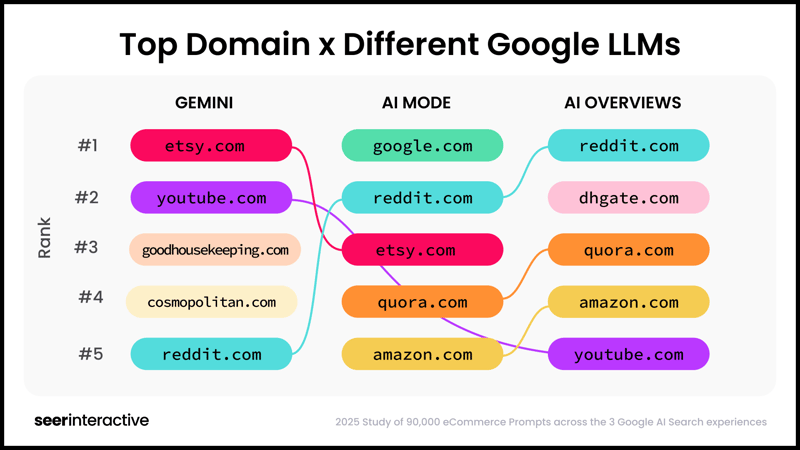
Within Google’s ecosystem alone, there were vastly different experiences. Add ChatGPT and Perplexity to the mix, and the fragmentation of the experience would be even more significant.
Gemini leans heavily into lifestyle publishers and virtually ignores Amazon (rank #8,869).
While the platform had the highest amount of citations, within the outputs it didn’t specifically ‘recommend’ products as much. Most of the outputs included gift ideas and had more of an inspirational approach prior to providing specific recommendations.
AI Mode attempted to keep users within Google’s ecosystem, citing Google Shopping PD’s the most often (8% of sources)
For reference, Google Shopping citations made up less than 0.25% of all citations across AI Overviews and Gemini.
AI Mode’s outputs seemed more curated, with more explanations as to why the person would appreciate specific gifts and providing the related options.
AI Overviews prioritized user-generated content, with Reddit, Quora, and YouTube appearing in 3 of the top 5 cited websites
I didn’t expect to see DHgate here, especially having the second-largest number of citations and outperforming Amazon in visibility.
Even more surprising was the amount of product options that AI Overview provided compared to the other platforms. As a feature that exists within the traditional search results, I expected the experience to be a bit more compact compared to conversational-focused platforms.
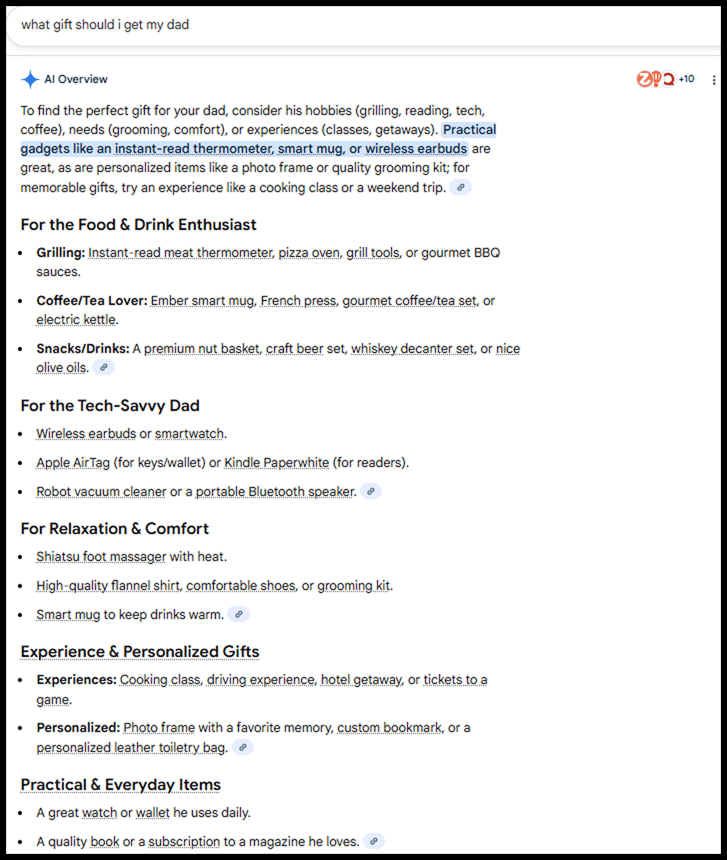
The screenshot above includes 37 different ideas for the search ‘what gift should i get my dad’ - a much higher amount of products than the other platforms.
E-Commerce Retailer Visibility Across Google's LLMs
We’ve consistently seen that brands with the most awareness or market share don’t always have the strongest visibility within LLMs, and that’s no different in Gemini, AI Mode, or AI Overviews.
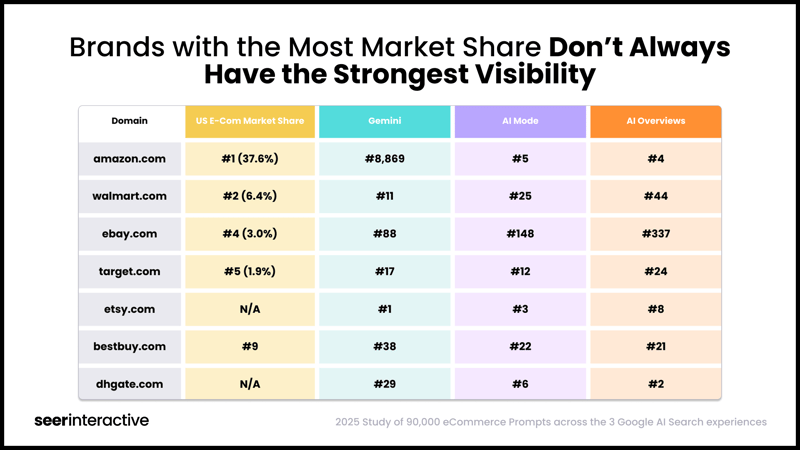
Amazon’s position immediately stands out because theoretically the brand would check off most of the boxes that we recommend for AI visibility:
☑ Traditional organic visibility
Amazon’s site is ranking for 42.9K ‘gifts for’ related search terms; Walmart and Target are the next closest in this competitive set at 32.7K and 25.5K respectively.
☑ Strong technical website foundation
I didn’t complete a full technical analysis of the websites, but Amazon did have the strongest Core Web Vitals of the pages I tested against compared to Walmart and Target.
☑ Brand awareness
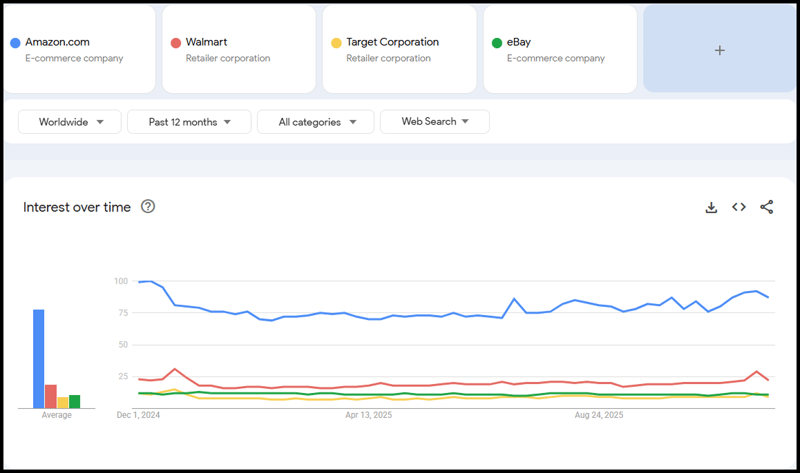
Using Google Trends interest as a proxy, Amazon clearly has the most search awareness by a large margin.
☑ Brand mentions on third-party sites
Even though we’re moving into a future of search where branded mentions don’t need to be linked to hold value, I’m using backlinks as a proxy measurement.
Amazon wins this round too:
- Amazon: 5.9B backlinks
- eBay: 1.6B
- Etsy: 151.3M
- Walmart: 78.2M
- Target: 23.7M
I know reading that Amazon is winning in each of those four categories won’t be surprising to you, but that’s the point.
We’re moving into a point of search where other players have an opportunity to compete based on merit, not just quantitative, brand authority–focused metrics.
Even DHgate, a Chinese e-commerce marketplace, had the second-most citations in AI Overviews and were top 30 in the other platforms, even with our prompts being US-based and being quantitatively lower than the other brands worldwide.
What This Means
No longer are we optimizing for one platform of Google Search and trusting this works for the majority of our online discoverability. Different platforms favor different types of sites. Some may lean more into the direct retailer route, and others may lean into editorial content.
But what this also means is that smaller brands have a chance to gain visibility by merit.
If you’re trying to outrank Amazon for “gifts for 80 year old man”, that would be a tough battle in traditional SEO. Amazon’s owned position 1 for 12 of the last 13 months.
However, if your audience is starting to use Gemini more often, this could be your moment to figure out how to make the most of this newly found real estate.
Implications
If you're an e-commerce brand trying to navigate AI-driven search this holiday season, here's where I'd focus:
1. Measure your current AI referral traffic
Start by getting a baseline of how much traffic you're already receiving from AI platforms. This tells you how often your target audience is using these tools - and how urgent this should be for your brand.
The easiest way to check is filtering for referrals from Gemini, ChatGPT, and Perplexity in your analytics. Keep in mind that AI Overviews and AI Mode don't have distinct referrers yet, so these sources would be grouped into Google Organic.
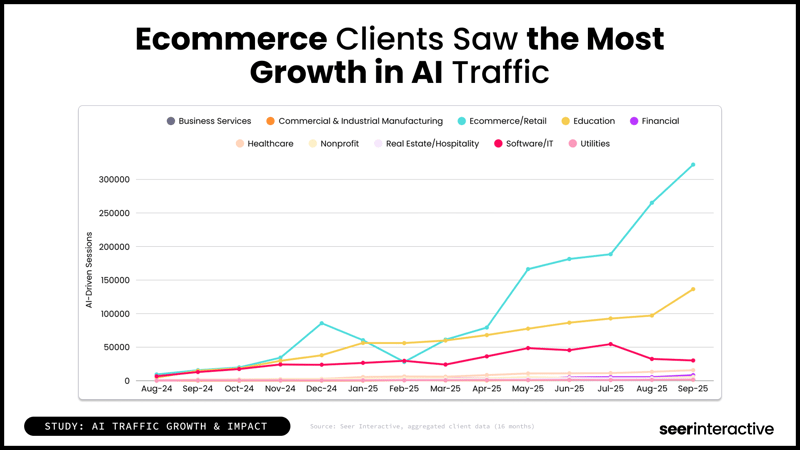
In aggregate, we’re seeing AI-referral traffic provide the most growth for e-commerce clients compared to other industry AI traffic (within our client dataset).
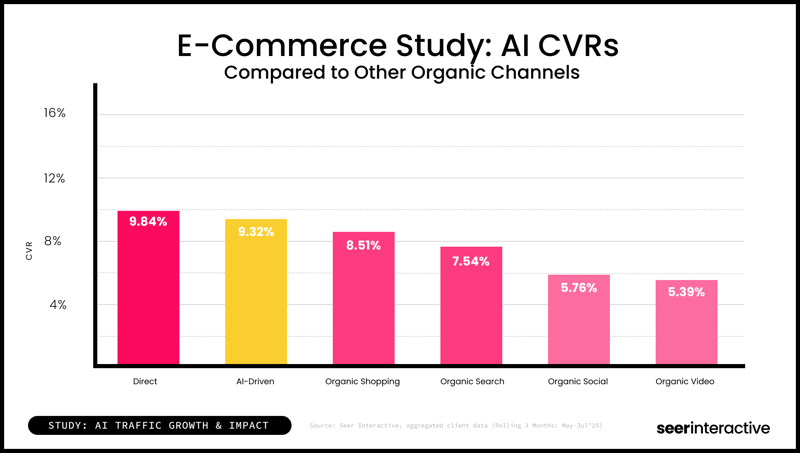
In an industry-wide study, we also found that AI-driven traffic had a 9.3% conversion rate for e-commerce clients. You may already be bringing in a steady stream of AI-generated ROI without even realizing it.
2. Understand which platforms your audience prefers
Tools like SparkToro can show you which AI search platforms your audience has a higher affinity toward. Pairing this with your referral data helps you prioritize where to focus.
3. Identify which content types are earning visibility
Look at which landing pages are receiving AI referral traffic. Are they product pages? Editorial content? Gift guides?
Seeing which pages are being visited and landed on most by AI-referred users can give you insight into which pages to prioritize and keep updated.
4. Select an AI Visibility Tracker
Alisa Scharf, Seer’s VP of AI & Innovation, did an awesome job walking through how to select the right AI visibility tracker based on a maturity model we developed. If you haven’t already, select one of these platforms to begin monitoring your brand presence and citation ownership for prompts you care about.
Longer-Term Strategies
None of us have time to build a strategy for 10 different search experiences.
Use your selected AI visibility tracker to identify the top domains that are showing up for the prompts you care about. Segment these into two groups:
Prompts where you can compete
These are going to be areas where you see brands like yours gaining visibility.
In areas where you can compete, check out what types of pages competitors are gaining citations through and leverage this as a type of content gap analysis. What are the topics and on-page elements that your site may be missing?
Sites where you can't compete directly
This is going to be the area to prioritize strategically based on domains that are cited in LLMs and that have your audience’s attention.
To identify your top domains, complete the following steps:
1. Gather the domains being cited across AI platforms
From our initial list of 45,136 unique domains, we’re narrowing the scope to only the sites that appeared across all three AI platforms. That brings us down to 5,358 domains - which is still more than we can realistically focus on.
2. Use Sparktoro to find the domains with high audience affinity
Domains being cited by AI platforms are continually changing. If you have a set budget for PR and publisher partnerships, you want to make sure that you’re setting up your bets for success.
I believe the best way to do this is by checking in where your audience is already spending time, since their behavior won’t change as fast as AI platforms.
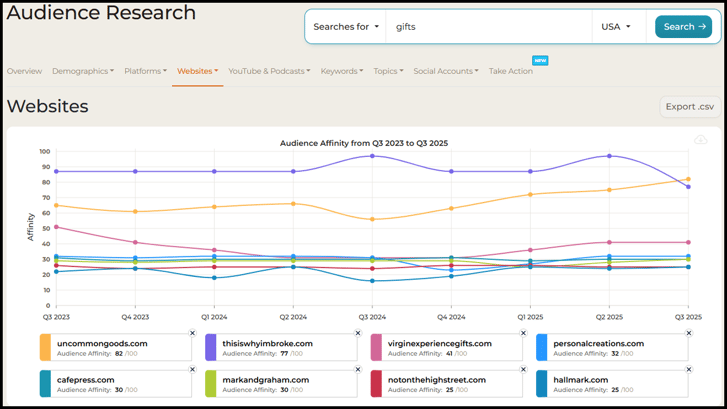
Using Sparktoro, I can see what websites users are commonly visiting when searching for gifts. These websites already have our audience’s attention.
3. Find the overlap of LLM Citations and Audience Affinity
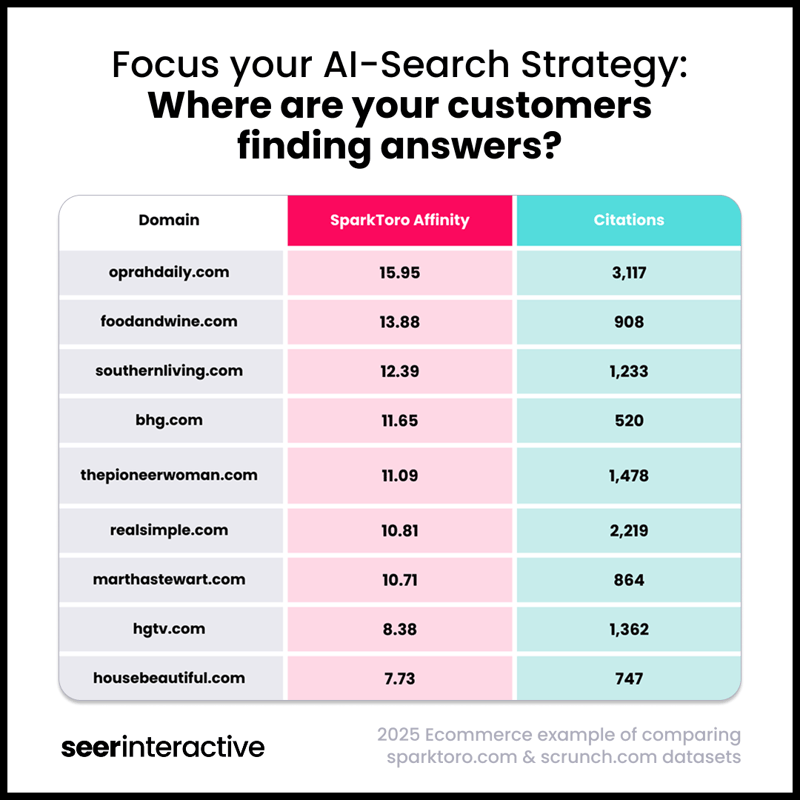
After merging the datasets, we have a list of 175 domains that are generating citations in Google’s AI platforms and that our audience is already visiting.
If you’re a retailer that will only focus on visibility through editorial sites, that will narrow your focus even further. We found 23 sites commonly being used as citations, including:
Why This Strategy Matters for E-Commerce Marketers
An audience-first approach risks missing LLM visibility as adoption continues to grow. On the other hand, an LLM citation strategy requires managing at least three strategies for Google alone - and citation coverage can shift overnight if platforms change their sourcing methods.
The upside of this dual strategy: even if LLMs change how they pull information, you're not fully exposed to that bet. Our view is that while LLM patterns may shift more frequently, it's far more difficult for your audience to suddenly change where they discover products.
Framework:
- Audience First
- Focus on where your customers actually discover products
- Traditional SEO, social, affiliate partnerships
- Risk: May miss LLM visibility as adoption grows
- LLM Citation Strategy
- Requires THREE different approaches for Google alone
- Risk: Citation coverage can change in an instant
- Dual Strategy
- Focus on domains that appear in BOTH audience affinity AND LLM citations
What's Next
While this research highlights how fragmented the search experience has become, our next focus is understanding how that fragmentation is actually impacting users beyond just brand visibility.
We’re running a pilot user-testing study with Outset to explore how behaviors may be shifting as AI platforms continue to grow. Contact us to learn more about how we can help you with your GEO tests.

.png)
.png)