When we first published this on July 15, we were working from three days of ChatGPT ads data. Revisiting the data this week, our main takeaways haven't changed, but ecosystem is evolving. Share of responses with ads rose significantly, a wider set of brands is now buying them, and early patterns are sharpening.
The updated numbers below now reflect about 2 weeks of data. With that, we advise you treat this as a developing study. It's still early and we are prepared for this to change fast.
OpenAI officially launched the ChatGPT Ads pilot on February 9, 2026, rolling the placements out more widely as of May. While we've been tracking how ads work, tests and usability through our own pilot and other studies, we have not had a view into how often they show up, what types of prompts they’re shown for, and how well they align with those responses that they are served under.
That changed this week when ads started appearing in our AI tracker.
Advertising in ChatGPT is creating more questions than answers right now:
- Are ads showing up on the prompts I care about? Are they my competitors?
- If ChatGPT is answering the questions outright, will my ad be effective?
- Should I bid on my own branded prompts, the way I'd defend terms in paid search?
- If I'm the brand ChatGPT already recommends, can a competitor's ad still take the moment from me?
But that doesn't mean that placing some smart bets and experiments isn't right for your brand. And now that we're starting to get some real data around ChatGPT ads, experimenting effectively is going to get a whole lot more interesting walking into the second half of 2026.
AI Search is just SEO? Not anymore.
For the past year we have treated AI search as its own lane, sitting somewhere alongside SEO and how people organically find answers and products. Paid now sits directly underneath the organic answer. Is that different than Google Search with ads? Yes, in how ads and organic are positioned. But the two experiences are starting to converge, both now living inside a single customer's research and context within ChatGPT.
Here are 5 initial observations that are helping inform early experimentation:
1. Ads now appear in 7 out of 10 tracked responses
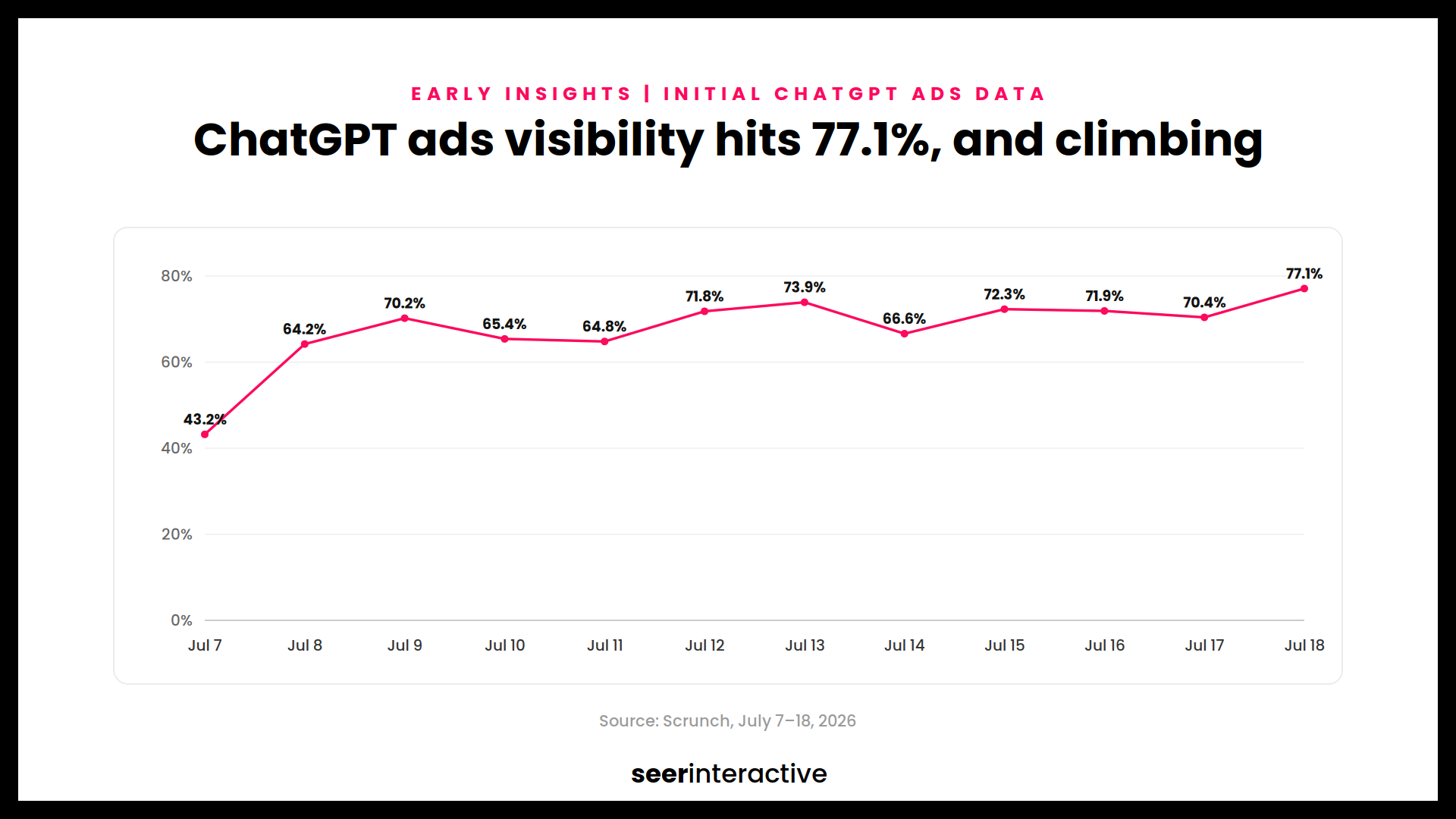
*In our first data pull, the data showed that 7.1% of responses featured an ad. In reviewing our updated data, the June 9th percentage showed 38%. We are more confident in the 38% figure and have updated the growth curve accordingly.
Over the past 2 weeks, the share of responses featuring an ad has increased 34 percentage points*, currently sitting at 77%.
Within our client portfolio, ChatGPT Ads are:
- Visible in 99% of client AI tracking workspaces (96 of 97)
- Featuring 3,697 unique advertisers
We expect these ad placements to continue climbing.
Why? Google Search ads often concentrate on high-intent searches near the point of purchase.
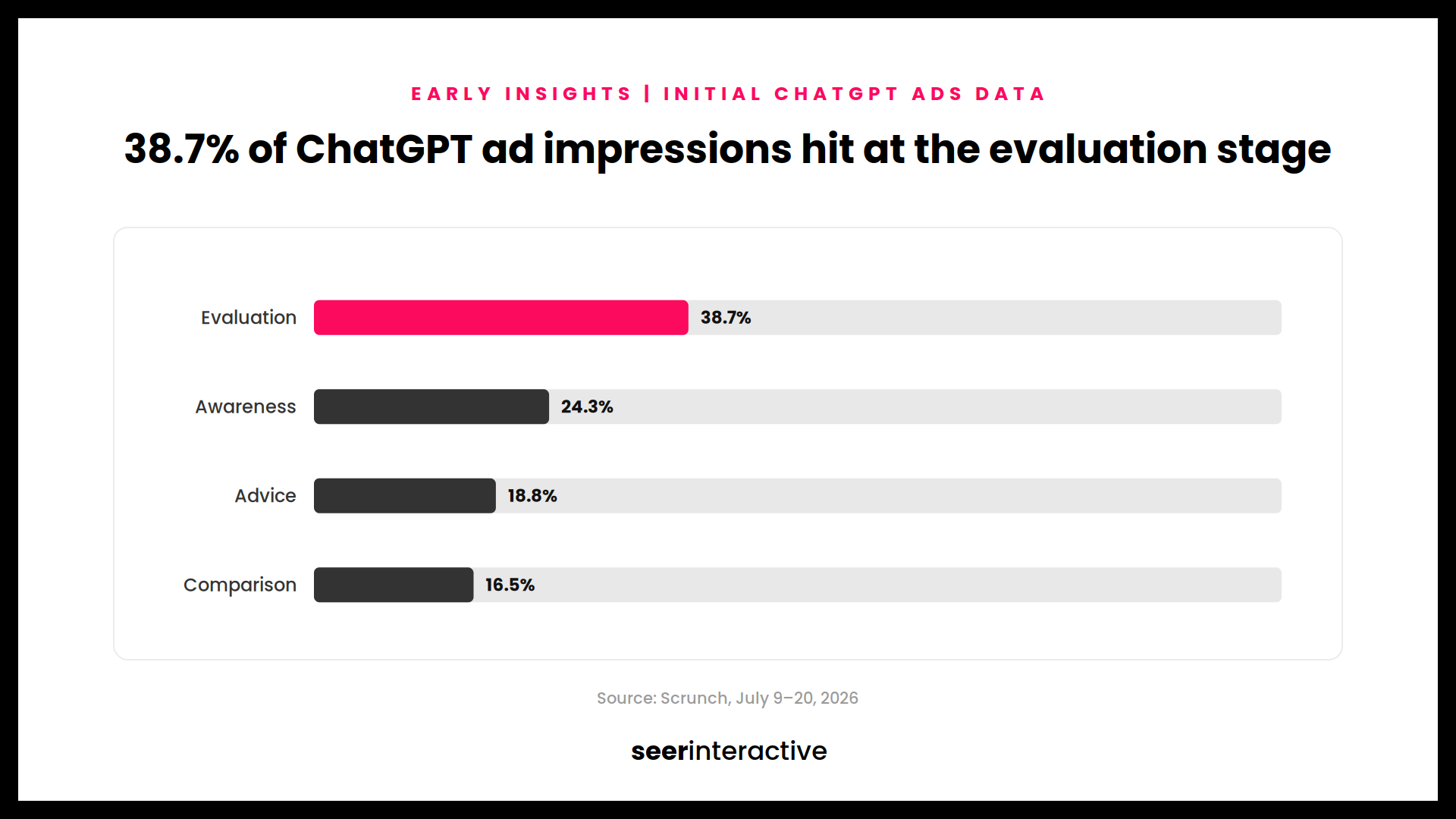
Intent breakdown has stayed stable since our last pull, with top of funnel (Awareness and Advice) making up over 40% of impressions:
-
Evaluation: 38.7% (previously 41.9%)
-
Awareness: 24.3% (previously 22.3%)
-
Advice 18.8% (previously 19.1%)
-
Comparison: 16.5% (previously 16.7%)
Advertisers are already running these as both lead gen and brand awareness plays across the funnel within the prospective customers own ChatGPT context.
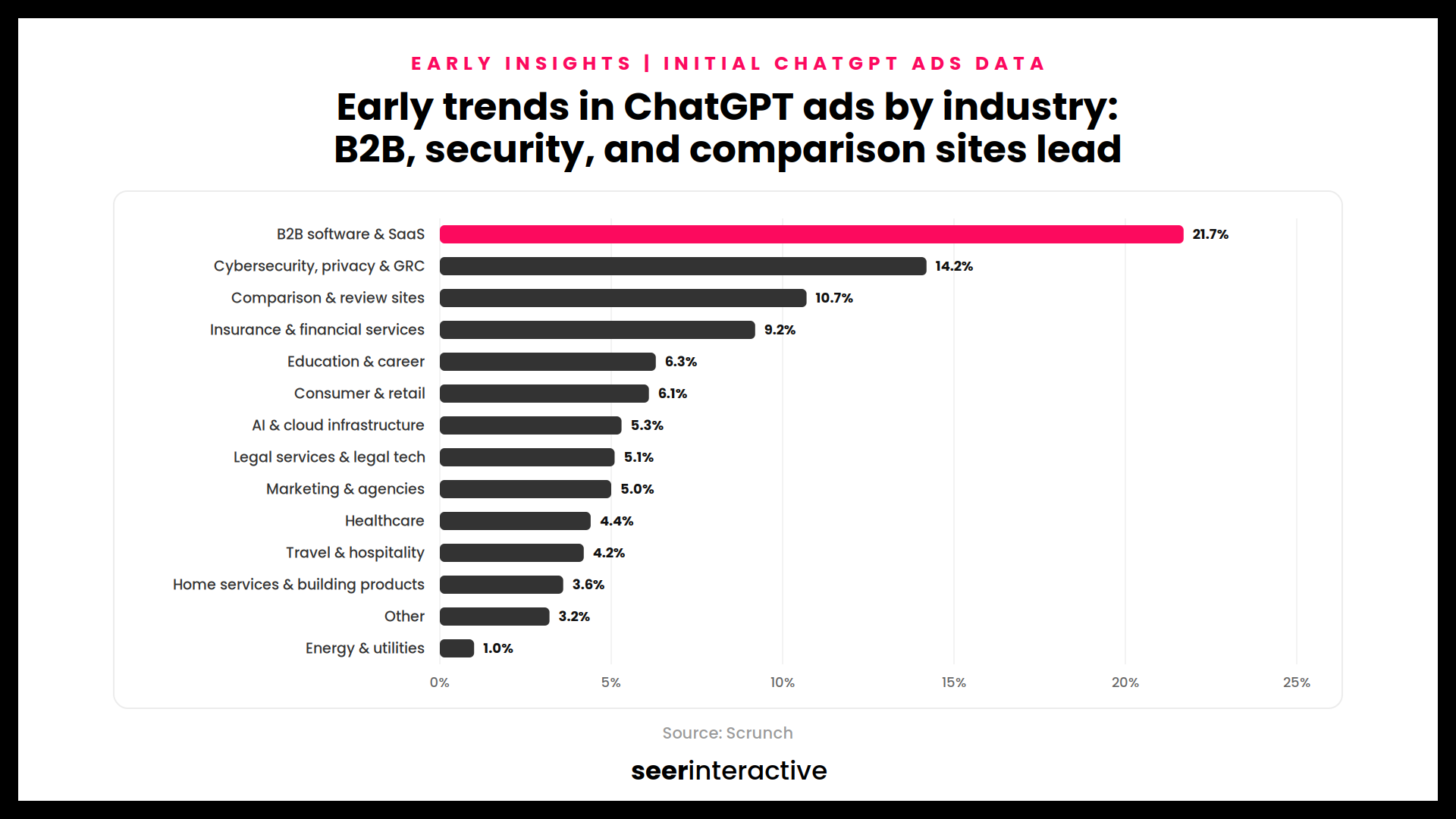
Ads are showing across nearly every industry we track and spend is still heavily front-loaded in software and services.
- B2B Software and SaaS leads at 11,072 impressions making up 21.7% of total impressions.
- Cybersecurity, privacy and GRC had 7,216 impressions, 14.2% of total
- Comparison and review sites had 5,466 impressions, 10.7% of total
These are the fast movers you would expect to test a new channel first, so we are reading this as who is quickest to adopt, not where ads will ultimately concentrate.
Several other industries are ticking up their impression share in ChatGPT ads and testing early:
-
- Insurance & financial services gained 4,688 impressions, 9.2% of total
- Education & career gained 3,196 impressions, 6.3% of total
- Insurance & financial services gained 4,688 impressions, 9.2% of total
-
- AI & cloud infrastructure gained 2,674 impressions, 5.3% of total
-
- Consumer & retail gained 3,090 impressions, 6.1% of total
-
- Legal services & legal tech gained 2,594 ad impressions, 5.1% of total
-
- Marketing & agencies gained 2,570 impressions, 5.0% of total
-
- Healthcare gained 2,246 impressions, 4.4% of total
-
- Travel & hospitality gained 2,159 impression, 4.2% of total
- Home services & building products gained 1,813 impressions, 4.4% of total
-
- Energy & utilities gained 506 impressions, 1.0% total
2. Branded prompts are unclaimed
As of our first report, only 2.2% of a brand's prompt responses featured its own ad. About two weeks in, that data point rose to 7.3% - leaving the majority of placements still sitting open.
That is not brands losing a bidding war. Most of them are not running ChatGPT ads yet at all, so their branded prompts are simply sitting open. Nobody is defending "should I get [your brand] or [their brand]" because they’re just not in the channel yet.
That puts a familiar paid search question in a new place: should you advertise on your own branded prompts? Right now the slot is uncontested and a rival can take it without outbidding anyone. We specifically saw one example of a competitor using an ad to guide the user in another direction with "Looking Beyond [Brand]? Try [Competitor]" on the branded prompt.
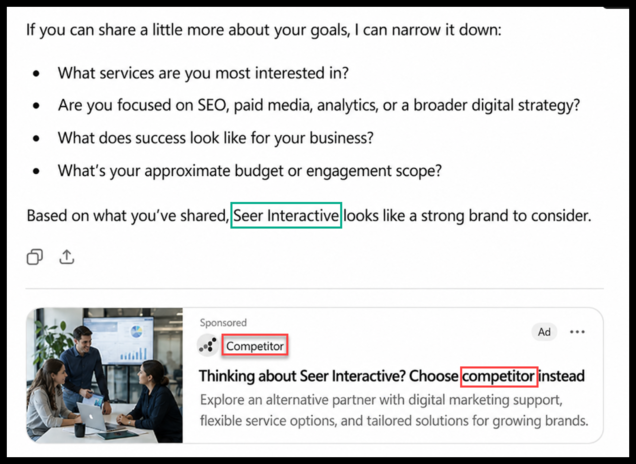
3 months ago, winning the recommendation in ChatGPT's response was the win and a sign your GEO strategy was paying off. Now there's a new obstacle between your brand and being chosen.
Monitoring what AI says about you in its responses is no longer enough, you also need to watch what your competitors can say about you.
With ad volume climbing fast. If you are not claiming your branded prompts, someone else will be doing it soon.
3. The advertiser is in the organic response only 5% of the time
Across 3,697 ads, the advertiser appeared in ChatGPT's actual response 5.4% of the time (5.0% as of July 9) and was cited as a source 3.3% (2.0% as of July 9).
Think about what that means for the person reading the response. ChatGPT recommends a brand, and directly underneath sits an ad for someone else offering an alternative. Traditional search never created that moment, though AIOs are certainly starting to create a similar AI answer to ad tension.
[Check out our 2026 update on AI Overview impact on Google CTR for more on how AI is affecting traditional search.]
Depending on where your brand stands, that cuts two ways.
On one hand, if you are not showing up in the organic answer, the ad slot gives you a way into a query that matters to you while you build that visibility. If you are the brand being recommended, someone else's ad can now sit under your best moment.
Either way, the work is the same: getting your context targeting right so you are showing up on the prompts that actually fit. The advertisers winning early are treating this less like display inventory and more like search, using what they know about their prompts and their organic visibility to pick their spots. That gap between the ad and the answer is where we will be testing.
4. Ad/response alignment with responses is improving
We created a rubric to evaluate how aligned each ad was to the ChatGPT response above it. This lets us see how direct or out of touch an ad is, which hints at both the advertiser's strategy and how ChatGPT's targeting works.
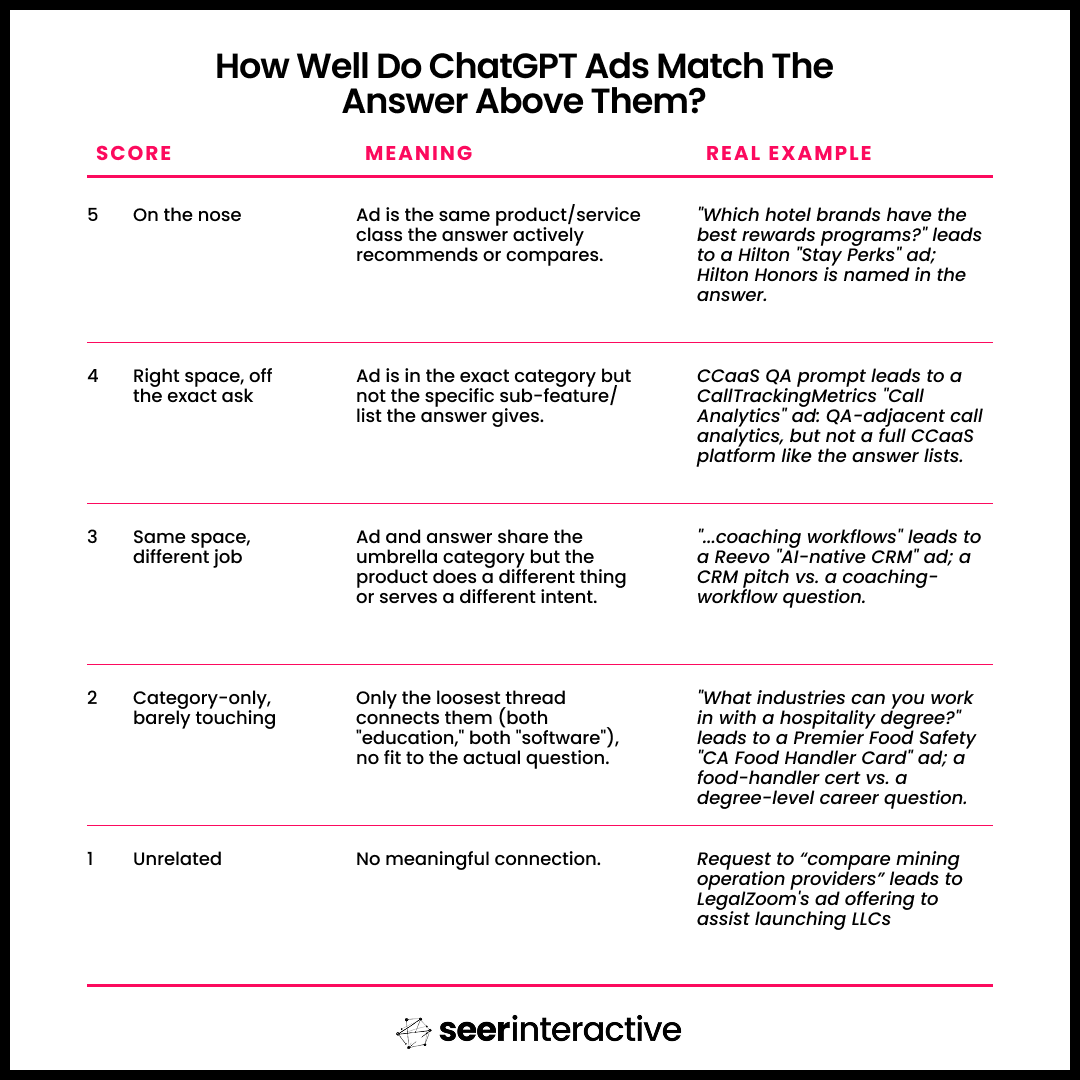
Alignment averages stayed stable at 3.29 out of 5 (previously 3.39/5). However, the breakdown of which scores the ads fall into have shifted and indicate that ad alignment is improving.
-
On Topic (scores of 4-5): Dropped from 50% to 38%
-
Category-Adjacent (scores of 2-3): Increased from 28% to 58%
-
No Meaningful Connection (score of 1): Dropped from 22% to 4%
Some buyers are treating ChatGPT Ads like display: going wide for impressions in front of what they hope is the right audience, even when the context is off. Think of it like a banner ad following you into an article it has nothing to do with. In our first data pull, Monday.com is the clearest case, with the most ads in our dataset and a 2.7 average alignment, including 21 placements on law-firm related prompts.
Others are treating it like search. In our first data pull, CrowdStrike concentrated its ads on data-security questions and landed a 3.6 average by picking its spots.
5. Aggregators already make up 11.6% of the ads
Affiliate and aggregator sites like BestMoney, Top10, and Insurify make up 11.6% of the ads we saw (down from 16.2% in our first pull) , and they are placing them with high alignment: BestMoney (~4.5) and Top10 (~4.3) are more on topic than most of the direct brands beside them, with BestMoney owning banking and insurance prompts and Top10 owning education.
These are some of the same "best X" players who have been losing organic ground and citations for their listicle content. Now they are buying their way back into the answer through paid.
The open question is whether they’re outbidding everyone to protect their awareness in AI or if these are simply unclaimed by the brands. If it’s the former, this could make those placements expensive fast for the brands sitting next to them.
So what should brands do now?
Based on this early data, as well as what we've learned by running ChatGPT Ads for our owner clients, here's what we recommend:
- Go look at your branded prompts today. Run the prompts that matter to your brand in a free ChatGPT account and see whose ad shows up. Right now the answer may be nobody, but the window where your branded prompts sit unclaimed will not stay open.
- Know what the answer says before you buy the space next to it. Your organic AI presence and your paid placements are now one conversation, so audit what ChatGPT actually says about you and your category first.
In one B2B client audit, we found zero content on ROI, pricing transparency, or competitive comparisons. Competitors owned all three in AI responses. Running ads on top of that would have had a negative brand impact, and wasted spend.

Read more about why you should track organic reputation as a part of your paid strategy here. - Go in with a testing plan, not just a budget. The risk is not the spend, it is spending it without structure and coming out with no real learning. Define what you are testing before you launch, like a display approach or a context aligned approach. Know what and why.
- Watch the platform week to week. Audience list targeting launched the same week we captured this data, and the creative formats are already shifting. What is true about ChatGPT ads this month may not be true next month.

.png)
.png)