

Brands investing in how-to and explainer content in 2026 are building for search engines that answer questions, not refer traffic. I analyzed 247 blog posts and this data heavily suggests original research earns more AI referrals than the listicles and guides that served as safe fluff in every content strategy since the dawn of SEO.
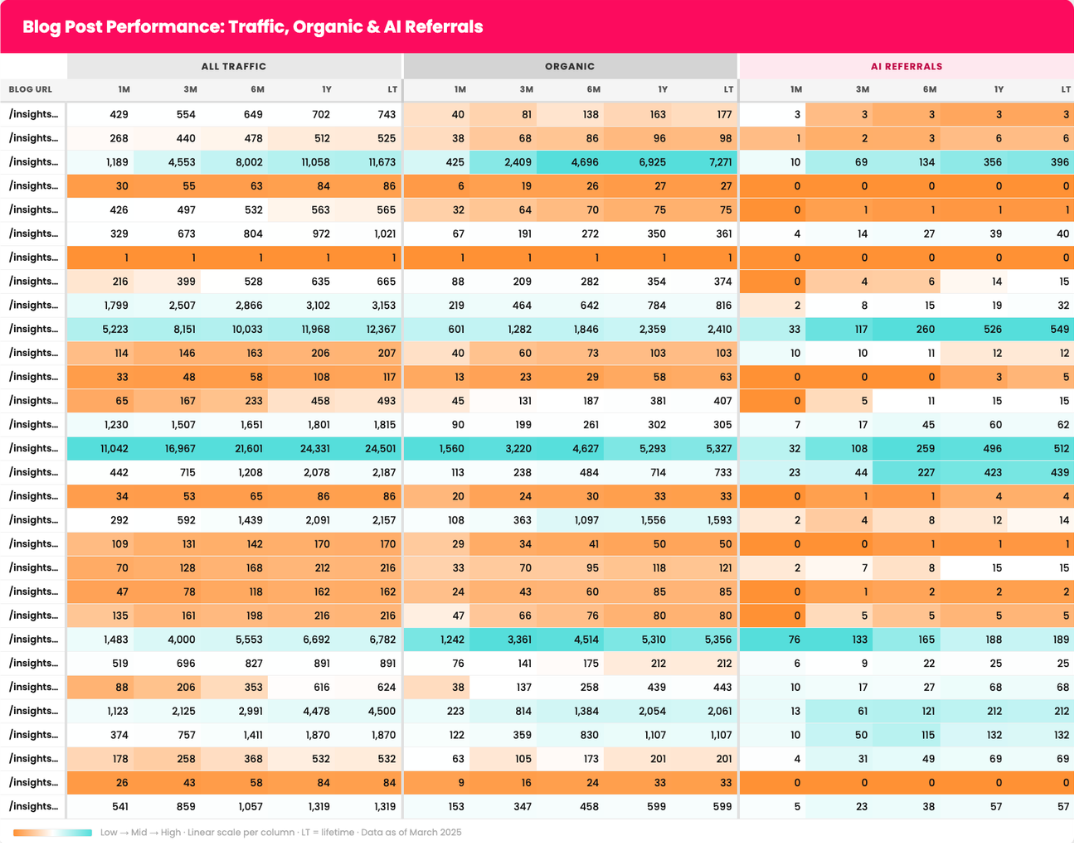
What started as a new method to view how content performed over time, resulted in an interesting finding: there really might be a correlation between organic content performance and AI referral traffic. So I took the analysis a step further and ran a Spearman correlation analysis.
TL:DR; they are strongly correlated. But the more interesting story is where they diverge.
First, The Data
I analyzed 247 blog posts published between January 2024 and December 2025, using daily views from Jan 1, 2024 to Feb 28, 2025, tracking three traffic sources at five time intervals (1 month, 3 months, 6 months, 1 year, and lifetime):
- All Traffic
- Organic Search
- AI Referrals (ChatGPT, Perplexity, Copilot, and other LLM-based tools)
We used Spearman's rank correlation (a statistical test that expects outliers in the data and assumes a normal distribution) to measure how closely organic and AI referral rankings move together.
The Correlation Grows Over Time
Every result is statistically significant (p < 0.0001), but what makes this particularly interesting to me is that the correlation gets stronger over time.
At one month post-publish, organic and AI referral traffic are somewhat aligned. After a year, you can see the correlation at a glance (that’s what started this whole study). This implies AI tools don’t blindly trust new content, and instead favor content that has established credibility.
The practical implication: creating valuable content that performs well in search is a fundamental element of AI visibility. It's not an either/or.
But Organic Rank Doesn't Guarantee AI Traffic
When we sliced posts into organic quintiles and looked at average AI sessions, the relationship holds — but with notable variance:
The jump in Lifetime Session volumes from Q4 to Q5 is dramatic. But notice that the organic traffic median for Q5 is only 75 sessions — meaning even top organic performers vary widely in how much AI referral traffic they attract. Something beyond organic rank is determining AI visibility.
The First-Party Multiplier
When we looked at which posts punch above their organic weight in AI referrals, a clear pattern emerged: first-party research received a significant multiplier.
These posts are getting more AI referral sessions relative to their organic rank than almost anything else in our dataset. LLMs are actively citing content about our research, and people are likely clicking to learn more about our methodology and findings beyond what the summary showed.
Want to see how much AI traffic your site is getting? This Looker dashboard can tell you in a few clicks.
Where High Organic Traffic Doesn't Convert to AI Referrals
The opposite is even more interesting (and should be terrifying if your pipeline looks like this). Some of our strongest organic posts get very little AI referral traffic:
These are high-intent, tactical how-to posts — and they're exactly the type of questions that are solved in a session with ChatGPT, Perplexity, or even Google’s AI summaries without ever clicking through to a source. Strong organic rank isn't enough if the query is being answered in a summary
Let’s look closer at the data though:
This blog EXPLODED in organic search. Traffic grew almost consistently MoM… until April 2025. Suddenly, it stopped - it went from nearly 3,000 views a month, to 7,000 views in nearly a year. Either someone took over the SERP position or, as I suspect for a pretty straightforward question like “how do I find my Sitemap?”, AI results just gave users the answer they needed.
What This Means for Your Content Strategy
1. Organic fundamentals still matter for AI visibility. The 0.82 lifetime correlation means that a well-executed organic strategy isn't wasted in the AI era. It's still the foundation.
2. First-party research and studies earn a bonus. If you're the source of truth, the original creator of a study, performed valuable research, etc. expect AI referral traffic to outperform what your organic rank alone would predict. These are the articles that require more attention than .
3. Scrap every piece of content you have planned that starts with “how to”, “what is”, “5 of the best”, “where to find”.. You get the idea. Posts answering simple procedural questions are increasingly getting their answers absorbed by AI tools. High organic traffic on these posts don’t translate to AI referrals and are likely to disappear altogether as AI handles the questions in-session.
4. Don't expect instant AI visibility for new content. The weak 1-month correlation (0.47) compared to the strong lifetime correlation (0.82) suggests AI tools are conservative about citing new content. Building AI referral traffic appears to take time and organic credibility.
A Note on Methodology and Limitations
A few things worth knowing before you take this data to your next strategy meeting. Not that I don’t trust the data, I just believe in being thorough.
Why Spearman? We used Spearman's rank correlation rather than Pearson because it doesn't assume the data is normally distributed - which is important because the lifetime values of the organic traffic alone are: median = 136, mean = 1,171, and max is 74,730. With a dataset that looks like birdshot on a scatterplot, Spearman is one of our only options. For context, removing our single biggest organic outlier (a post with 74K lifetime organic sessions) moved the lifetime correlation from 0.824 to 0.822. The finding isn't dependent on any one post.
AI referral traffic is undercounted. This is the most important caveat. A meaningful portion of traffic that originates from AI tools never gets attributed correctly - it arrives as direct traffic or gets lost entirely. This is the floor, not the full picture. The true correlation between organic and AI referral performance may be even stronger than what we're reporting here.
Correlation isn't causation. Organic success and AI referral success are probably both downstream of the same thing: content that is genuinely useful, well-sourced, and topically authoritative. We're not arguing that ranking well in Google causes AI tools to cite you — rather that the same content qualities tend to earn both.
It’s still early. This is the first round of my research and AI is still changing rapidly. We’ll continue to research why AI chooses the content that it does, but we’re well aware that this could change next quarter (or week).
The Bottom Line
Think of organic performance as a prerequisite, not a guarantee. The posts that win in both channels tend to be well-established, authoritative, and original perspectives or analysis substantive enough that AI tools want to cite them rather than just answer the question themselves.
The divergences, AI overperformers and underperformers, are where the real strategic signal lives. If you have posts with strong organic traffic but minimal AI referrals, it's worth asking whether those queries have been absorbed by AI tools. And if you're producing original research, expect that work to travel further than its organic rank alone would suggest.
[Analysis based on 247 blog posts published January 2024–December 2025. Spearman rank correlation used throughout. All results statistically significant at p < 0.0001.]
Questions about this data or methodology? Contact us.

.png)
.png)