Your SEO team is already measuring brand visibility in AI search.
They're tracking which AI prompts mention your brand, monitoring citation rates, and investing in the earned media that makes AI more likely to mention you when buyers ask questions in your category.
And if you ask them how to improve visibility, the answer sounds like brand building: show up on trusted third-party sites, get cited by credible sources, and build a footprint across the web that AI can recognize and reference.
But here's what almost no one in paid media has said out loud yet: that's also a paid media strategy.
Let’s talk about why paid media should be investing in AI visibility, and why brands who don’t will fall behind.
The Attribution Problem Hiding in Plain Sight
Most marketing teams haven't fully reckoned with the fact that your attribution model has been hiding your brand's contribution to performance.
Last-click models reward the final touchpoint; the paid search click, the retargeting ad, the branded query that closed the deal. Yet brand awareness efforts and programmatic campaigns remain invisible in conversion reports.
While this isn’t a new problem, AI search has made these challenges significantly worse because of one key reason: attribution (or the lack thereof).
The Seer team has conducted extensive research and experiments to better understand brand visibility and citations in AI platforms. We’ve identified a few key gaps as to why AI marketing efforts fail to show up in attribution models.
1. The Limits of Direct Traffic Attribution
A meaningful portion of traffic that originates from AI tools never gets attributed correctly. Instead, it often arrives as direct traffic or gets lost entirely. What you can measure is the floor, not the full picture.
A buyer who researched your category in ChatGPT, formed a preference based on which brands appeared in the answers, and then navigated directly to your site shows up in your analytics as direct traffic. The AI influence, and the brand investment that earned it, is completely invisible.
2. The Ghost Citation Problem
Seer research shows that AI platforms like ChatGPT, Google's AI Overviews, and Claude are now contributing to dark traffic (clicks that carry no attribution information whatsoever). The consideration your brand built before the measurable click never appears in your dashboard.
Both attribution failures are hiding the same thing: brand influence that happened before the conversion. The reason brand investment keeps losing is because the measurement systems most teams rely on were never designed to see it.
Cost-Per-Click Is Eroding Because of AI Search
AI has made the cost of ignoring the brand awareness problem impossible to deny.
In one of our recent studies, we found that organic CTR has plummeted for queries with AI Overviews, while paid CTR efficiency has declined sharply — dropping from 19.70% to 6.34% for AIO queries between June 2024 and September 2025. While that paid CTR has picked up since then, AIOs seem to still diminish paid CTR when compared side-by-side.
Your cost-per-click may not have changed, but the efficiency of every click is eroding. The brands that show up inside AI answers before the click are the ones protecting their performance.
The solution isn’t to avoid AIOs. Instead, paid media teams should shift focus from measuring traditional rankings and traffic toward authority and brand visibility.
Why AI Visibility Is a Paid Media Conversation
When SEO and GEO teams talk about building AI visibility, they recommend brand-building tactics: PR outreach, earned media, publisher partnerships, authoritative content that earns third-party citations, etc. We know brands that consistently invest in these high-effort, high-reward plays will be the ones that show up when AI answers questions in their category.
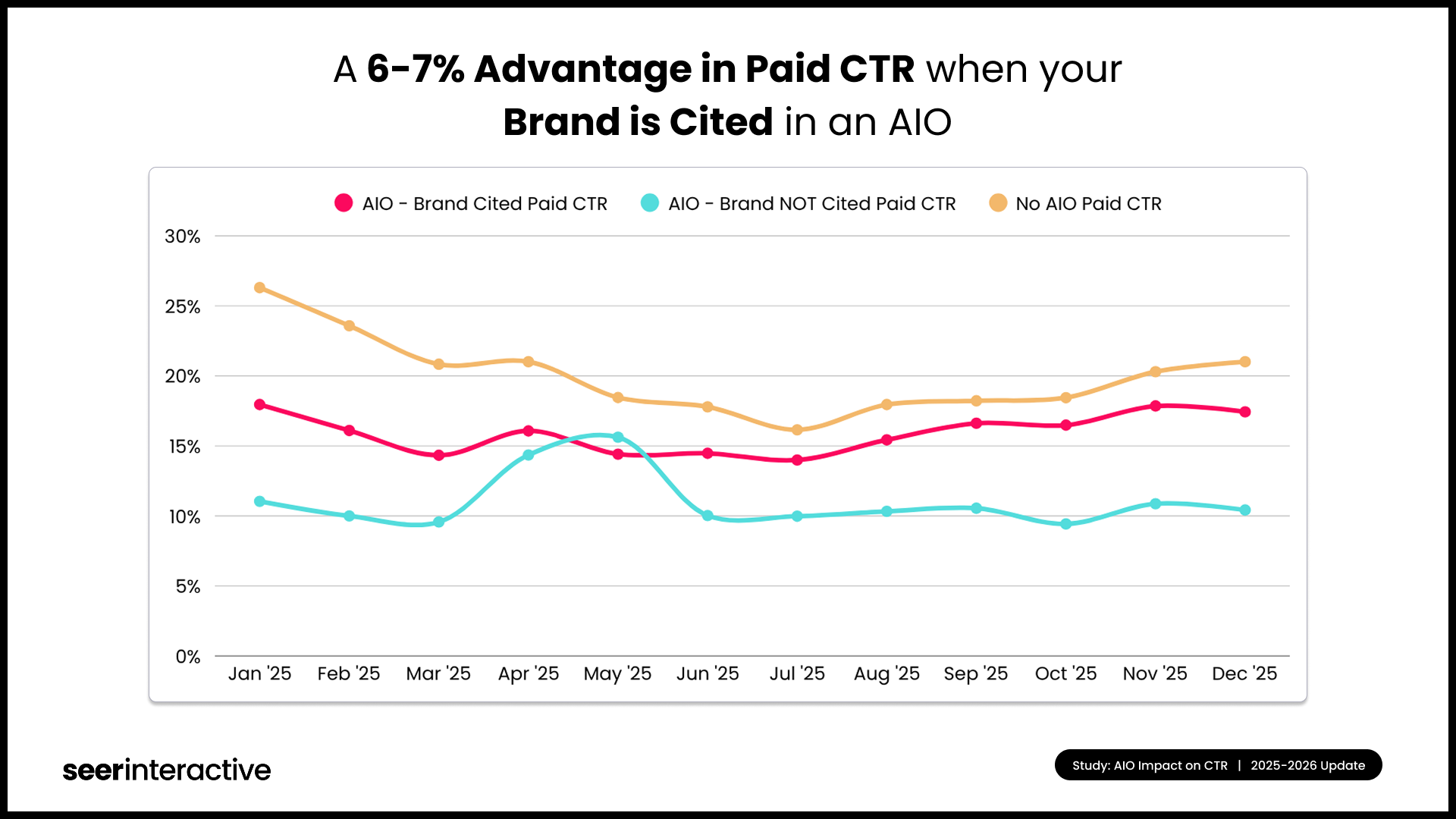
And guess what? When a brand is cited in an AIO, they get a 6-7% advantage in paid CTR. There is a direct correlation between brand awareness → brand visibility → performance media results.
Brand advertising does something remarkably similar at scale, with targeting, and with a budget that can be planned and adjusted in real time.
Seer's research into what drives brand visibility in LLMs found that brand awareness has a meaningful correlation with how often a brand appears in AI-generated answers. The more a brand appears on trusted sites, the more likely LLMs are to crawl and cite it. Known brands get picked up in credible news and industry coverage more often, and that coverage feeds directly into what AI surfaces.
Advantages of a Full-Funnel Awareness Campaign
A well-run programmatic awareness campaign places your brand across the premium publisher inventory that AI search treats as trusted sources. These campaigns grow branded search volume (itself a signal that correlates with LLM visibility) and create the broad, consistent digital footprint that AI models associate with established, credible brands.
This effect is strongest in verticals like banking and finance, where trust drives decisions and AI tends to surface recognized brands over lesser-known alternatives. If credibility is what your buyers are evaluating, brand investment determines whether you're in the AI answer.
Your SEO team calls this brand building, GEO calls it AI visibility infrastructure, and paid media calls it a brand awareness campaign. They're all describing the same outcome, even though most organizations are only funding two of those three strategies.
Brands That Pivot Are Seeing a Positive Impact on the Sales Funnel
We’ve seen firsthand what happens when organizations close this gap. One brand with minimal top-of-funnel investment and rising customer acquisition costs pivoted to a full-funnel programmatic strategy leveraging CTV, display, and native ads.
The brand saw a 57% decrease in cost-per-qualified-lead (CPQL) on brand search the month after launch, and a 135% incremental lift in qualified leads.
Another brand that had maxed out returns from Google and Facebook evolved from a performance-only model to a full-funnel cross-channel strategy. This led to a 270% increase in annual revenue over the following years.
These results didn't come from better targeting or smarter bidding. They came from investing in the brand presence that made every downstream performance dollar more efficient, and from finally giving credit to what was working upstream all along.
How Brands Can Close This Strategic Gap
Performance campaigns harvest demand. Brand campaigns create it, protect it, and increasingly, feed the AI systems that shape how buyers think about your category before they ever type a search query.
The brands that are hardest to displace are the ones buyers already know before the search starts. That recognition compounds over time in ways a performance campaign alone can't replicate.
In an environment where AI referral traffic converts at significantly higher rates than organic search (but remains largely invisible in standard attribution), the brands investing in awareness now are building an advantage their competitors won't easily see coming.
Steps Your Brand Can Take Right Now
1. Track AI visibility
This is a great proxy for understanding how visible your brand is and how it's being perceived by your audience. Monitor the prompts where AI platforms cite your brand, how often your brand gets cited compared to top competitors, and what narrative AI tells when it mentions you. We use Scrunch and Semrush to help monitor Seer’s AI visibility, but there are other tools as well.
2. Set up cross-channel attribution systems
Google released a beta for attributed brand searches so you can see how upper-funnel media (i.e. YouTube) impacts searches for your brand after viewers see the ad. DSPs like StackAdapt have capabilities like cross-channel attribution that show the impact of programmatic ads on conversions from other sources. Media vendors are becoming more aware that this kind of data is a must for validating brand visibility efforts.
3. Make the jump to brand spend
It’s scary to step away from performance media like paid search when your current reporting systems say paid drives most of your conversions. But if you’re noticing conversions plateauing, CPCs rising, and your bottom line taking a hit, it may be time to try something new. Consider setting aside budget for a specific market or LOB to flood the market in a more upper-funnel media. Then ask:
- Are you seeing brand search increase?
- Are you seeing paid search cost per conversion decrease?
- Does LLM visibility change over time
These are questions that you can test against to help move the needle. Use this brand awareness diagnostic checklist to see if you’re in a position to invest in brand.
If your paid media and GEO strategies are running in separate lanes, we can help you bridge the gap. Let's talk about what a connected brand investment strategy looks like.

.png)