

One year ago, we had a big problem: we’d let an increasing amount of basic account management responsibilities slip. Emails that were received but not acknowledged. Promises to follow up after a call going unmet.
Since 2023, we have been pushing the team hard to understand the importance of evolving into an AI-forward agency. We’re all trying to evaluate the jagged-edge of AI and identify what works well and what doesn’t. That’s time-consuming and mentally draining. The team’s cognitive load was maxed out. People were trying their best, but coming up short.
After diving into our own client health data, we realized these missed responsibilities were adding up. So we looked for a solution to help our team continue evolving with AI while upholding our standards for client relationships. In a not-so-surprising twist, we used AI to solve it.
The Impact of Stretching Our Team to the Limit
We track the health of our client relationships compulsively. It’s a big reason why we’ve maintained over 90% retention for the last several years. Once we noticed a pattern of slipping account responsibilities,we used data to confirm the feeling in the air: We were letting our clients down by overlooking the little things.
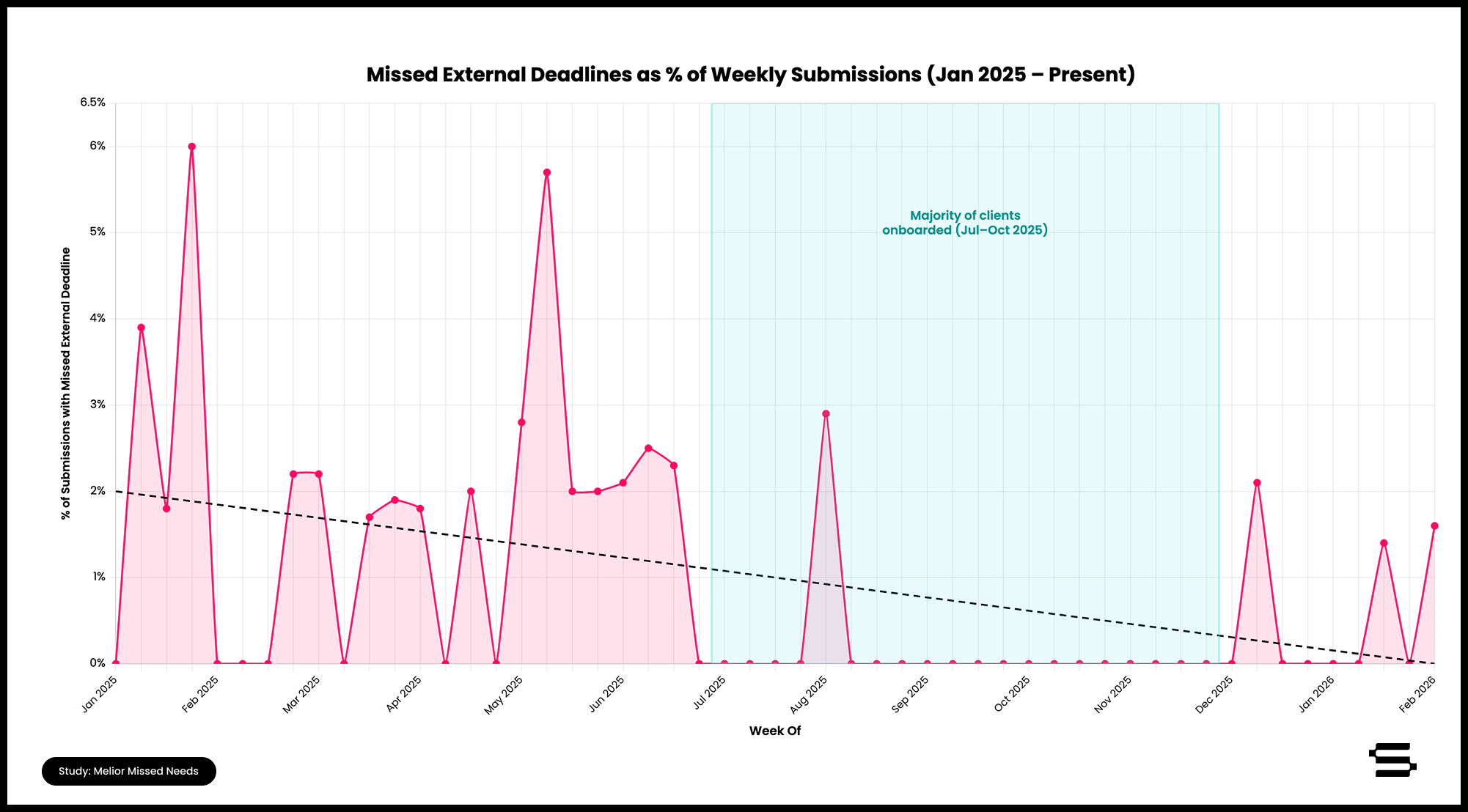
At the peak of this issue, 6% of our clients experienced a missed deadline in one week. We knew that was unacceptable, and we addressed it as we always do: with transparency, accountability, and open communication. The more we discussed it, the more the trend weakened, but we remained at unacceptable levels.
How We Used an AI Consultant to Tackle Missed Account Tasks
We believe one of the best investments you can make to improve your AI readiness is with a great consultant. Ours is Melior. They’re thought partners, architects, and developers who act as an extension of our team.
We brought the problem to their team and quickly began formulating a system:
Raw Data:
- We mostly recorded client calls with Zoom Revenue Accelerator (ZRA). Accessible via an API, but that was easier said than done.
- The majority of our clients communicate with us on Basecamp. Also accessible via an API.
Inputs:
- Raw data is great, but messy. Melior identified an opportunity to ingest the above content into a vector database so we could extract unaddressed needs, requests, and commitments.
- This required a significant amount of calibration to identify the right prompt structure and sequence to hone in on the signal and ignore the noise.
Outputs:
- The tool they developed mined the communications, looked for follow-through, and if it was absent, sent an alert.
- Missed needs were organized and sent as notifications to our internal team’s client specific Slack channels.
- These alerts were not accusatory, they were framed as a helpful reminder.
- All client conversations were pulled from ZRA’s API and organized into Google Drive folders, which is handy to have in and of itself.
The results of our pilot were compelling. We consistently saw a downward trend of missed needs alerts once the system was established. In other words, we saw a change in behavior.
Scaling the System
After running a successful pilot, we knew we wanted to roll this out to as many clients as possible. We did have to invest further, in both resourcing with an internal owner as well as additional support from Melior.
In a few months, we had a robust system:
- 79 clients onboarded
- 900+ notifications sent
- 1,800+ action items surfaced
- 1,700+ ZRA transcripts processed
- 21,000+ Basecamp messages logged
Impressive coverage, but our goal isn’t in the volume of notifications sent or identified. We needed to see this activity result in business impact. So, we turned back to our client health data to see the impact over time:
Building Stronger Client Relationships and Better Team Workflows
This tool has a positive effect on our team as well as our clients. As team leads, it helps us address specific issues, while account teams have a backup system to ensure no commitments are missed. And when the Missed Needs report was delayed, account teams asked about it. This immediately became part of the team’s workflow.
About 95% of the time, the report doesn’t give us anything new, but that 5% is invaluable to remind us of something missed. Clients have even reported sleeping better at night because of this change.
Perhaps the most exciting part is the byproducts of success. Not only did the system we built succeed in what we set out to do, but we developed extremely helpful tools and products along the way.
- Call Transcript MCP: When word got out that we had call transcript data available at scale, everyone’s gears were turning. This quickly sparked the idea for our Call Transcript MCP, a custom MCP that enables the team to tap into client call data to identify themes, validate hypotheses, and better understand our clients’ needs.
- Cross-Client Trend Identification: With the foundation built to surface missed needs, we realized we could also surface trends impacting our clients more broadly. This enables us to prioritize the right solutions at the right time.
- Client Vault: Since 2023 we have had a vision for a Client Vault. A way we eliminate the pain of account team transitions by indexing all relevant data, insights, and experience. We aren’t there yet, but this work propelled us forward.
All of this gave us confidence in continuing to invest in solving problems that will directly help our clients. It’s a tumultuous time for agencies, and we firmly believe the shops that survive the AI wave will be the ones that focus on creating value more so than creating efficiencies.

.png)
.png)