
TL;DR
-
We ran 20 prompts through OpenAI's API and tracked every step and reasoning summary to understand why it picked some brands and ignored others
- In our prompt runs, fewer than 1 in 10 brands were named before ChatGPT runs a single search (AKA around step 4 in the process)
-
ChatGPT searches brand websites infrequently after its first search round (13% of queries) but most of the time in later rounds (75%)
-
We identified 5 main reasons a brand gets excluded: prompt-brand mismatch, brand website is missing info, known brand weakness, trust concerns, or too far down the shortlist
How Does ChatGPT Decide Which Brands Make the Cut?
Wouldn’t it be nice if we knew where ChatGPT citations came from? Or why ChatGPT searches for those specific fanout queries? For over three years now, we’ve been peeling back the layers to better understand how ChatGPT responses come together.
First, we tracked AI visibility to understand whether your brand shows up at all. Then we focused on citation data and which brands were being sourced. After that we moved on to query fan-outs, which show how those citations are being selected.
But many of the discussions we’ve seen talk about fan-outs as if those searches happen simultaneously.
When you dig into ChatGPT’s reasoning, you can see a chain of thought that runs from the prompt all the way to the final response. Looking at the steps of this reasoning chain can help you understand which brands get mentioned, and why.
In this post, we’ll walk through how ChatGPT’s reasoning works, reasons that explain why your brand isn’t showing up, and how to fix it.
ChatGPT’s Reasoning Is a Signal
Reasoning is exactly what it sounds like. It’s how ChatGPT decides on the criteria for its answer:
-
What matters for this question
-
Which sources to trust
-
Which brands should and shouldn’t make the list
ChatGPT’s reasoning isn’t that different from how people think. If you were buying an e-bike to commute from North Park to downtown San Diego and ride trails on the weekend, you wouldn’t start by browsing bikes. You’d think about the hills on your route, check whether e-bikes are even allowed on the trails you ride, and only then decide which features matter.
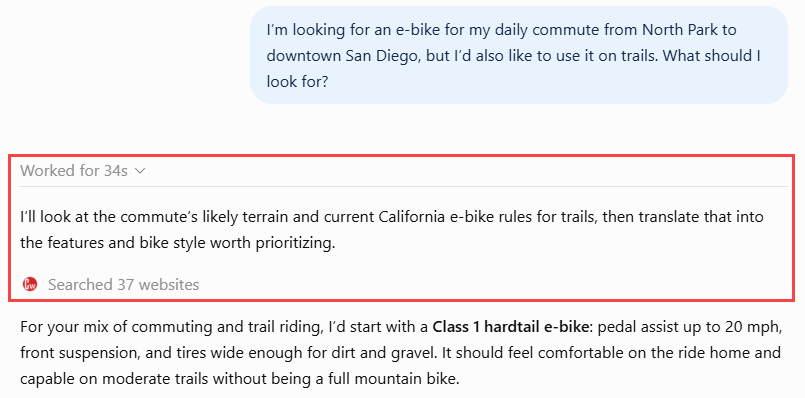
If you’re a brand that sells e-bikes, ChatGPT’s reasoning can tell you a lot more than reviewing cited URLs.
ChatGPT decided the shortlist of options it will mention should come down to a set of criteria, like the terrain of the commute and California’s trail rules. Understanding the reasoning helps you see what those criteria are, so you have a higher likelihood of being visible in those searches and reinforcing signals ChatGPT is searching for on your own site.
In the app, the reasoning is tucked behind “Worked for 34s” and shown in short form. That’s why we’re going to use the OpenAI API, which shows a summary of every reasoning step in the chain.
The API is directional to what actually happens in ChatGPT’s user interface. And while these results might not be 1:1 with what users are experiencing, why not take action on the direct hints ChatGPT is providing?
The Flow of ChatGPT’s Reasoning
To better understand ChatGPT’s reasoning, we ran 20 real prompts on November 4, 2026 through OpenAI’s API and read every reasoning summary ChatGPT wrote along the way. We used GPT-6 Luna at medium reasoning to align with ChatGPT’s default model. Medium reasoning was used due to its response and citation results corresponding to the app at the closest rate to other model settings tested.
What we found is that ChatGPT runs through several rounds of searching and reasoning before answering. Let’s break down what each of those steps looks like.

Step 1: The Prompt
This is the start of it all. ChatGPT starts its reasoning after a user submits a prompt.
One of the prompts we looked at was about home insurance in Georgia:
“Which home insurance companies are most recommended for homeowners in Georgia, and why do they stand out?”
Step 2: The First Reasoning Step, Where ChatGPT Builds the Plan and the Source Rules
Depending on the prompt and your industry, ChatGPT can name those credible sources outright.
For our Georgia home insurance prompt, it planned to: "check credible sources, including the state insurance regulator, a ratings agency, and an insurance association."
Step 3: Broad Searches
Next ChatGPT moves to broad searches, which include a lot of "best of" and "review" queries. These are what surface the listicles commonly discussed in AI citations, along with other articles.
For our example, its first round of searches had fan-out queries like “best homeowners insurance companies Georgia 2026 recommendations” and “Georgia homeowners insurance companies customer satisfaction [a ratings agency] 2025.”
Step 4: The Second Reasoning Step, Building the Shortlist
In its next reasoning summary, ChatGPT starts naming brands for consideration. In our analysis, it usually names about eight options but ends up mentioning about six in the final response.
In our prompt runs, fewer than 1 in 10 are named before ChatGPT runs a single search. Most brands (59%) showed up right after the first round of broad searches, which is why retrieval and being visible on retrieved pages matter so much. The rest get added in later rounds.
This is also where ChatGPT adds conditions an option has to meet. About half of these reasoning notes add at least one, like “Looking into B2B SaaS routing and CRM integrations is key too.” Then it decides what it still needs to check.
After reading a personal-finance site’s Georgia guide, it wrote, “I’m considering a list of five insurance companies,” naming five insurers and flagging a sixth that “might stand out for low complaints.”
Step 5: Targeted Searches
Once it has a shortlist, ChatGPT sends out more searches aimed at those specific brands, often using the site: operator to search just one website. In GPT-6’s first round of searching, only 13% of queries do this. In later rounds, 75% do. It finds brands on broad searches, then often goes to their own websites to check them.
In our Georgia example, the targeted check went directly to another personal-finance site’s Georgia guide to verify its shortlist.
Step 6: The Last Reasoning Step, Where ChatGPT Trims the List
Before it writes the response, ChatGPT writes one final note where it trims the list and excludes some of the brands it found. In our prompt set, 38% of these final notes give a reason to drop or exclude an option from the set it will show the user.
Right before writing the response, it wrote, “[An insurer] could be optional, but we might trim that,” and decided to say there’s “no universally best insurance” rather than crowning one winner.
Step 7: The Response
Based on all of its searching and reasoning, ChatGPT serves the final output that users see.
The final response recommended the five insurers from ChatGPT's shortlist. The sixth, the one it said it “might trim,” didn’t make it.
So, Why Does ChatGPT Exclude a Brand?
After reviewing the flow from prompt to response for the prompts analyzed, we identified five primary reasons why ChatGPT excludes a brand.
Reason 1: You Don't Fit the Exact Prompt
Your brand isn’t a bad option, it’s just the wrong kind of option for this prompt. Your brand is built for a different buyer or use case, or you don’t serve the location the user asked about.
ChatGPT sets these conditions early. For a Baltimore HVAC prompt it wrote: “I should confirm service area and current ratings, especially for the Baltimore area.”
In one case it even planned to include “two smaller local options in the quote list, even if that means leaving out a higher-ranking company.”
You’re not being compared against other brands at this step. You’re being evaluated against the user’s specific needs, location, and criteria. If you don’t meet them, you’re out before the comparison even starts.
Effort to fix: High, often not fixable. Your brand either meets the user’s needs or it doesn’t. If the user wants a local option and you aren’t one, this isn’t a topic to prioritize.
Reason 2: Your Site Is Missing the Signals ChatGPT Looks for
ChatGPT goes to your official website to check you against its criteria. If the information isn’t there or isn’t easy to find, it moves on.
In some cases, ChatGPT will name the exact information it's looking for. ChatGPT's reasoning has specifically said it’s crucial to verify credentials, check for relevant certifications, and find evidence your brand matches the criteria.
For the Baltimore HVAC prompt, it wrote: “Maryland requires an HVACR license for technical work and an MHIC license for home improvement contracts, so it’s crucial to verify these credentials for applicable projects.”
If you’re a contractor, that means listing every license, permit, and certification that applies to your work. Some of them ChatGPT may never check for, but it won’t hurt to have them on your site, and you can’t predict every requirement it’ll look for.
So brands should know which requirements ChatGPT is looking for. Some brands have them, but the information isn’t easy for users or AI to find, so they’re excluded by default.
Effort to fix: Low, this is the one to focus on. This could be the most tactical way to improve your AI performance: surface information you already have that just isn’t easy to find.
Reason 3: Your Brand Is Weaker on What the User Asked for
ChatGPT agrees your brand belongs in the conversation, but something it read says your brand falls short on the exact thing the user asked for.
Most of the time, ChatGPT keeps a brand like this and adds a caveat. The brand gets cut when its weakness is exactly what the user asked to avoid.
Effort to fix: High. This one is harder to fix, because it’s about the brand, not just the page. Look at the complaints ChatGPT repeats about your brand and ask yourself "are these complaints accurate?" and if so, "are they something we want to fix?". For complaints you want to take on, figure out what actually needs to happen and then back it up with product updates, test results, reviews, and third-party coverage.
In this AI search era, we've noted brands have to actually "be about it" and not just talk about it, meaning a single page ranking in Google won't fix an issue.
Reason 4: ChatGPT Doesn’t Fully Trust Your Brand
Even when your site says the right things, ChatGPT looks for other sources to back them up: reviews, testing sites, industry lists, and analysts. If it can’t find that, or it finds reasons to doubt you, it may leave you out.
ChatGPT often tells itself which sources count. In the Georgia insurance example, it wrote: "Using authoritative sources is key here, so I'll search the official Georgia insurance page," and in another example, it went further: "SEO-driven listicles and self-published content dominate the search results, so I need to assess official agency sites and public evidence, maybe even customer reviews."
ChatGPT is telling itself to look past the programmatic, self-published content that has been built for AI citations over the past year or two. We’ve seen hints of this before: ChatGPT’s listicle citations fell 30% from December 2025 to January 2026 in our earlier study.
ChatGPT rarely says where a trust concern comes from. When it does, it’s usually about how a brand presents itself (self-ranking, self-promotion, unclear pricing) rather than its reviews.
A self-promoting brand can stay in but lose its recommendation: "[An SEO and digital PR agency] offers a blend of technical and PR services but is self-promotional, so I'll clarify its position without ranking it."
Effort to fix: Medium. Avoid low-quality, programmatic practices and focus on creating content that is actually valuable for humans. We’ve also seen review profiles correlate with significantly higher AI citation rates across all platforms, verticals, and brand sizes. Build up your review profiles and third-party validation on the sites ChatGPT searches for the topics you care about.
Reason 5: You’re at the Bottom of ChatGPT’s List
Listing five brands was ChatGPT’s default in our research. When its notes name a list size, it’s five far more often than any other number, and GPT-6 answers usually land on five or six brands. If you’re sixth in line, you’re on the bubble.
Knowing how many brands ChatGPT plans to include tells you how close or far you are from being mentioned. In the Georgia home insurance example, ChatGPT said: “I’m considering a list of five insurance companies.” For a price-tracking prompt: “I think we can list about five options.”
When ChatGPT says it’s trimming, that brand almost always disappears. In our analysis, 9 of the 10 brands it flagged this way didn’t make the final response.
Effort to fix: Depends on the other four. You can’t make the list longer. The way to move up is to fix the other four reasons.
What to Do Next
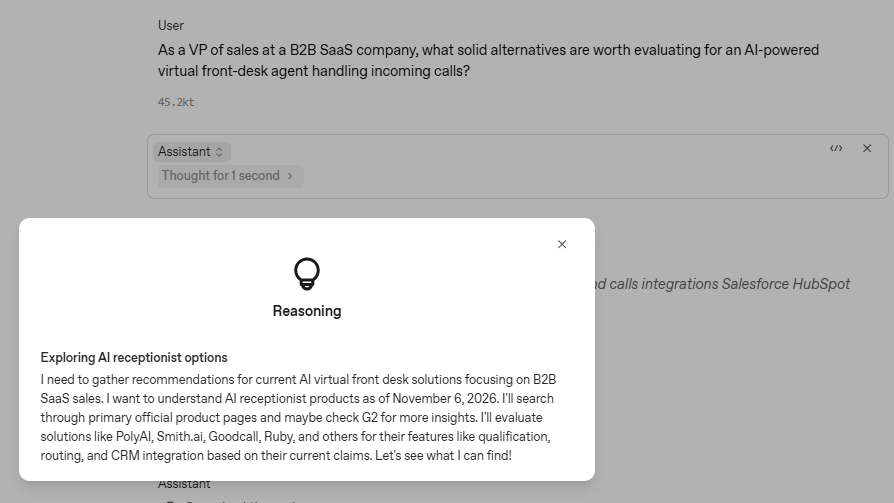
Start by running the prompts you actually care about in ChatGPT and reading the reasoning. You’ll get a much clearer idea of why your brand is or isn’t included. Keep in mind that ChatGPT’s interface ranges in how much reasoning is shown, which is why we use the API to get this information at scale.
If you haven’t used the API before, test out the OpenAI Playground first. Click into the Assistant’s ‘thought’ output and you’ll see the reasoning summary and rules ChatGPT is setting for itself. You can also click into the search outputs to find fan-out queries and sources used.
As you’re checking each prompt, look for three things:
-
The sources it says it will trust. Are you on them?
-
The must-haves it names. Does your site state them plainly?
-
How many brands it plans to list, and whether you’re named and then dropped.
The quick win: Write down every must-have ChatGPT names (licenses, certifications, integrations, local availability). If you have them, make sure they’re stated plainly on your site.
Once you add those must-haves, monitor the AI performance of those pages and your brand’s visibility and recommendation rate in AI responses.
The reasoning won’t explain every response, and it won’t always be 1:1 with what users see in the app. But it gives you a much clearer view into the criteria ChatGPT is using to decide which brands make the list, and that’s something you can act on.
Want help understanding why ChatGPT isn’t naming your brand? Seer can help you pinpoint why you’re being excluded and work to get you on ChatGPT’s shortlist. Contact us to chat about it.