TL;DR
We watched 161 recorded AI search sessions and logged every ad that showed up inside a ChatGPT answer. Most of the people we asked told us they hadn't seen any.
-
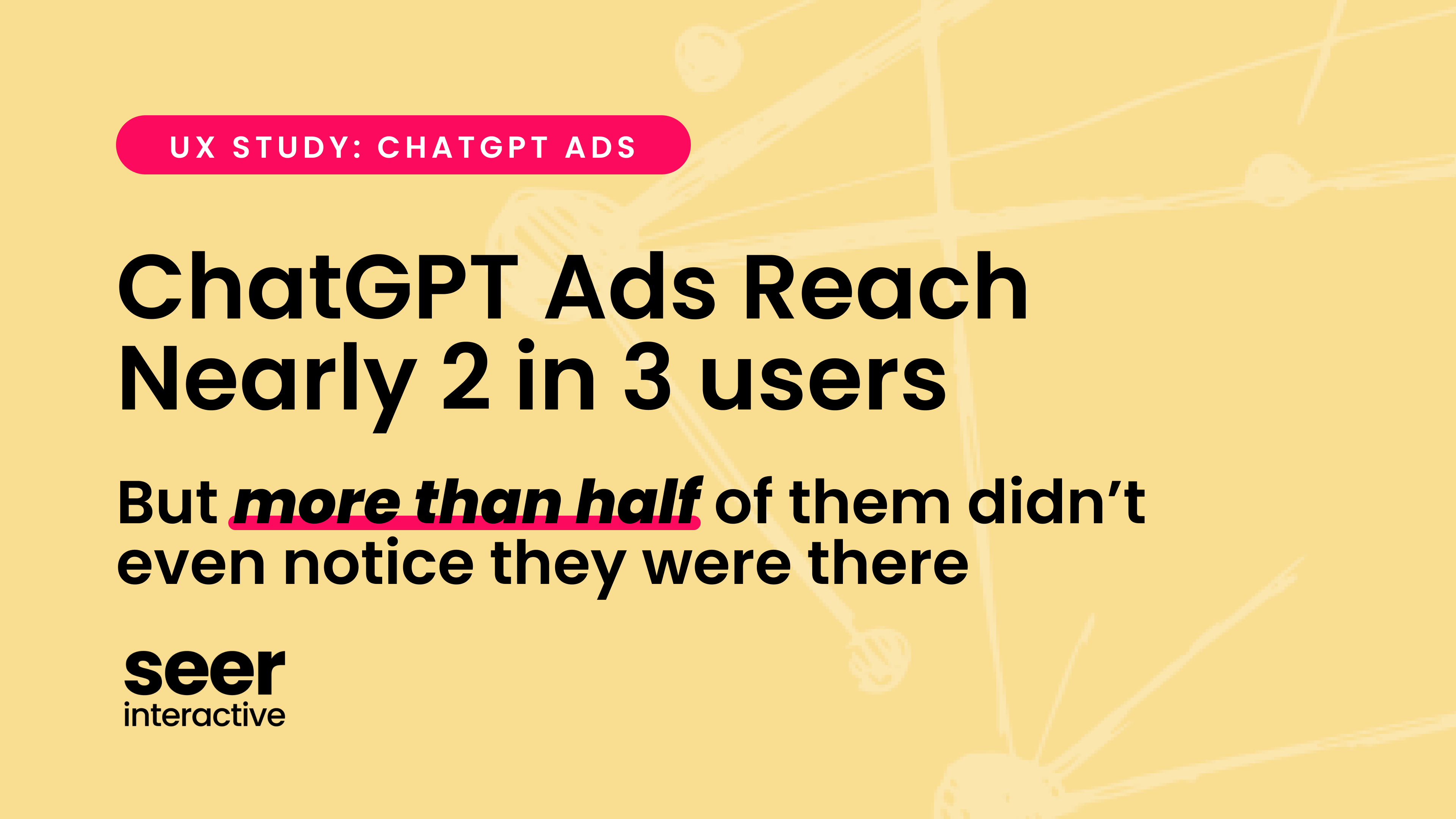
The share of ChatGPT users who saw an in-answer ad went from 1 in 11 in March to nearly 2 in 3 from July to September.
-
7 of the 12 participants who were shown an ad said there were none, in the studies that asked.
-
Branded prompts still drew ads, and in 5 of 6 verticals the ad was for someone other than the brand named in the prompt.
-
The ads placements use context hints from the conversation to increase relevancy and look more like the answer around them.
Below: what we saw by vertical, who bought the ads in our insurance study, and four steps to take now.
Skip to the Methodology→
When we asked one of our travel shoppers about ChatGPT Ads, they told us they hadn’t noticed any.
“Maybe I’m just accustomed to over-scanning them,” they said.
But their screen recording showed travel-site ads in two separate tasks.
That gap between what was on screen and what the person perceived sent us back through our session recordings.
Our UX team pulled nine AI search usability studies (161 sessions, March to September 2026) and logged every paid unit that appeared inside an AI answer.
In about six months, ads in ChatGPT answers went from uncommon to something most of our free and logged-out ChatGPT users saw. But even as the ads changed shape, most people still said they didn’t even notice them.
How Often People Saw ChatGPT Ads
In March, 2 of the 22 ChatGPT users in our sessions saw an ad inside an answer.
By May and June it was 17 of 46.
And from July through September it was 12 of 19, nearly 2 out of 3.

Ads were already running in March, just on few questions, and account type made a big difference.
Every Plus and Pro session was ad-free, while free and logged-out accounts got the ads (though a logged-out session didn't always get one).
We didn't find an in-answer ad in any Gemini, Claude or Grok session, and we only scanned those tools in some of our studies, so read that as what we observed.
Where the ChatGPT Ads Showed Up
Whether people saw ads depended heavily on the industry and the type of question:
-
Insurance led, with ads for 8 of 11 users
-
Ecommerce shopping questions drew them for half of users and travel planning for 4 of 10.
-
Home and DIY questions drew them for 13 of 37 users.
The advertisers shift with the question.
Insurance quote questions drew comparison sites first and carriers second.
Home repair and contractor questions drew home-services marketplaces, while product questions pulled in retailers and a fixtures manufacturer.
Travel planning drew online travel agencies and one competing hotel brand.
In ecommerce, one direct-to-consumer brand showed up in every session where a user saw an ad at all, along with retailers in priced product carousels.
Auto questions got the automaker's own card under ChatGPT's recommendation of its model, plus a car marketplace on a price-comparison question.
A utilities question in ChatGPT drew a home-services marketplace under an answer about a provider's plans.
In Google AI Mode, the same kind of question drew rate-comparison sites.
A Closer Look at Insurance
Our B2C insurance study gave us the clearest picture of who is buying these slots.
Across 16 AI search sessions we logged 34 ad impressions, all on non-paid ChatGPT accounts, logged in and logged out.
The ads sat under the answer and came back with each response, so some participants saw 6 or 7 ads in a single conversation.
Of the 76 responses we could observe, 45% carried an ad.
Comparison sites accounted for 24 of those ad impressions, while insurance carriers accounted for 10.
Our earlier analysis showed the same pattern of aggregators outspending brands, and across studies, home-services marketplaces appeared more often than most direct competitors.
If you’ve been monitoring competitors’ ad activity, add the lead-generation sites in your category to that list.
Every ad in this study was relevant to the prompt. That’s an improvement from our first analysis of ChatGPT ads, when many ad cards had nothing to do with the conversation.
Branded Prompts Still Draw Ads for Other Brands
Including a brand name in a prompt doesn’t protect it from ads.
ChatGPT answers about the brand the person asked for, but the sponsored card below the answer can belong to a different company, including a direct competitor.
In 5 of the 6 verticals where we tested a branded task, a branded prompt returned a sponsored card for someone other than the brand named.
For example:
- One shopper asked about one brand’s shoes. ChatGPT recommended four of that brand’s models, then showed a sponsored listing for a shoe from a different brand.
- A traveler asked for the top 3 hotels from one hotel brand and saw a sponsored card from an online travel agency on the same screen.
- In the insurance study, ads also appeared on branded prompts and follow-up questions.
This creates a clear opportunity for advertisers.
When an ad blends in with the answer and appears on a branded prompt, competitors can reach people who were already looking for a specific brand.
Brands can use this space too.
In one case, a retailer’s sponsored card featured products from the brand the shopper had asked about. In another, an automaker’s own ad appeared directly below ChatGPT’s recommendation of its vehicle. space can work for brands as well.
Do Shoppers Even Notice Ads in ChatGPT?
Ads showing up doesn't mean that they become part of the user's experience. We wanted to understand if people even notice the ads that were served to them? The reality we found is more than half of them don't.
7 of the 12 participants who were served an ad told us there were none.
Some participants told us they prefer AI because it feels less sponsored than Google.
That perception persists even as the number of ads grows. Only one participant pointed out an ad on their own, after a card took them somewhere unexpected: “These are ads.”
People who did engage with an ad rarely recognized it as one.
-
An ecommerce shopper browsed a department store's ad carousel, settled on a pair of shoes from it, and described the pair as ChatGPT's pick: "I don't know why it gave me a ballet shoe."
-
A home and DIY shopper saw a furniture retailer's card and started asking ChatGPT for that retailer's furniture about 7 minutes later.
-
An insurance shopper clicked an ad only after the interviewer asked about clicking.
Most participants dealt with the ads by ignoring them ("over scanning," "I just ignore them").
One shopper even told ChatGPT to leave out sponsored content. But a small group repeatedly saw sponsorship as a sign that a company was legitimate.
The result of this is that when someone engages with an ad, they may credit the recommendation to ChatGPT rather than the advertiser.
How the Ads Read Now
The ads have changed shape too.
From March through June, an ad was a single card below the Sources row, often below the fold, and the "Ads do not influence the answers" line was already on screen.
By July the cards responded to what the shopper typed. A shopper researching car insurance mentioned living in Georgia, and the next card was a geo-targeted Georgia car insurance ad with an image and a small "Ad" tag.
By September, a runner who asked for shoes for a charity run got a card that opened with "For a charity run with a lot of walking, here's one daily running shoe option," followed by a priced product carousel.
The ad reads like ChatGPT is talking. Google AI Mode places its sponsored units the same way.
Wondering What You Should Do About This?
We checked these steps with our paid media team and here's our recommendations:
-
Test ads as an awareness play. Use them to join conversations you're missing from organically, especially non-branded prompts in competitive spaces. But don't expect high conversions.
-
Check your branded prompts first. Ask ChatGPT about your brand on a free account and look at the card underneath.
-
Count aggregators as competitors. Lead-gen and comparison sites bought more of the ad slots than brands did.
-
Make the paid ad and the answer agree. The brand whose ad reinforced ChatGPT's own recommendation held the strongest position we saw.
Want help checking what shows up under your brand's prompts? Talk to Seer.
Methodology
- Our UX team ran nine AI search usability studies from March to September 2026, 161 sessions in total, where real people used their own AI tools while thinking out loud.
- Every session was unmoderated and recorded. We reviewed select sessions manually.
- To scale the counts, we sampled each recording every 2 seconds with on-device text recognition to find ad units, then checked each one by eye against what the participant said.
- An ad counts as shown when it was on screen.
- What people noticed comes only from what they told us. Two of the nine studies asked about ads directly after the AI sessions.
- In one study, the scan matched a manual review on every session and ad count, though it undercounted some creative variations.