

TL;DR: Bryan Gunawan, an intern in Seer's AI Optimization Academy, made 5 targeted changes to an existing Seer blog post and took it from under 100 impressions to a peak of 1,195 in a matter of weeks. The page was also cited in a Google AI Overview.
Here's what he changed:
- Added a direct answer at the top of the page
- Added AI Overviews as the 19th reason organic traffic drops
- Added a FAQ section at the bottom
- Rewrote the meta description to be more direct
- Updated the title and last updated date to reflect the new content
This is the follow-up to our first post about the AI Optimization Academy. If you haven't read that one: we invested $20,000 and 13 weeks into three local Philadelphia interns to do real SEO and GEO experimentation on our own site.
One of our interns, Bryan Gunawan, took this blog and ran with it. Here’s what that looked like…
- Wil's POV
I pulled our intern, Bryan, aside at some point and asked him a question that I don't think most interns ever get asked: What is the value you're generating relative to what you're being paid?
Nobody asked me that when I was an intern. I would have frozen like a deer in headlights.
But Bryan didn't fold, he sat with it.
And then he came back and said, essentially: I think if I improve some pages on this site, I can show more value.
That was the moment for me. That's what "getting it" looks like. Not the impressions number, though that number is real, and we'll get to that. But, it was watching someone not fold under a hard question, and then go do something about it.
- Bryan's POV
When Wil asked me that, I really had to sit down and think. I was only a couple weeks into the program. I had training and a hypothesis about meta descriptions, but that was pretty much it.
I even asked my colleagues and other people in the program to try to figure out how to put a number on what I was contributing, but everything felt theoretical, like there was nothing I could point to.
The answer came to me during my third rewatch of Wil talking through my question. I heard him say, “Why don’t you take an old page and see if you can make it better?”
So I found one, spent a couple days recording what changes I wanted to make and building a hypothesis.
Before I show you that, I want to say this: I came to Seer expecting the kind of office that you see in movies – grey, uninspiring.
But the people here, the conversations, Wil… this has been the most fun I’ve had since I first discovered my passion for building things with code.
It’s hard not to be passionate about your work here, so I jumped right in.
Here’s The 5 Changes Made:
I started by searching the keywords the page was already ranking for and just looking at what was beating us. I went through six different pages sitting at the top of the results and started noticing patterns.
Change #1: Add a direct answer at the top
Almost every top-ranking page had some version of a direct answer or TL;DR section right at the top before any of the depth. I saw it consistently across six different pages.
So I thought: let me test that and see if doing the same helps us.
Before: 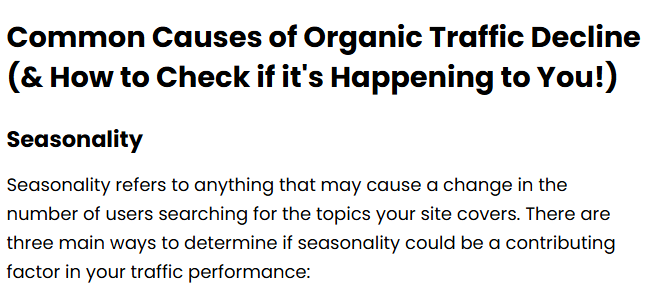 After: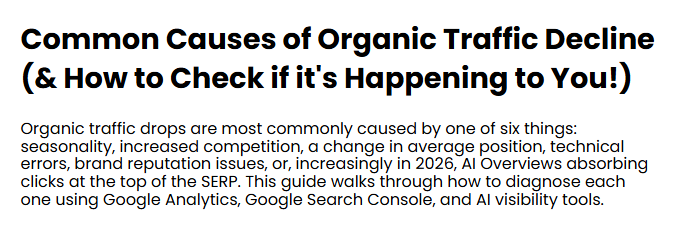
Change #2: Add AI Overviews as the 19th Reason
The original blog hadn't been updated since 2011. And one of the biggest reasons organic traffic is dropping right now is that Google's AI Overview is absorbing clicks before anyone gets to your page. It felt wrong to have a guide about diagnosing traffic declines that didn't mention that.
So I added it, bringing the list from 18 to 19.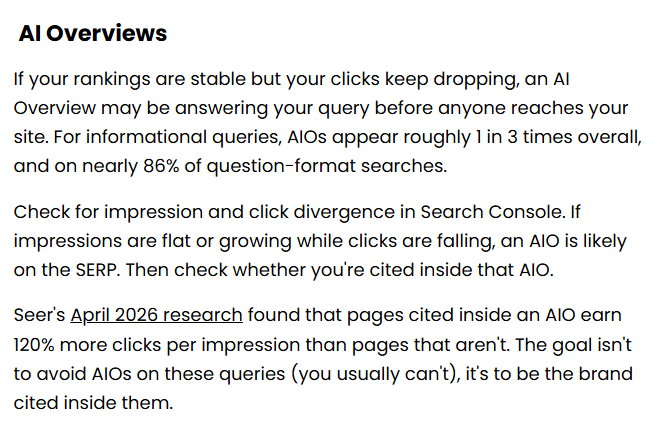
Change #3: Add a FAQ section at the bottom
Same logic as the TL;DR. FAQ sections showed up consistently across every top-ranking page I looked at.
The questions were always traffic- or SEO-related, so I made sure that ours followed that pattern.
Before: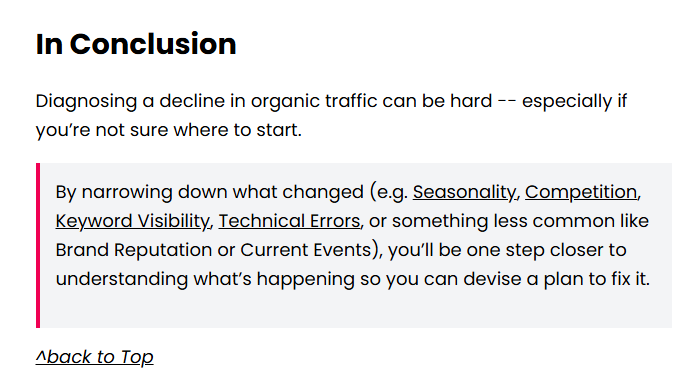 After: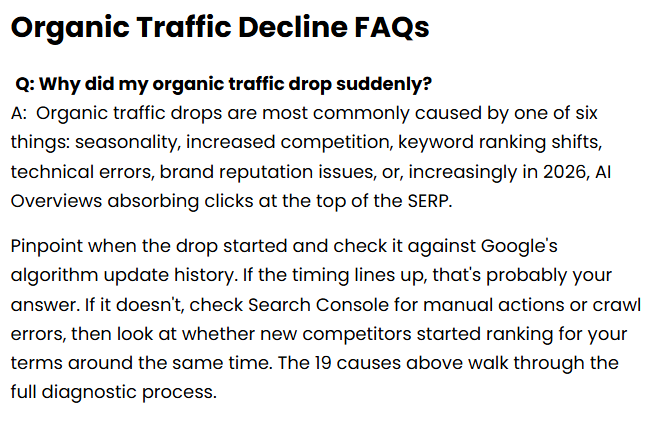
Change #4: Rewrite the Meta Description
The meta descriptions on higher ranking pages were more direct, almost like a pitch. Things like: Is your website traffic going down? Here's 15 reasons why. I rewrote ours in that direction.
I'll be honest though, I tested meta descriptions separately after this and found they don't really move the needle. That one was a learning moment.
Change #5: Updating the title and last updated date
I added a 19th reason, so the title needed to reflect that. The date too; since I changed the content, it should say so.
(One side note that I didn’t expect: even after re-indexing, it took about a week for that date update to actually show up.)
The Results
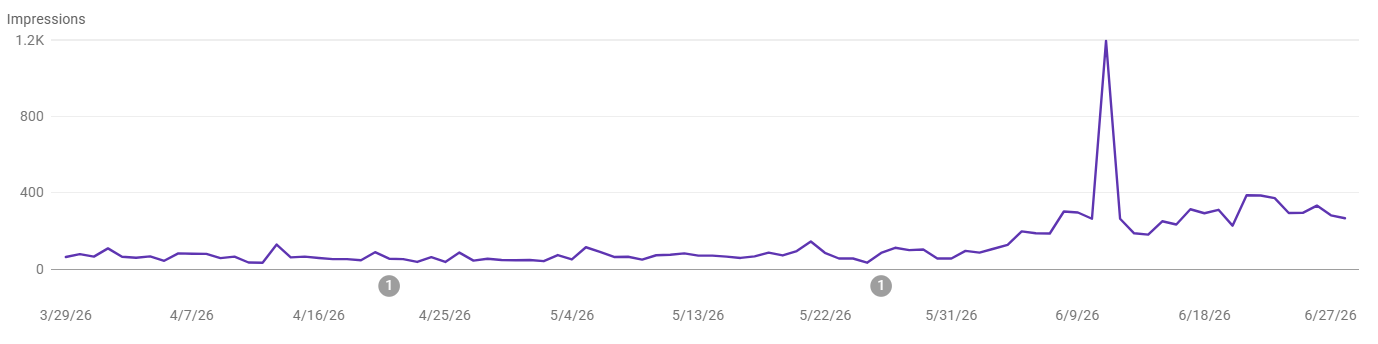
Before the changes: the page barely cracked 100 impressions across a 2-3 month window.
After: impressions grew to a consistent 100–400 per day, peaking at 1,195 on June 11, 2026.
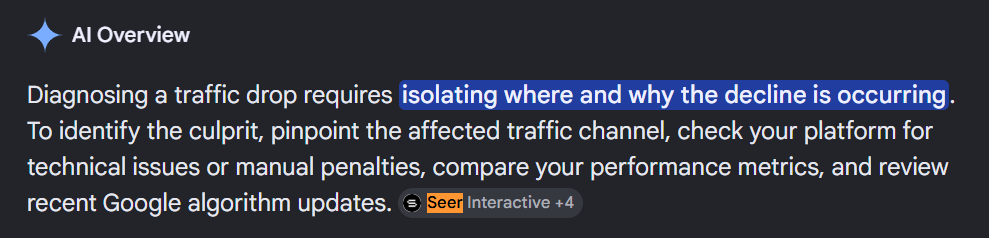
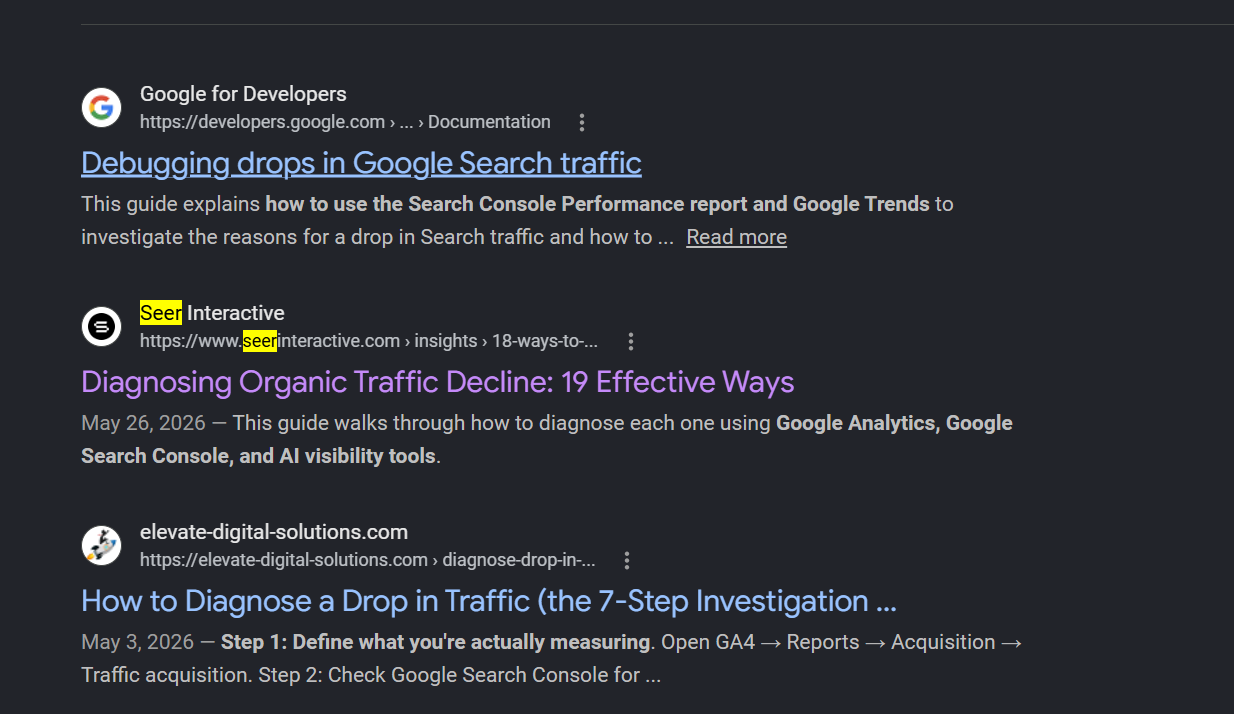
The page was also cited in a Google AI Overview. And it hit position 2 for the keyword "traffic drop diagnostic" before settling toward the bottom of page one. It currently holds position 1 for "organic traffic decline."
- Bryan's POV
After making these changes and waiting almost 2 weeks, the first thing I did after re-indexing was check SEMrush. And I saw a lot of our keywords going down in the rankings.
I was like... did I do something wrong?
But then Wil showed me Google Search Console. I knew how to re-index from working with one of our team members, Hannah Cooley, earlier in the program, but I didn't realize you could track impressions this way.
And the impressions were growing. And it wasn't just a spike. They had steady growth from the moment I had re-indexed forward.
When I saw 300 impressions on June 10th, I was already kind of baffled. When it peaked at 1,195?
That's me? I did that? No way. Impossible.
.png?width=926&height=461&name=image%20(13).png)
^This was me. I was bragging to my friends. I won't pretend otherwise.
The piece showing up in AI Overviews wasn’t even my intention going into this experiment. That was just a byproduct of the structural changes. I was just looking at what other pages were doing and testing whether copying the pattern would work. I fully didn't expect it to land there.
On the keyword side: I realized I was competing against pages that had "traffic drop" and "diagnostic" in their title, meta description, and body content. The fact that I was beating them at position 2 was honestly surprising.
Now I'm weighing which keyword to go harder on.
"Traffic drop diagnostic" gives me more impressions at a lower position, "organic traffic decline" puts me at position 1 with fewer. The data is pointing me toward "traffic drop diagnostic," so that's probably the next step.
One thing this experiment taught me that I genuinely didn't expect: SEO is competitive in a way that's actually fun. It's like a game.
Before any of this, I was literally asking AI to make my websites SEO-friendly without understanding a single thing about why.
Now I know what's actually happening: why keywords matter, how page structure signals things to Google, why your competitors' pages tell you what to do next.
This is way more complex and interesting than I thought going in and I loved it from start to finish.
- Wil's POV
Hearing this from Bryan got me hyped, and not because his experiment was a success, or that it convinced me our internship program was a success, because…I’ve never liked calling things successful.
I wrote about this almost 15 years ago: the idea that the moment you declare something a success, it starts to feel like a destination instead of a journey. I feel the same way about this program. I don't experience it as a success. I experience it as a receipt.
We made a commitment to this community when we founded Seer in August 2002. That receipt says we're still living it out.
What Bryan's experiment actually proves to me isn't that we've built a perfect AI optimization program. What Bryan did here was traditional SEO, done well, by someone who cared about the outcome.
What it proves is that the people we're going to need most in this new era of AI aren't necessarily the ones with the right credentials. They're the ones who try new things, do the work, and get excited about what they can build on. Bryan did all three.
I'll also say this: I underestimated how much work this program was going to be for our People Ops team. Emily Allen, Joanna Bowen, they took on real extra work to make this happen.
The fact that after all of that, they still felt it was worth it, tells me everything.
We're doing this again.
.png)
.png)
-png.png)