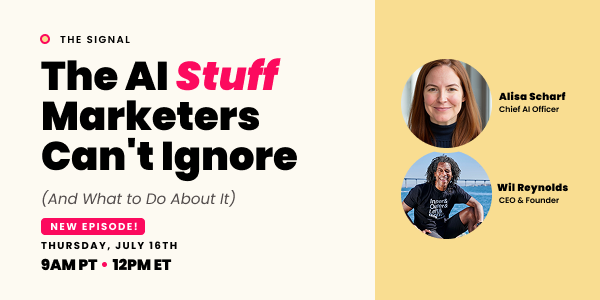
Alisa's Key Takeaways
1. Ask "Why" Before Chasing AI Visibility
Alisa's perspective: When clients come to Seer asking to improve AI visibility, Alisa's first question is always: what does AI visibility actually mean to you, and who's asking for it? Because visibility rarely translates into meaningful traffic or revenue on its own, she pushes brands to define what winning looks like before investing.
What your brand can do: Before building out an AI or GEO strategy, define your why. AI is still an experimental channel, so you should layer it alongside other tactics that have proven successful for your brand (and only if you have the bandwidth). If you're looking to boost traffic or revenue, ask yourself: how will AI visibility help you get there? Then be realistic about the answer.
2. Citations Are a Weak, Overhyped Metric
Alisa's perspective: Citations feel measurable, so the industry has latched onto them. But Alisa compares citations to page-two Google rankings: a leading indicator, not a business outcome. A citation doesn't mean your brand was actually mentioned in the response. Citation sources are also wildly volatile and often change for unexplainable reasons.
What your brand can do: Don't treat citations as a KPI you report to leadership; use them as a signal. If your content is being cited, investigate the why: what's the surrounding content doing right, and how can you use it to further optimize or expand yours? Don't over-invest in chasing a specific citation source, because it could disappear by next month.
3. Brand Recommendation Rates in AI Are Shockingly Low
Alisa's perspective: Seer's research shows that LLMs recommend a specific brand only about 2.3% of the time. Alisa frames this as a maturity model: citation (your page shows up) → mention (your brand appears among options) → recommendation (the model tells the user to go with you). Reaching that final stage is rare and hard-won.
What your brand can do: Don't panic if your recommendation rate is low. Benchmark it against your competitive set first, since the whole category is likely sitting in low single digits. Use that baseline to set realistic goals (e.g., "How do we move from 2% to 4%?") rather than assuming a bad number means broken strategy.
4. Defensive Work Before Offensive Work
Alisa's perspective: Based on Seer's own work, the team has found that most models share inaccurate information about brands. Alisa's team currently focuses on "brand accuracy audits": building a list of objective, factual prompts about your brand (i.e. Where is your brand based? When was your brand founded?) and checking where each model gets it right or wrong.
What your brand can do: Before investing in content aimed at ranking for competitive or aspirational terms, audit what AI models already believe about your brand. Where the models are wrong, prioritize fixing the easiest things first on your own website and owned content liked LinkedIn and ZoomInfo profiles, before trying to influence third-party sources.
5. Positioning and Identity Work Is Foundational
Alisa's perspective: Brand positioning failures are one of the biggest blockers to AI visibility, and enterprise brands are often the worst offenders. Alisa likens LLMs to "matchmakers" trying to match a user's specific need to the best-fit brand: if a smaller, sharply-positioned competitor is obviously "for you" while a bigger, vaguer brand isn't, the niche brand often wins the recommendation.
What your brand can do: Put in writing what your brand stands for and who it's for. Avoid broad "we serve everyone" language and give a clear point of view so an AI model can confidently match your brand to a specific type of buyer or query. This is slow, often political internal work (getting leadership aligned on positioning), but it's a prerequisite for AI visibility gains.
.png)
Google Is Not Going to Stop Ranking Your Claude-Assisted Content
TL;DR Claude’s watermark only flags that Claude was “likely involved,” so it can’t tell a fully AI-drafted piece from a human draft Claude lightly edited It’s a…
.png)
Stop Chasing AI Rankings Before You Fix How LLMs See Your Brand
The counterintuitive truth about AI visibility: Most brands are trying to win elections before voters know their name.


.png)
.png)