

Conversational analytics is having its moment. With Google's Analytics MCP (Model Context Protocol), connecting your GA4 data to AI companions like Claude, ChatGPT, or Gemini has become remarkably straightforward. Instead of navigating dashboards and building custom reports, you can simply ask "How many users visited from organic social last week?" and receive instant, accurate answers.
But as with most technology that promises to transform how we work, there are costs involved — and they're not always obvious upfront.
This post breaks down what conversational analytics actually costs, where those costs come from, and how to approach implementation without breaking your budget or making premature infrastructure commitments.
Our Take: Prove Value Before Going All-In
At Seer Interactive, we've been implementing conversational analytics systems for clients ranging from small ecommerce businesses to enterprise organizations processing hundreds of millions of events monthly. Through this work, we've developed a phased approach that lets companies start small, prove value with minimal investment, and scale strategically toward comprehensive business intelligence systems.
Let’s discuss why this strategy works by first looking at what you end up paying for, and then exploring how a multi-phased approach can help you maximize your investment.
Want to calculate costs for your business?

Try the Seer Conversational Analytics Cost Calculator!
.png?width=1080&height=1080&name=Seer-conv-analytics-cost-calculator%20(1).png)
What You're Actually Paying For
Unlike traditional SaaS products with simple per-seat pricing, conversational analytics involves multiple cost layers that interact in sometimes surprising ways.
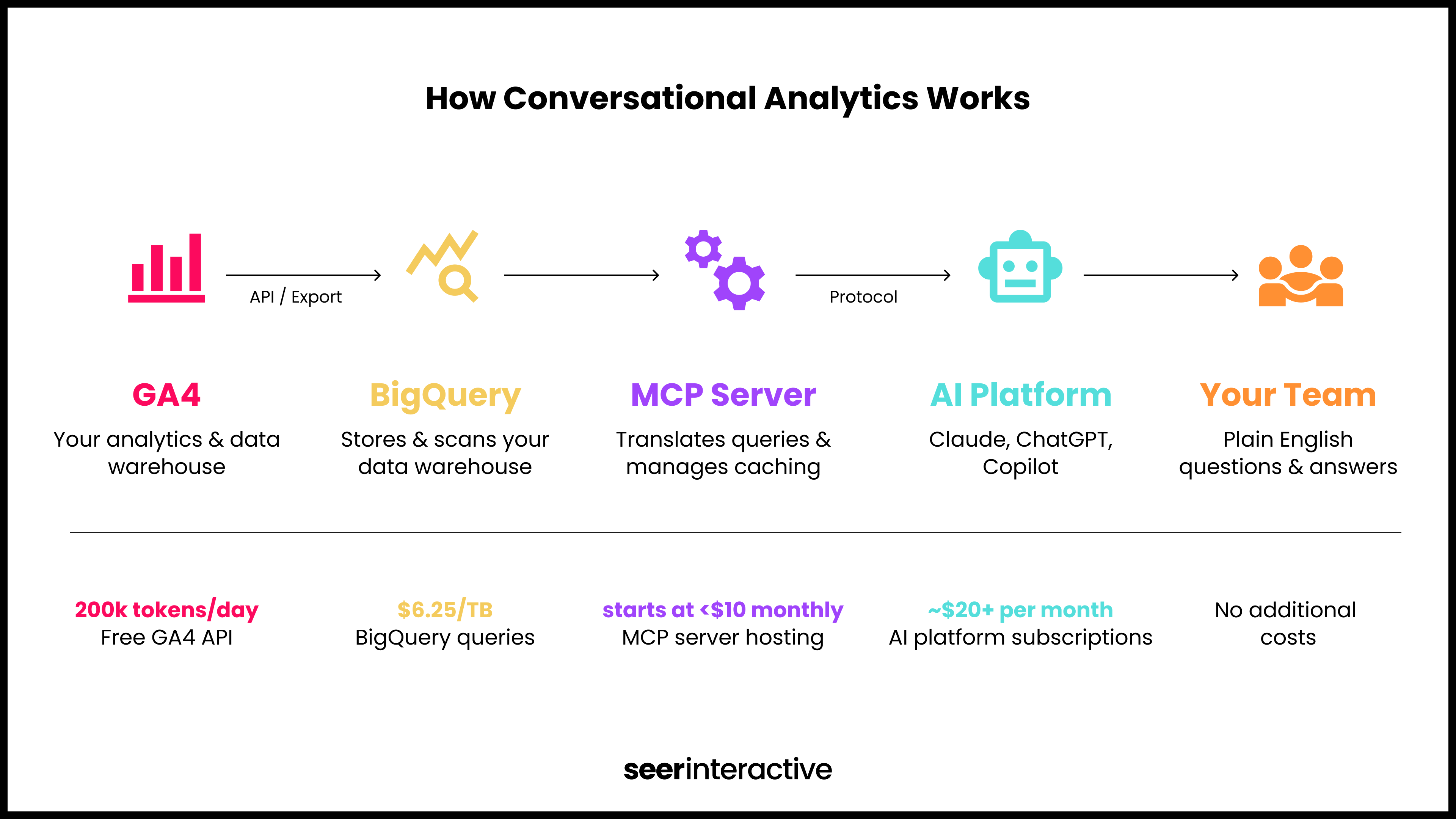
Google Analytics API Access represents your first consideration. Standard GA4 properties receive 200,000 API tokens daily at no cost, with each query consuming tokens based on its complexity. Simple queries might use 10-15 tokens, while complex analyses with high-cardinality dimensions can consume hundreds.
If you're a GA360 client, you receive a substantial upgrade: 2 million tokens per property daily (that’s a 10x increase over the free GA4 version). For most business applications, this proves more than sufficient. The critical constraint: Google doesn't sell additional tokens. Once you exhaust your daily allocation, you wait until midnight Pacific Time for the quota to reset. This makes intelligent caching and query optimization essential practices rather than optional enhancements.
In short: If you’re on a budget and using GA Free, then you may want to limit Conversational Analytics users to a select few.
BigQuery Integration is where variable costs enter the equation. While you can answer many questions through the GA4 API, you will need BigQuery for complex analysis, historical queries beyond standard retention windows, and joining GA4 data with other sources.
BigQuery charges $6.25 per terabyte of data scanned. At typical GA4 export densities of 10-50 GB per million events, a company processing 100 million events monthly might store 1-5 TB of data, with query costs depending entirely on how efficiently those queries are constructed. A poorly designed query scanning an entire dataset might cost several dollars per execution. An optimized query using partitioned tables and specific date ranges might cost pennies.
This dramatic difference makes query design your primary cost management lever.
MCP Server Infrastructure bridges your AI platform and data sources. For individuals or small teams, this server runs locally on your workstation at zero hosting cost. It operates as a lightweight process requiring minimal resources, and depending on your local processing power, you probably won't even notice it running.
Teams requiring 24/7 access or centralized deployment can use cloud hosting. Serverless options like AWS Lambda or Google Cloud Functions typically cost under $10 monthly for moderate usage. Always-on server instances range from $20-100 monthly depending on capacity requirements.
AI Platform Subscriptions represent fixed costs independent of your analytics usage. ChatGPT and Claude enterprise licenses start at $20 per user per month. GitHub Copilot costs $10-19 per user monthly depending on plan tier. Microsoft 365 Copilot runs $30 per user monthly and requires Microsoft 365 E3/E5 licensing. These subscriptions power AI-assisted work across coding, writing, and business applications. MCP simply adds analytics capabilities to an existing productivity investment.
The Phased Approach: Start Small, Scale Smart
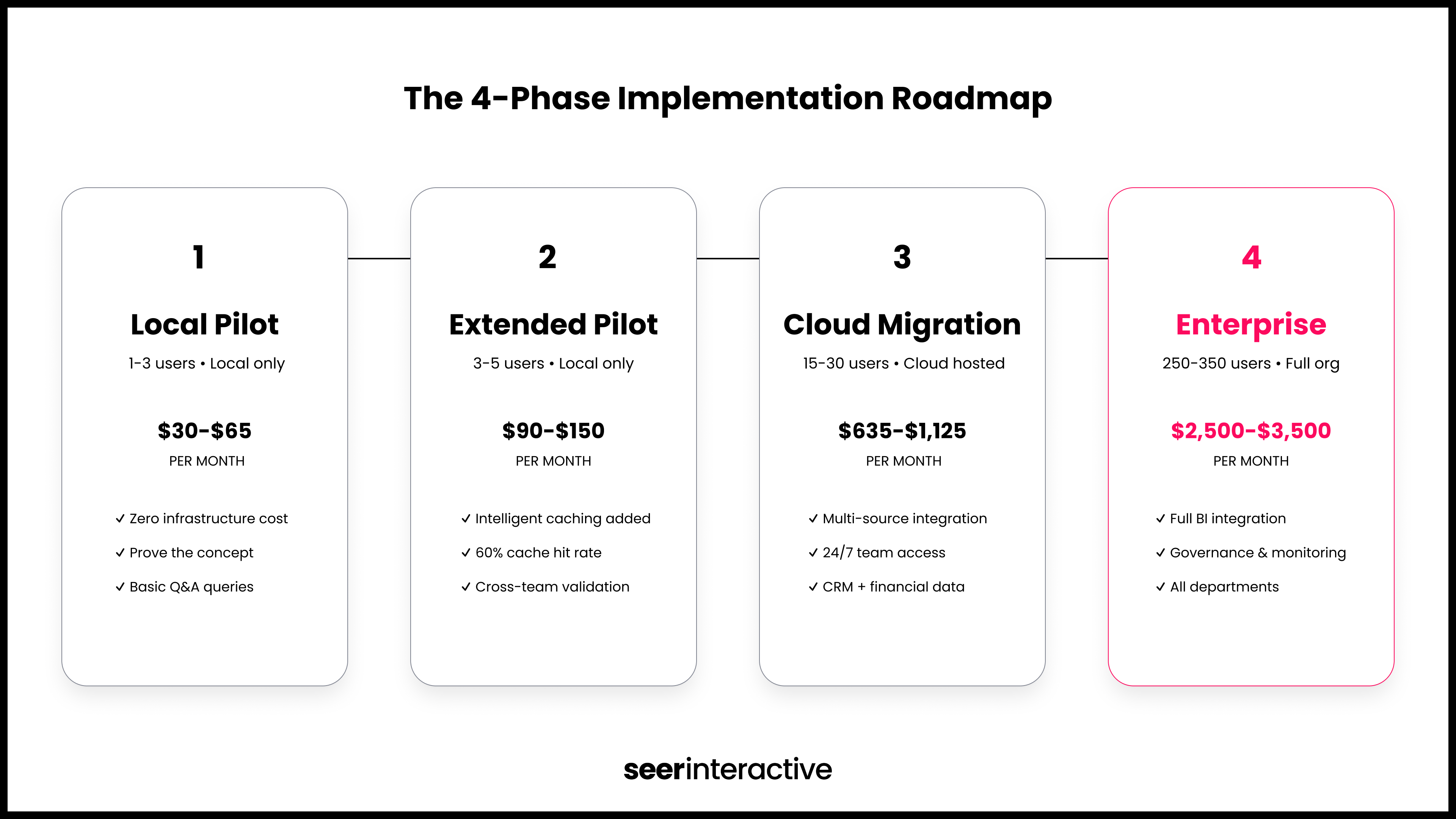
Based on our implementation experience, we recommend a four-phase approach that minimizes initial investment while proving value before scaling.
Phase 1: Local Pilot ($30-65/month total)
Start with 1-3 users running MCP servers locally on their workstations. This requires zero infrastructure investment beyond the BigQuery storage you likely already have enabled.
Your pilot team asks basic questions: "How many users did we have last week?" or "What's our top-performing product category?" Most answers come from the GA4 API using cached results. BigQuery queries remain minimal, primarily for data you're already storing.
Cost breakdown:
- BigQuery storage (existing): $30-60/month
- BigQuery queries (new): $0-5/month
- MCP infrastructure: $0/month
- Total: $30-65/month
This phase proves the concept with virtually no financial risk. Your pilot team identifies valuable use cases, establishes usage patterns, and determines whether conversational analytics merits broader deployment.
Phase 2: Extended Pilot ($90-150/month total)
Expand to 3-5 users across analytics and marketing while maintaining local deployment. As usage increases to 50-75 queries daily, you introduce intelligent caching based on observed query patterns and create targeted summary tables to reduce BigQuery scanning costs.
About 60% of queries get answered from cached results. The remaining 40% require BigQuery for custom analysis like cohort comparisons or audience segmentation.
Cost breakdown:
- BigQuery storage (existing): $30-60/month
- BigQuery queries: $60-90/month
- MCP infrastructure: $0/month
- Total: $90-150/month
This validates broader organizational value while maintaining zero infrastructure costs. You gather concrete data on query patterns, token consumption, and user adoption to inform scaling decisions.
Phase 3: Cloud Migration with Multi-Source Integration ($635-1,125/month or $2,200-2,800/month with flat-rate BigQuery)
This is where conversational analytics transforms from "better GA4 access" to "unified business intelligence."
You move to cloud-hosted MCP servers for 24/7 team access across 15-30+ users. More importantly, you begin integrating data sources beyond GA4: financial systems for actual profitability data, CRM platforms for customer lifetime value, inventory systems for stock levels, marketing platforms for comprehensive attribution.
BigQuery becomes your central data warehouse. Complex questions like "What's the actual profitability of customers acquired through paid search last quarter?" require joining GA4 data with financial and CRM records. You're scanning 2-4 TB monthly, with storage growing to 3-5 TB as you warehouse integrated datasets.
Cost breakdown:
- BigQuery storage (existing): $60-100/month
- BigQuery queries: $375-625/month (or flat-rate at $2,000/month for 3+ TB scanned)
- MCP cloud infrastructure: $200-400/month
- Total: $635-1,125/month on-demand, or $2,200-2,800/month with flat-rate BigQuery
At this scale, API token management becomes active rather than passive. With 150-250 daily queries, you're using 40-60% of your GA360 daily allocation, requiring smart caching and query optimization to avoid hitting limits during peak usage.
Phase 4: Enterprise Deployment ($2,500-3,500/month)
Full organizational deployment across multiple GA360 properties with comprehensive data integration makes conversational analytics available to your entire knowledge worker population. That’s potentially 250-350 employees across engineering, marketing, product, finance, and operations.
Multi-source data integration becomes sophisticated, incorporating web analytics, financial systems, CRM platforms, ERP systems, marketing tools, and support platforms. Questions that previously required hours of manual data assembly across multiple systems become instant conversational queries.
Cost breakdown:
- BigQuery with flat-rate pricing: $2,000-2,500/month
- BigQuery storage: $200-300/month
- Enterprise MCP infrastructure: $500-1,000/month
- Total: $2,700-3,800/month
At scale, per-user cost drops to approximately $11-15 per employee monthly. This is a fraction of traditional BI tool licensing while providing more accessible, conversational interfaces.
The key challenge becomes comprehensive governance: dashboards tracking token usage by property, query complexity analysis identifying optimization opportunities, data access policies defining who can query which sources, and potentially approval workflows for exceptionally complex queries.
Cost Control: Where to Focus Your Energy
Effective cost management focuses on four key strategies:
Query optimization and caching represents the highest-impact lever. Configure MCP servers with intelligent caching that stores frequent query results for defined periods. Typically, this is 1-4 hours depending on data freshness requirements. This reduces redundant BigQuery queries by 60-80% in typical implementations.
When queries do execute, apply best practices: date range filtering, column-specific selection rather than wildcard queries, and partition-aware query construction. These optimizations typically reduce costs by 10-20x compared to naive query approaches.
Progressive data access patterns mean starting with aggregated summaries and drilling into details only when necessary. Answer "How many users visited last week?" from a daily summary table rather than scanning millions of individual events. Detailed event analysis occurs only for specific deep-dive questions where aggregate data proves insufficient.
Summary table architecture provides the foundation for cost-efficient querying. Create pre-aggregated tables for common analysis patterns: daily traffic summaries, conversion funnel metrics, campaign performance rollups. These summary tables update incrementally rather than recalculating from raw events. Queries against them cost pennies rather than dollars, typically reducing query costs by 80-95% for established reporting needs.
Monitoring and alerting ensures costs never surprise you. Establish BigQuery budget alerts at 50%, 75%, and 90% of defined thresholds. Google Cloud Console provides usage dashboards showing daily query volume, costs by query, and trending patterns. Review these metrics monthly to identify optimization opportunities as analytics needs evolve.
The Real Value Proposition
Before focusing purely on cost optimization, consider what you're actually gaining.
Democratizing Data Access
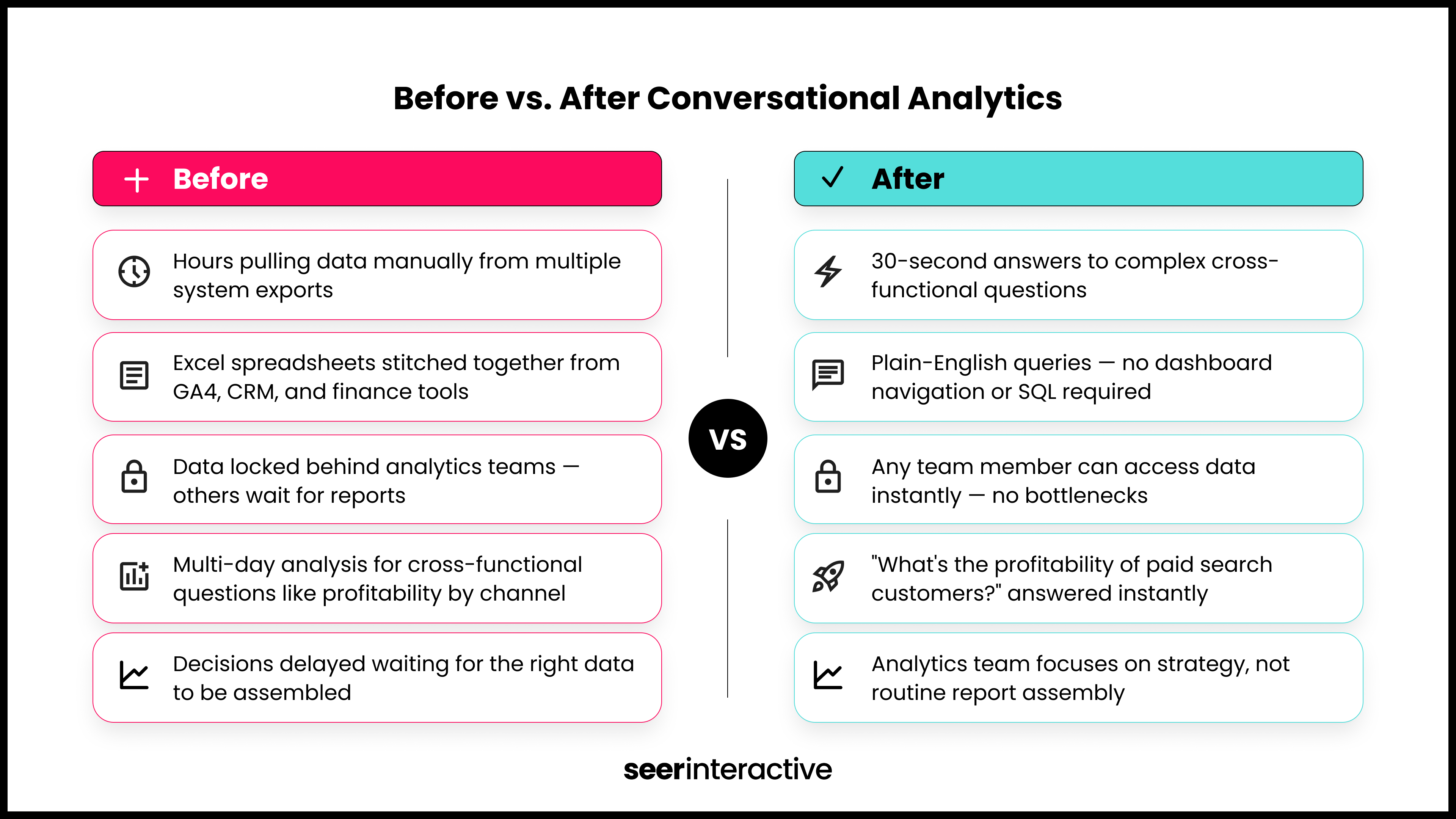
On a basic level, conversational analytics democratizes data access. Marketing managers, executives, and team members without analytics training can ask questions in plain English and receive accurate, data-driven answers instantly. This reduces bottlenecks, accelerates decision-making, and allows analytics professionals to focus on strategic insights rather than routine reporting.
Instant Support for Complex Data Analysis
As implementations mature through multi-source data integration, the value proposition expands dramatically. Questions that previously required hours of Excel work across multiple system exports become instant conversational queries. "What's the actual profitability of customers acquired through paid search last quarter?" or "Which product categories have the best combination of web traffic, inventory turn, and margin?" transform from multi-day analysis projects into 30-second conversations.
Unified Business Intelligence
This integration eliminates the manual data assembly that typically prevents cross-functional analysis. When GA4 (or BigQuery) connects with financial systems, CRM platforms, inventory management, and marketing tools, conversational analytics evolves from improved reporting into unified business intelligence infrastructure.
Starting Your Journey
Here's what you're actually buying: time. Marketing managers stop waiting on analyst queues, executives stop guessing, and your analytics team stops pulling routine reports and starts doing work that requires a human.
The phased approach exists for good reasons beyond cost management. It lets you prove value before committing resources, identify optimization opportunities through real usage data, and build organizational competency gradually — so governance frameworks match actual needs rather than theoretical ones.
Start with a local pilot. Prove the concept with minimal investment and scale based on demonstrated value and concrete usage patterns rather than projected assumptions.
The technology is ready and the costs are manageable. The value proposition is real.
It’s already been proven that conversational analytics can transform how your organization works with data. The question is whether you’ll approach that transformation strategically or reactively.
Interested in exploring conversational analytics for your organization? Seer Interactive helps companies implement GA4 MCP integrations with transparent cost structures and proven optimization strategies. Contact us to discuss your specific needs.

.png)
.png)