
Marketing analytics has always been a game of incomplete information. We've never had the full picture. We just got comfortable pretending we did.
For years, we worked around the gaps. Janky javascript code. Safari blocking cookies. The growth of ad blockers. GDPR consent banners tanking our tracking. Cross-device journeys that disappeared into the abyss. We built attribution models and multi-touch frameworks to paper over what we couldn't see. And for the most part, it worked well enough.
But now, large language models (LLMs) have become answer engines.
Consumers ask ChatGPT for recommendations and never visit a brand website.
Google's AI Overviews resolve questions before anyone clicks a search result. A Pew Research study showed people are less likely to click when an AI summary appears.
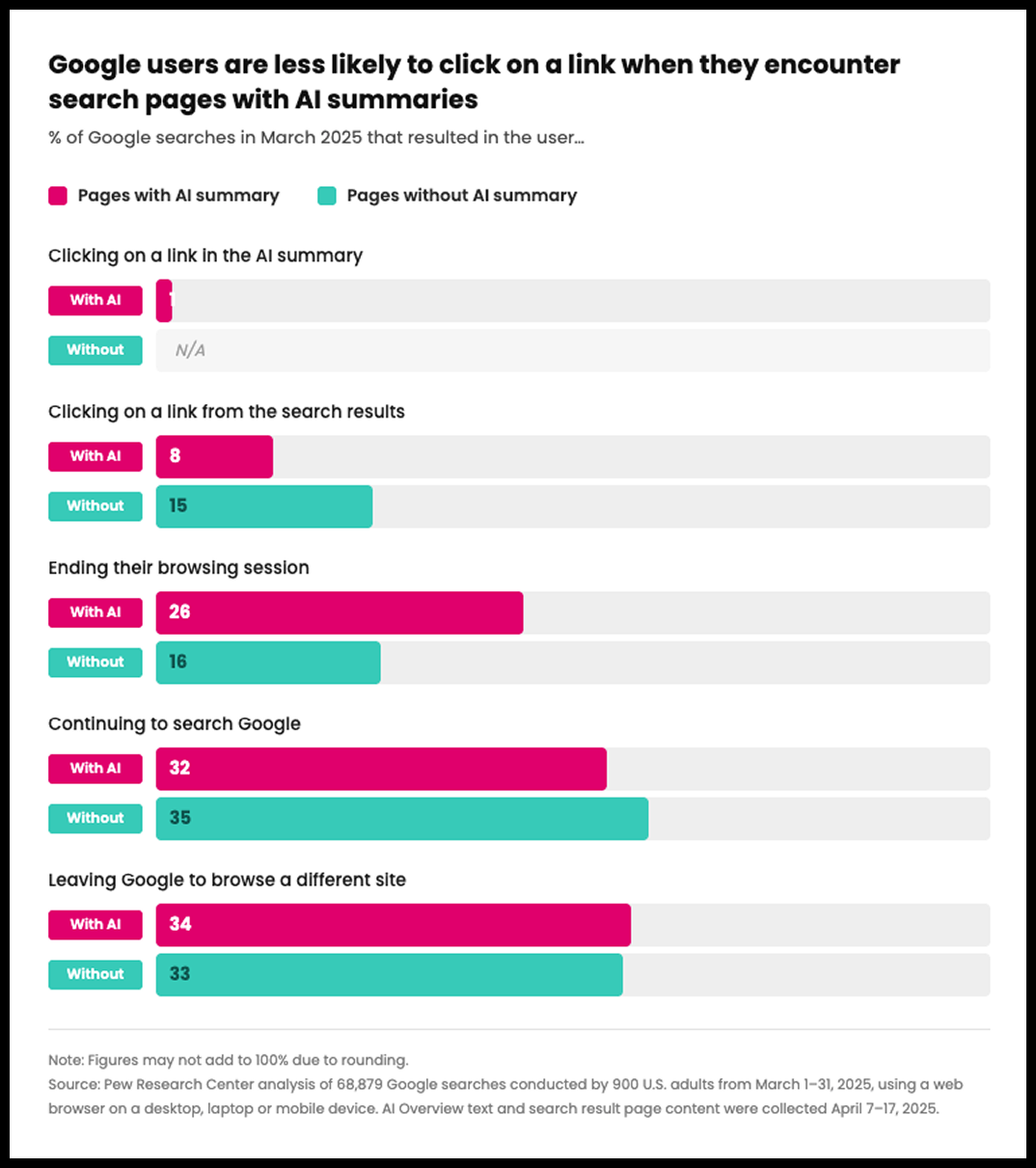
Zero-click searches now account for nearly 60% of all queries. The customer journey is increasingly happening in channels we cannot measure, and may never be able to. We’re working with incomplete data.
So do we abandon the data? No, we use what we have more intelligently.
Conversational analytics represents the most significant shift in how we'll work with marketing data over the next decade. It doesn’t necessarily fix the data problem, but it helps us think better with the data we already have.
Someone asked me recently…"What does Analytics mean to you?" Which was ironic because I ask that question of others a lot. And my response is… Analytics is the process of interpreting and analyzing data by putting your brain into it. You have to think about your data to make sense of it and find meaning so that you can relay that meaning to others.
"Let me get back to you on that" is 2020-era analytics
Here's an uncomfortable truth that Wil Reynolds, our CEO, surfaced recently: marketers have been using slow analytics as a shield.
The problem was how we built our systems. We designed analytics infrastructure for reporting: scheduled exports, static dashboards, monthly reviews. Not for thinking…or for the moment a CMO asks "Why did conversions drop last week?" and expects an answer before the meeting ends.
Dashboards aren’t going away, but they’ll become reference points rather than answers. The future of analytics is the real-time answer that drives smarter decisions quickly.
Our CEO proved our analytics team wrong in 30 seconds
A few months ago, one of our analysts came to Wil excited about a major win. One of our blog posts had gone viral. Massive traffic spike. Thousands of visitors from ChatGPT in a single day.
Wil hopped into Claude (connected to our analytics data via MCP) and started asking follow-up questions. What cities were these visitors from? What devices? How does this pattern compare to our normal traffic?
Thirty seconds later, the celebration was over. It was bot traffic. Completely meaningless.
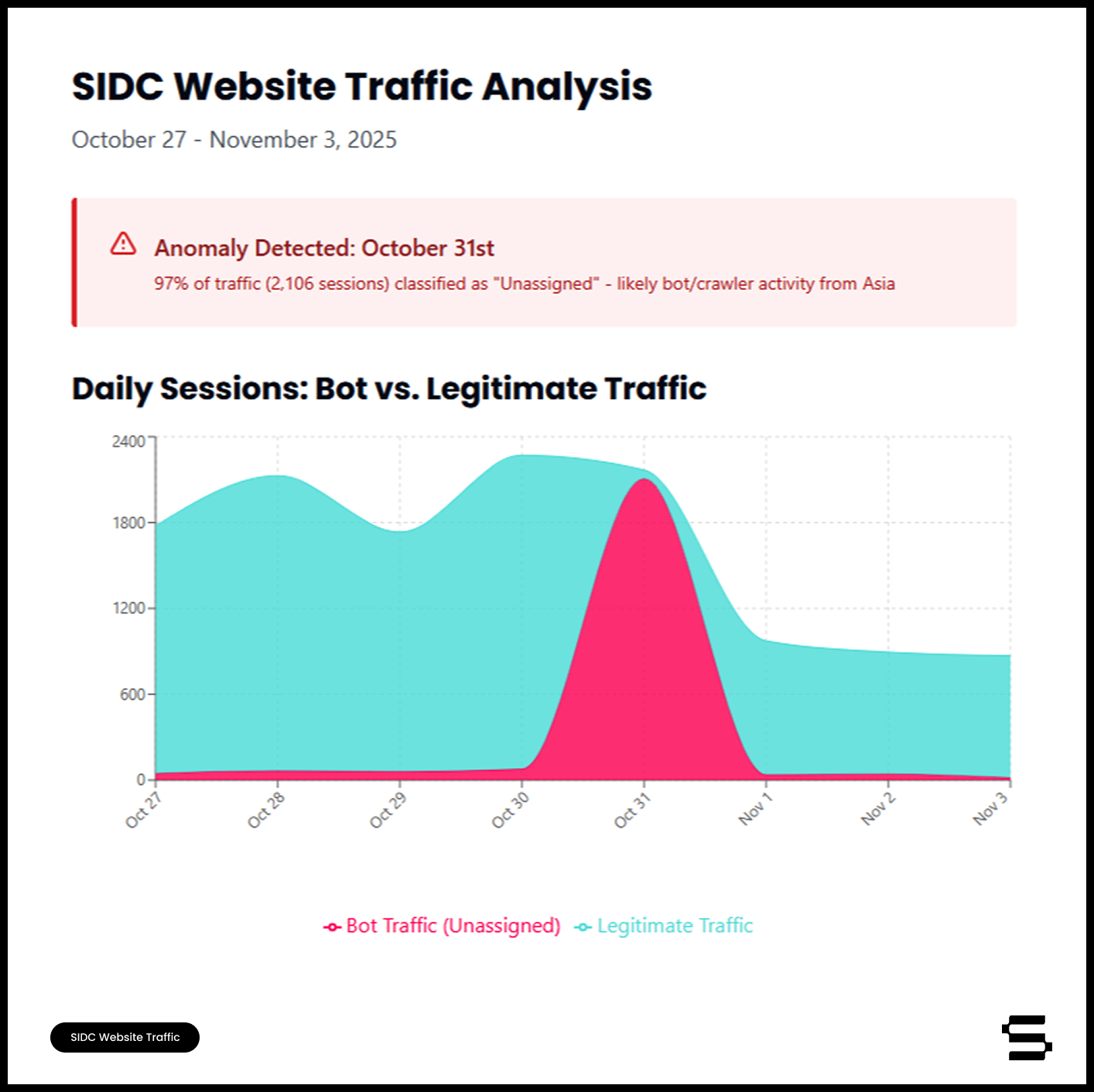
Traditional measurement would have celebrated that spike. We would have written a case study about it. We might have tried to replicate it. Conversational analytics revealed the truth in real time, before we made decisions based on garbage data.
The real, somewhat painful lesson: We were asking the wrong questions entirely.
Dashboards Aren't Dead. But they can’t talk.
AI is not here to kill the dashboard.
Dashboards still matter. I still use them daily and so do Seer Clients. They provide a recurring pulse on performance. They're excellent for trend monitoring, alerting, and giving stakeholders a snapshot of what's happening across the business. I don't see that going away.
What dashboards can't do is answer the follow-up question.
"Traffic dropped 15% last month." Great. Why? That question sends an analyst into a three-day excavation project. Export the data. Build segments. Cross-reference with campaign calendars. Check for tracking issues. Formulate hypotheses. Test them one by one. Report back.
By the time you have an answer, the moment has passed. The decision has been made…or worse, delayed until the next reporting cycle.
Conversational analytics is the intelligence layer. The dashboard is right now, AI is the “why” and “now what”.
Yes, AI can (and often will) Lie to You
Here's where I need to pump the brakes on the enthusiasm.
Conversational analytics is not infallible. Left unchecked, AI will confidently give you wrong answers. It will hallucinate patterns that don't exist. It will tell you exactly what you want to hear.
Remember the fake traffic spike story? The AI's first instinct was to celebrate too. It took skeptical follow-up questions to surface the truth. Without those questions, we would have optimized for bot traffic.
This is why guardrails are essential.
At Seer, we've built validation protocols directly into our conversational analytics workflows. One example is a custom skill based on Twyman’s Law.
Twyman's Law, a statistical principle that states:

"Any figure that looks interesting or different is usually wrong."
The skill automatically triggers enhanced validation when the data shows red flags. Metrics with greater than 50% change period-over-period. Conversion rates above 10% or below 0.1%. Traffic sources that account for more than 80% of total volume. Perfect correlations. Round numbers in large datasets.
Before the system draws conclusions, it asks a series of questions:
- Would this finding surprise the business stakeholder?
- Am I recommending action based on a single surprising metric?
- Does this perfectly confirm what the user wanted to hear?
- Would I bet my professional reputation on this data point?
If the answer to any of those is yes, the system flags it for human review before presenting it as a validated insight.
We've also implemented Seer's team-based quality assurance approach. Every month, our team actively tries to break the system. We attempt to make it hallucinate. We look for edge cases where it gives wrong answers. We document every failure and build instructions to prevent it from happening again.
Moving Beyond Any Single Data Source with MCP
Google Analytics is just one entry point. So is BigQuery. So is your CRM, your paid media platforms, your financial systems, your inventory data.
The real transformation happens when you connect multiple data sources into a unified conversational layer.
This is where MCP (Model Context Protocol) becomes the unlock. MCP creates a secure bridge between AI models and your data sources, regardless of where that data lives. It's not limited to GA4. It works with BigQuery, with advertising platforms, with any system that exposes an API.
The question that used to require a week of Excel work across multiple system exports becomes a 30-second conversation. "What's the actual profitability of customers acquired through paid search last quarter?" requires joining web analytics with financial data and CRM records. It used to be a project; now it's a query.
This is the shift from "analytics tool" to "business intelligence partner." The AI isn't just retrieving data. It's reasoning across data sources, identifying patterns, and suggesting next steps.
The Seer team has already built MCP integrations for GA4, BigQuery, and several marketing platforms. The phased approach for scaling from a single-source pilot to enterprise-wide deployment is something I covered in detail in [The True Cost of Conversational Analytics]. If you're thinking about implementation costs and infrastructure, start there.
The Future of Analytics Is Already Here → Don’t Get Left Behind
Every month you wait, your competitors are building institutional knowledge. They're training their teams. They're documenting edge cases. They're developing the muscle memory to ask better questions about their data.
Conversational analytics won't fix bad data, make your tracking gaps disappear, or replace the need for skilled analysts who understand your business.
What it will do is eliminate the friction between question and insight. It will make your existing data more useful. It will free your team to focus on strategic thinking instead of report building. And it will help you move faster than organizations still hiding behind the process.
The data we have is still incomplete. The difference now is that we have tools to use that incomplete data more intelligently than ever before.
Ready to get started?
Use Seer's free [Google Analytics MCP Setup Wizard - coming soon!] to configure your environment and connect your first data source.
Already connected? Read [The True Cost of Conversational Analytics] to plan your scaling strategy and understand the investment required at each phase.
Need help with multi-source integration or building guardrails into your workflow? [Contact our team].
And if you want more content like this on the future of AI and analytics, [subscribe to our newsletter].