
TL;DR
-
I compared llms.txt and AI info pages to determine if these were easy GEO wins or tactics without data proof
- llms.txt files failed to perform across several parameters: 0 for 2 on formal client tests, and almost no citation presence
-
AI info pages performed for 3 of 4 clients, and Seer's AI info page continues to be consistently cited a year after going live
-
A page bots never fetch can’t change an answer: one client’s AI info page got no traction as Markdown or as HTML, because AI agents weren’t requesting it
- In terms of which is more likely to be cited in AI responses, the AI info page is your winner
Are llms.txt and AI Info Pages Worth Your Time?
When the GEO race started, everyone was guessing about what worked - even us data wranglers. Without evidence of what worked well, we settled for what worked quickly.
Two of those tactics keep landing in my inbox: llms.txt and the AI info page. They’re often lumped together because they look alike and are "for the bots." Both are also pitched as low-lift and quick wins.
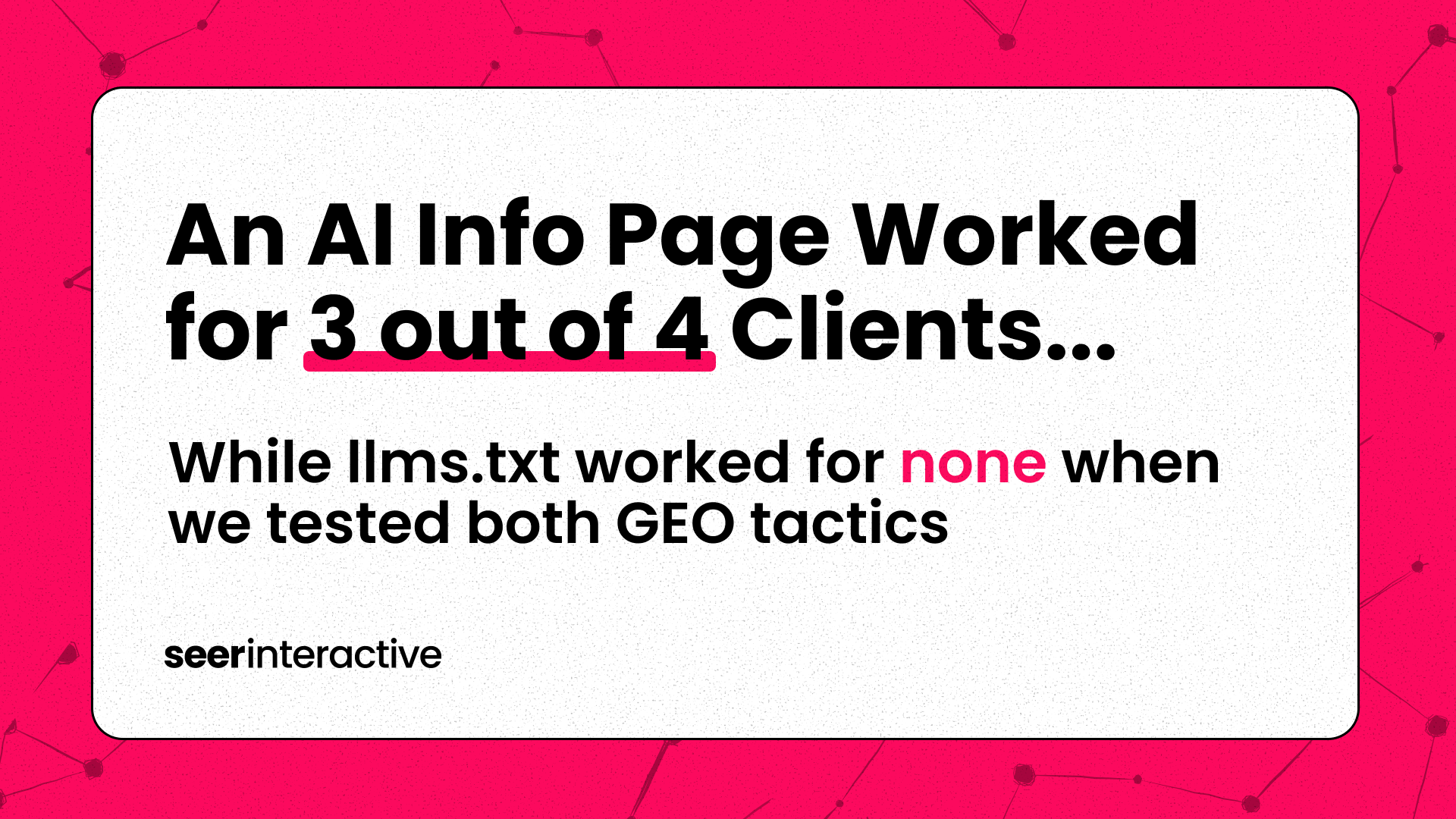
But llms.txt and the AI info page do different jobs, and in our testing they had very different levels of success: the AI info page got picked up for 3 of 4 clients, llms.txt for none.
Here's how they differ, what happened when we tested them, and when I'd reach for each.
llms.txt vs. AI Info Page: What’s the Difference?
llms.txt and AI info pages both get pitched as ways for AI answer engines to find and fact-check your brand. But they serve different purposes, and bots may or may not read them.
Here are our own examples from seerinteractive.com:
llms.txt started as a community proposal for a plain-text file that points models to a site’s most useful pages. The AI info page has no spec at all. It’s just a web page written for a different reader.
And here’s a quick overview of how llms.txt and the AI info page differ:
Bots browse your site differently from how people do: they search an index, or fetch a specific URL live when a question calls for it. An AI info page fits that path, while an llms.txt file gets largely ignored unless a crawler goes looking for it.
When we tested the two tactics, the AI info page worked for Seer and 3 of the 4 clients who've tested it. Conversely, llms.txt failed to draw meaningful bot traffic, let alone steer it.
In Our Tests, AI Info Pages Outperformed llms.txt
We have a GEO Test & Learn Library that tracks every completed GEO test we've run for our clients - 70 completed GEO tests across 17 clients as of October 5, 2026.
Our findings from client tests of llms.txt and AI info pages were as follows:
-
0 for 2 on tests targeting llms.txt
-
3 for 4 on AI info page tests
-
Counting a head-to-head test where both launched the same day, llms.txt is 0 for 3
When we ran the tests for ourselves at Seer, we saw the same effects.
llms.txt Saw Almost No Traction Among Bots
In 2025 we shipped llms.txt for several clients. It was cheap and LinkedIn was loud about it, so we decided to test it.
Overall, our findings on llms.txt were underwhelming:
-
Two clients ran formal tests, and neither logged a single ChatGPT request for the file
-
Across nine total clients, answer agents barely asked for it and the net impact on AI citations was negligible
We even tried a different perspective, analyzing the performance of llms.txt in AI answers. Of about 9.2M AI answers across 100 client data sets, only 73 cited an llms.txt URL, mostly developer docs. Of those, 15 were Gemini inventing yourdomain.com/llms.txt while giving GEO advice.
We’re not the only ones seeing it. Ahrefs found that of roughly 38,000 sites with a valid file, 97% got no requests for it in May 2026. An SE Ranking study of about 300,000 domains found no clear effect on AI citations. And Google’s own guidance says Search ignores llms.txt.
Once the results came in, we stopped recommending llms.txt as a GEO tactic. Performance didn't move, LLMs didn’t cite the files, and the logs showed AI crawlers weren't requesting them.
AI Info Pages Performed for Us and Our Clients
Often we say that good science is both repeatable and reproducible. So we ran AI info page tests just like the llms.txt tests, and found a very different picture.
First, the bots actually go get the page. Here’s how agent requests for the AI info page compared with llms.txt on the two client sites where we can see bot logs, and on our own. robots.txt is in the table as a yardstick, since nearly every crawler checks it:
Every site in our logs with an AI info page saw far more agent requests for the page than for llms.txt, including the developer platform that runs both.
Second, what’s on the page shows up in the answers. Four clients have tested an AI info page, and AI answers picked it up in three:
-
Energy technology company: 21 of 57 tracked facts (37%) showed up in ChatGPT answers about a month after launch
-
Enterprise data-protection software company: Launched an AI info page and an llms.txt the same day; Gemini and Perplexity cited the page and never the file, though that’s an early read on about 10 answers in three weeks
-
Accounts receivable software company: The client’s team called it a win
-
Communications SaaS company: Bots never fetched the page, so it never had a chance to change an answer (more on that below)
Audience and industry framing stuck best, and proprietary product names stuck least. That's a good reminder to use the words your buyers do.
Outside of our Library, we also tracked a financial data and ratings firm. The page drew 439 requests from ChatGPT-User, 74% of all requests to it. ChatGPT-User fires when a real person’s question sends ChatGPT to read a page live. In a 10-answer sample of branded ChatGPT responses, about half picked up some of the page’s language, most of it partial matches.
No Fetch, No Result
The miss was the most useful result of the bunch.
The communications SaaS company’s Markdown (.md) version of the AI info page drew zero AI crawler requests in its final week, and only 1 of 30 tracked facts showed up in answers. The team relaunched it as HTML in January 2026 and got 0 of 30 on the same prompts.
Changing the format didn’t fix it, because bots weren’t fetching the page. A page that never gets fetched can’t change an answer, regardless of what's on it.
We still recommend HTML, because every AI info page that worked in our data was HTML, and HTML is what answer engines search for and fetch live. But this client shows that the first thing to check is the logs, not the content.
A Year In, Seer’s AI Info Page Still Owns the Who-Are-You Answer
We looked at a year of data to see whether our AI info page has continued to perform. Seer's AI info page went live in October 2025 and Wil Reynolds has tracked it in Scrunch since mid-November.
On the most direct brand question there is, "Tell me about Seer Interactive," the AI info page has been cited in about half of answers all year: 50.4% on average from late November through March and 52.5% from June through September, across 403 answers. It held steady even when citations on our other brand prompts dropped in late January.

Then we split the branded prompts in two. Plain brand prompts ask about Seer by name and nothing else, like “Tell me about Seer Interactive.” Persona prompts still name Seer, but they come in a buyer’s voice, with a role and a problem attached: “As a CMO whose paid media costs keep rising while organic results decline, I want to know how Seer Interactive builds integrated strategies that reduce paid dependency.”
The first is a who-are-you question. The second is a should-I-hire-you question, and the model pulls from a lot more of the web to answer it.
Plain brand prompts: On the six we track, the citation rate fell from 57% to 37% in a single step on January 26, then slid into the high 20s by late March.
Persona prompts: On the 41 persona-style prompts we switched to in April, citation rate fell from 19.5% to 7.8% around the start of June and has sat between roughly 5% and 13% since.
So the page holds the who-are-you answer and loses ground on should-I-hire-you. That’s the line between what an AI info page does and doesn’t do. It isn’t set and forget, either: the core answer held while the broader branded share drifted down.
Now the Bayesian caveat.
The llms.txt results are the better-controlled ones: subfolder comparisons and server logs, though each has only two to three weeks of post-launch data.
My confidence there is high. llms.txt doesn't get fetched. The AI info page wins are thinner. None had a control, most were read on a single platform, and one is an early read on about 10 answers. I'm moderately confident in the direction, and I expect to update.
Our own backlog has already voted, with 21 AI info page tests proposed or in flight and exactly one llms.txt test.
llms.txt or AI Info Page: Which Should You Use?
Stop asking "which tactic should I use?" and start asking "what problem am I trying to fix?" For most brands I talk to, the problem is that AI gets their brand information or narrative wrong. That calls for an AI info page.
Here’s a breakdown of what to focus on based on what you’re trying to accomplish:
What if a client wants llms.txt "just in case"? Fine. It's about an hour of work, and it won't hurt anything. Ship it, link your AI info page from it, and move on. Just don't count it as your GEO strategy.
What I'd Do Today
If you only do one thing based on this blog, build an AI info page. The condensed playbook:
-
Find the gaps. Run your branded prompts and write down what AI gets wrong or leaves out.
-
Write plain facts, with corrections spelled out. Short sections, dated numbers, and your buyers' words instead of your internal product names.
-
Publish it as HTML. A clean URL, a 200 status, no noindex, and no JavaScript needed to see the text. Link it from the footer and add it to your sitemap.
-
Check the logs before you judge anything. No fetches from ChatGPT-User, PerplexityBot, or similar agents means no test.
-
Measure language adoption on branded prompts. First look at 4 weeks, make the call at 12, then refresh it every quarter.
All of this fits into a bigger shift in how the web works these days. As we move fact-finding and research to AI tools and Answer engines, the focus goes from how to organize information for human consumption (clean UX, semantic markup, responsive design for every conceivable screen size or device type) to AI consumption (schema, .md files, etc.).
My colleagues, to their credit, have been saying so already. Alisa Scharf argues you should fix how LLMs see your brand before chasing AI rankings, and John Lovett lays out how to write those facts down in a brand canon.
If you want help figuring out where to focus your GEO efforts, Seer can build and implement a strategy for you. We can help create your brand's AI info page or llms.txt, or even work with you to build a brand canon. Chat with us to learn more.