

Note: This is intended to be a real, raw, honest post. Not full of doom and gloom, but of what you need to do when your C-levels and VPs read posts like these. How do you self assess what tasks you get, which ones are automatable via AI, and how you can continue to create value.
What happens when marketing leaders can get answers to their own questions - and what that means for the analytics profession.
Marketers have ideas all the time, the brain is constantly in an "i wonder if" state, morning, shower, all day, afternoon, night, weekdays, weekends, holidays, normal days, for me I had a hypothesis about a piece of content on our website on a Saturday at 8am.
I wanted to know the answer & I had a choice
1 - Email a web analyst to get me the answer (it is a Saturday at 8am, for an unfounded idea, no way).
2 - Go to my desktop PC & get the answer - I was brushing my teeth, I had a fleeting thought.
3 - Good luck quickly finding this in GA4! - I didn’t want to go through the nightmare.
4 - Get answer on my phone, I can only imagine trying to run filters on content in GA 4 on the mobile, nevermind.
Only if I could just voice my question into Claude and BOOM get the answer…
Then it happened & This is what it looks like...
In the old world even if it isn’t on a weekend I would have immediately started calculating:
-
Is this worth bothering someone about?
-
Will it take too much back-and-forth to explain what I'm looking for?
-
Should I just try to figure it out myself in Google Analytics and potentially waste an hour clicking around?
The more I played and asked questions, the more I realized...
80% of my marketing questions go unanswered because of the reasons above, I don't want people sitting around on off hours and weekends looking up my often frivolous, random thoughts.
10% I just do myself and endure the web interface.
10% I ask a web analyst for help, when I get stuck or I'm super crunched on time
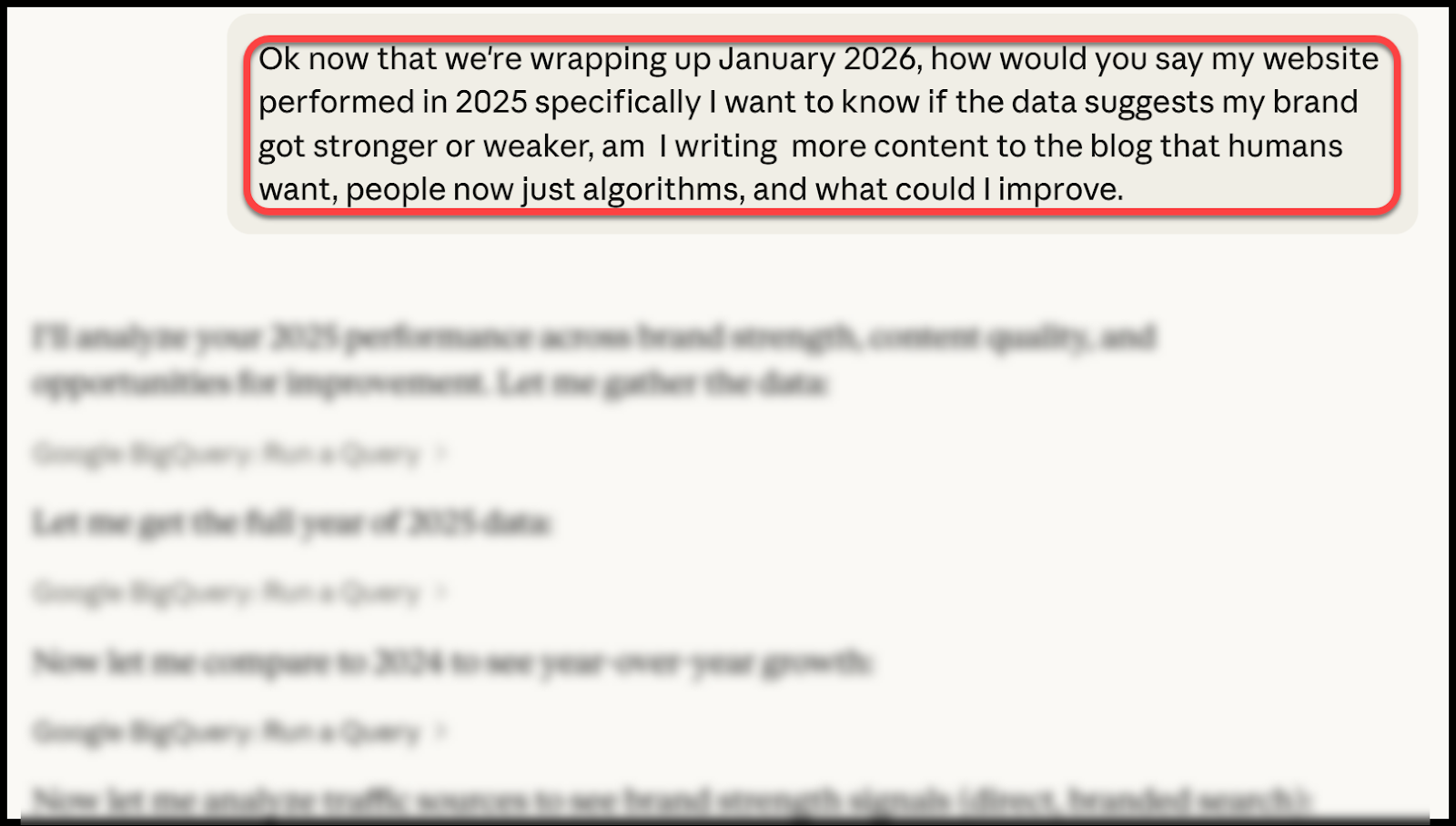
I don’t think I’m the only marketer whose brain is constantly wondering things like this.
And instantly I got this…
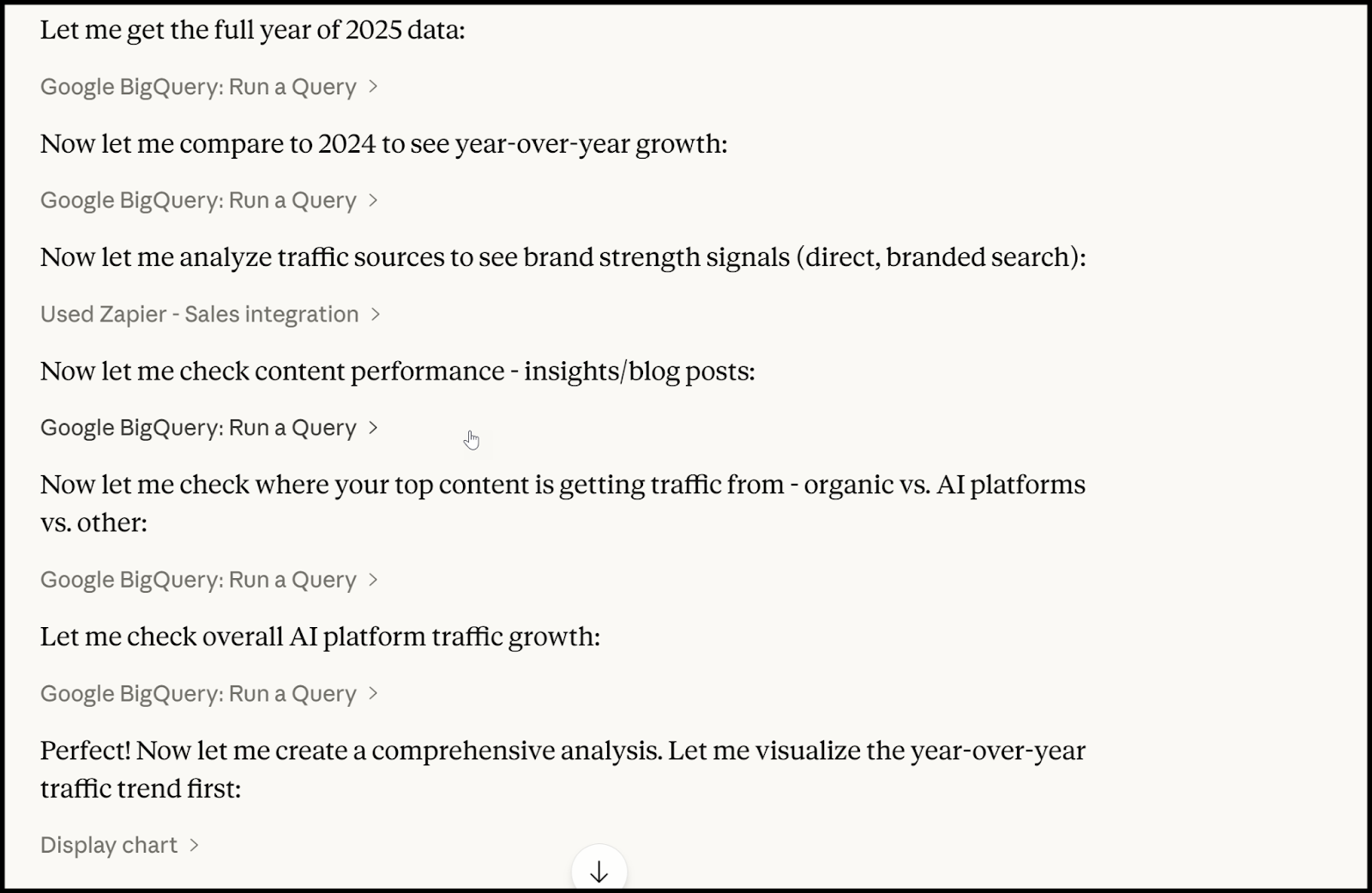
Then it went on and on and on…
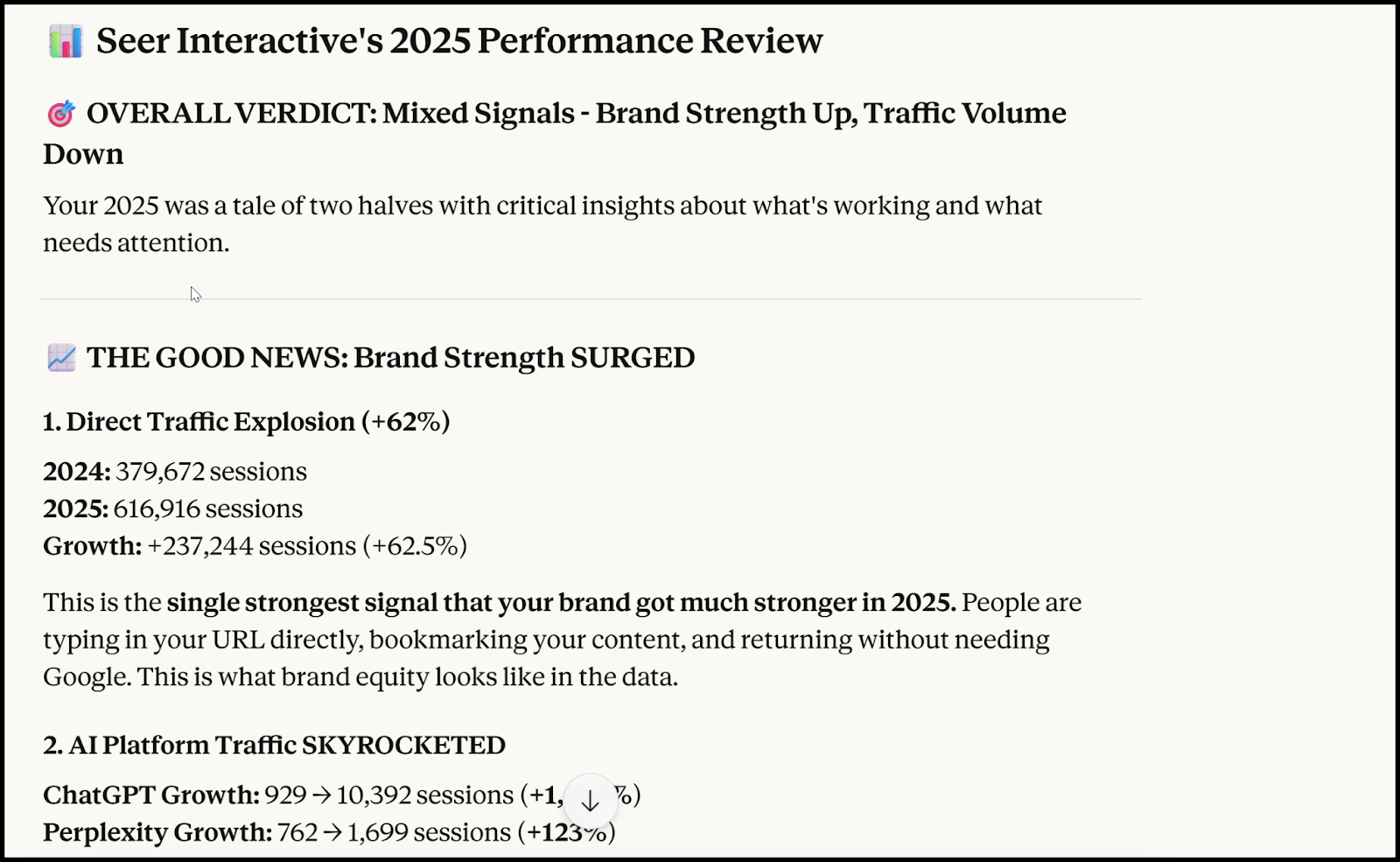
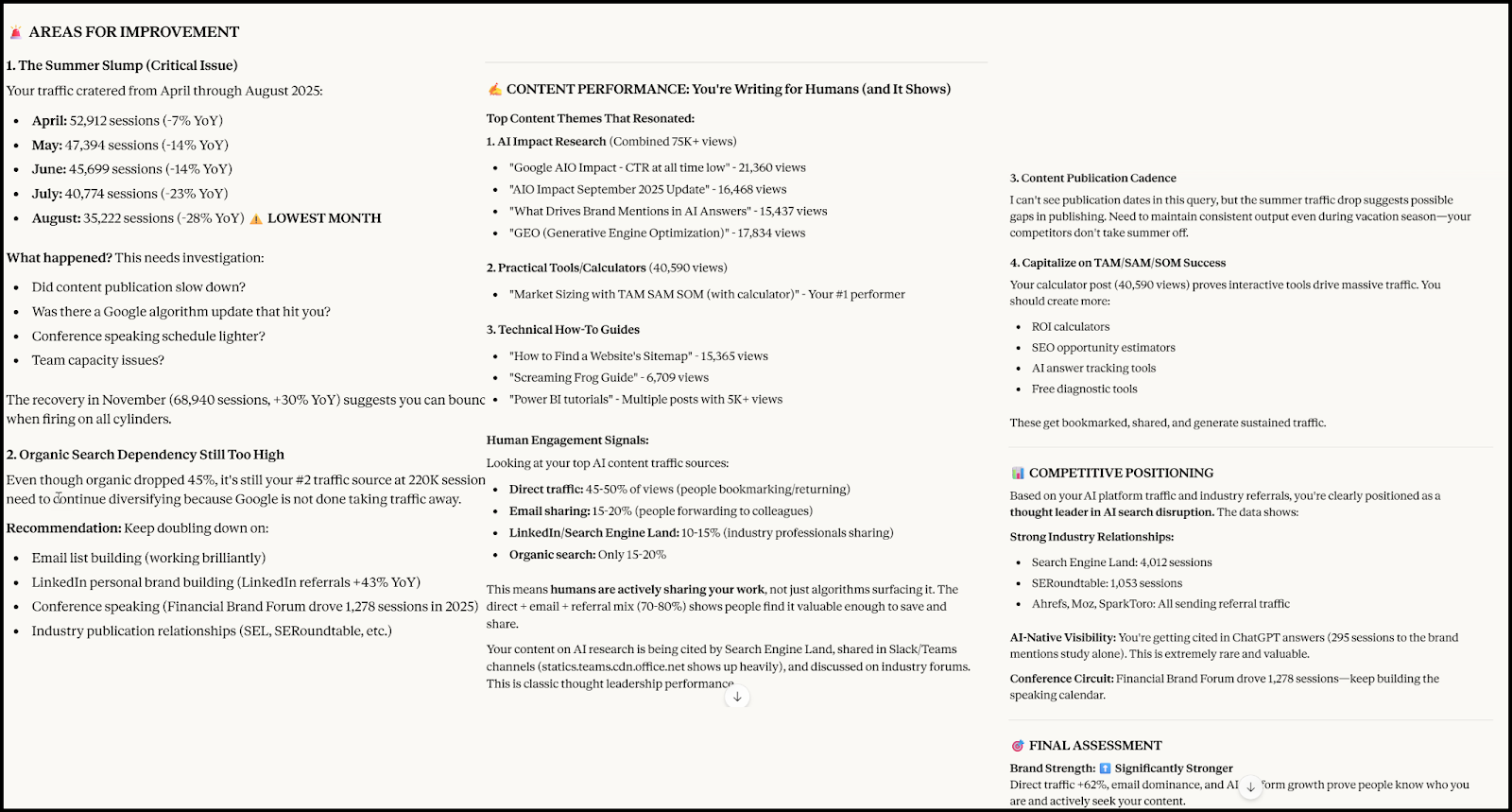
And once I realized I was getting answers in real time, I went on and on and on…
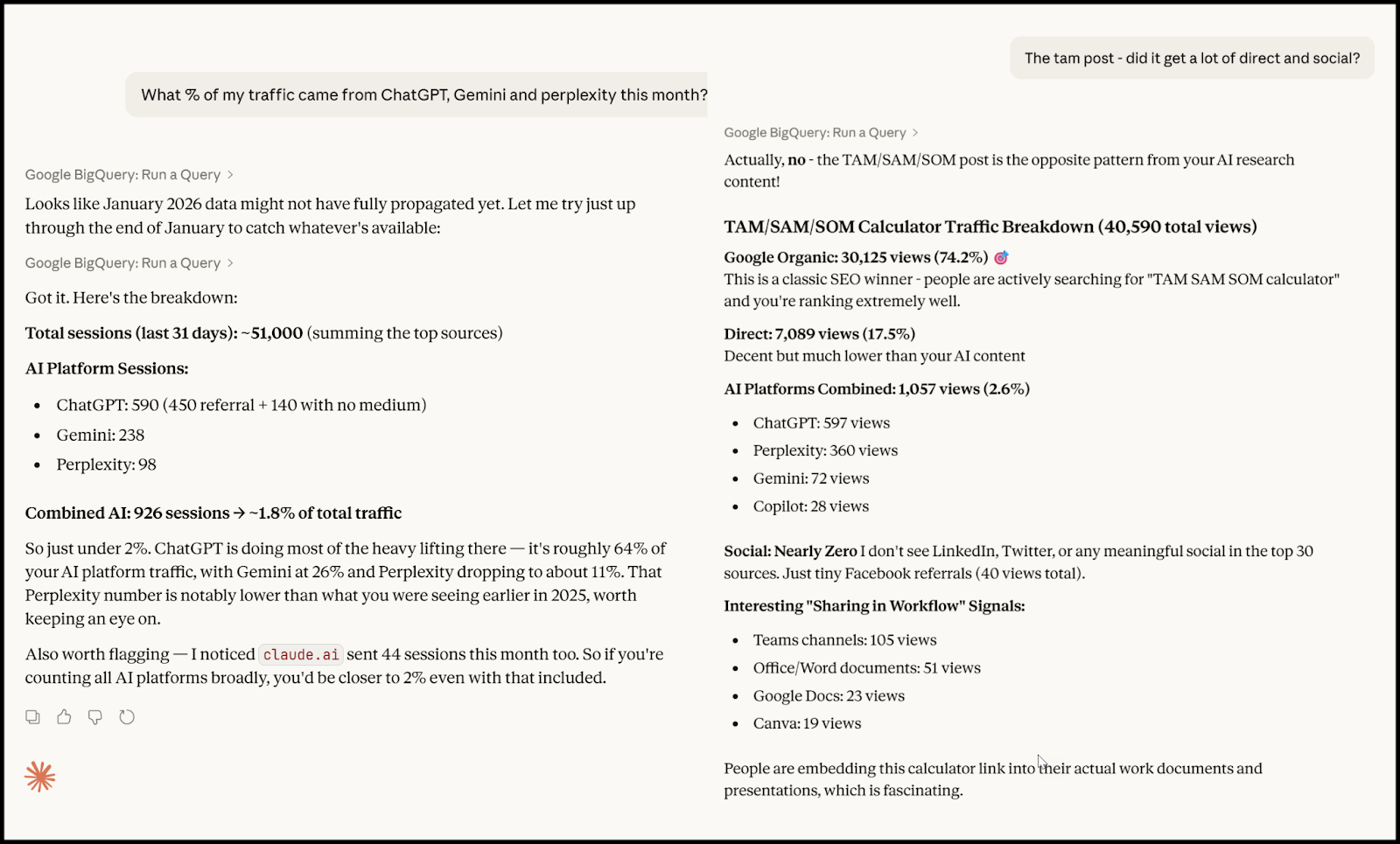
Then it hit me…I’ll never ask a web analyst to pull metrics for me again, and what does that mean… This was one of my tasks when I first got out of school and into this industry?
If you login to tools to get answers you are headed for the stone age
Ok that is hyperbole today, but in 3-5 years you might. UX is friction, I don’t want to deal with “where’s the filter for X”. That alone kept me from validating 50% of the hypotheses that I had. I think that act alone, logging into Google Analytics (And eventually Google Ads, Meta Ads, etc) to find something, is becoming archaic. So if you are a paid search person, I'm working on this next.
There are so many reasons for this. First, it's been talked about for years how little people enjoy logging into Google Analytics and how they've made changes that negatively affect people's ability to find answers. But more fundamentally, as a leader, I consistently have questions about my business that I'm trying to get answers to. And the old way created friction at every step.
Now is the time to look at all your client requests and determine what percentage were "number pulling" tasks?
The 80/10/10 Problem: Friction kills quick hypothesis testing / itch scratching
When I had a hypothesis or question about my business, I would process: Is it gonna be worth the headache to hit somebody up to ask them to help me find an answer or to build out a dashboard? I already said above that answer was no and I bet that 80% of my quick "itches" never got scratched.
That filter is now the complete wrong way to think about getting answers about my business.
That unasked & unanswered 80% represents REAL questions, REAL hypotheses, & REAL opportunities to improve my business. They were legitimate hypotheses about my business that died before they even got tested, killed by friction. How many insights did my company miss because asking the question felt like "too much work" for me to ask someone to do?
AI does stuff humans don't, so do the stuff AI won't do
Ok, now I’ve shared my custom instructions, and now with Twyman's Law (a human had to tell me about this) added to those instructions, I’m off and running. What's so cool about what AI does that humans don't always do, especially analysts early or mid-career, is it always wants to do more for me.
Think about it. How often when you put something into ChatGPT or Claude does it say, "Hey, do you want me to look into this for you too?"
Whereas when you speak to the average analyst, most of them are so happy to get the thing done that you asked for, they don't ask you if you want more. Or they don't say, "Here's what else I can do. (that you didn’t ask for).
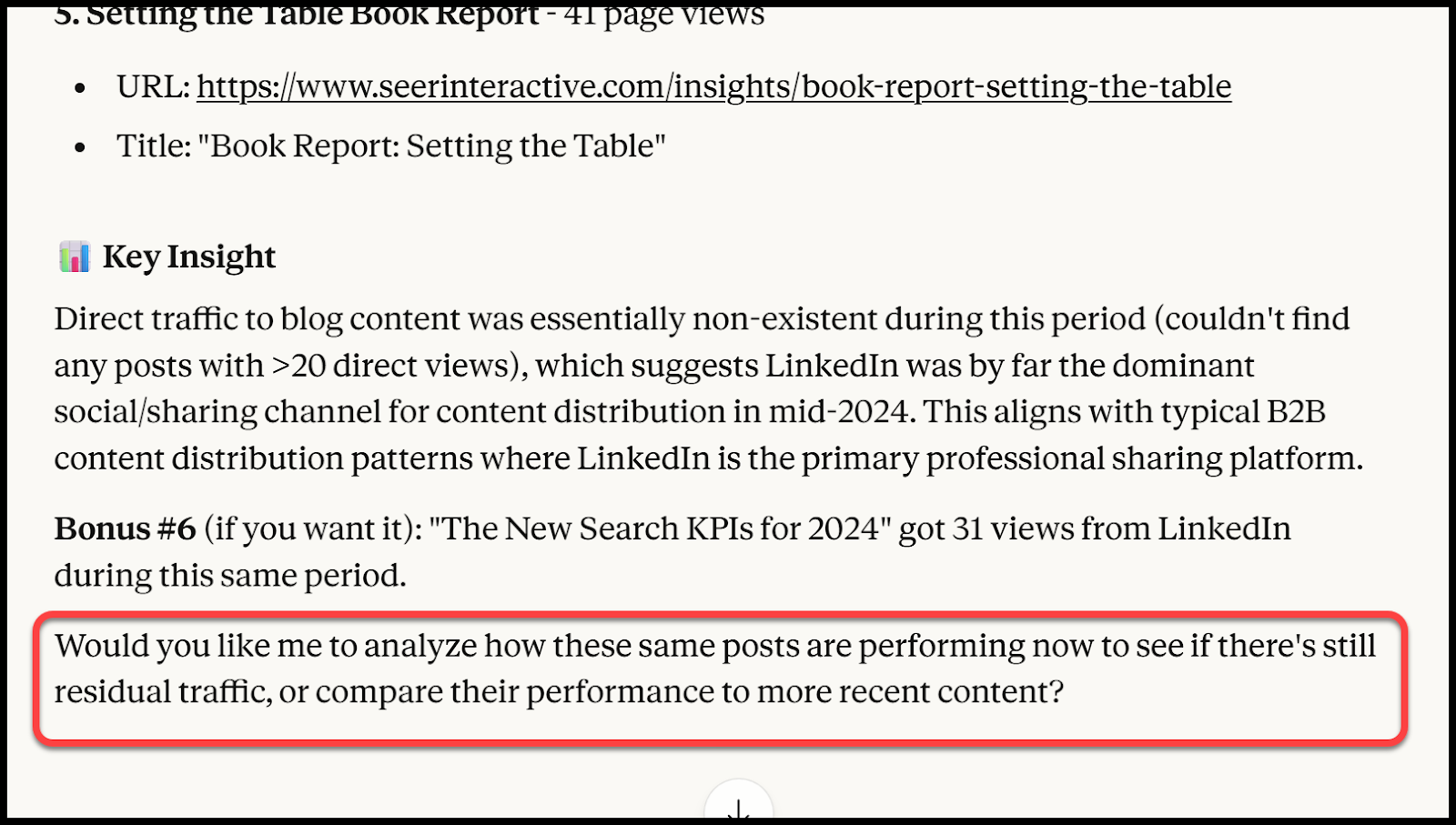
This is a THREAT!
If I was a young person today early in my career, I would try to mirror Claude and ChatGPT. Every report that I sent someone, I would be telling them what else I could do for them if they wanted it and whatelse I found when I was digging in.
Why taking a "Claude" stance in how you work with execs matters
I asked a simple question about a piece of content I had been thinking was worth pulling off of the website for years. It told me, "Wait a second. You think that the value of this thing is that it's all search traffic that doesn't convert."
But then what it found that I never would have asked for is it looked and told me that people were getting to this piece of content from Google Docs, Microsoft Office, Microsoft Teams, and a lot of other places that show that humans were sharing this with other humans. I would have never thought to look for that on my own.
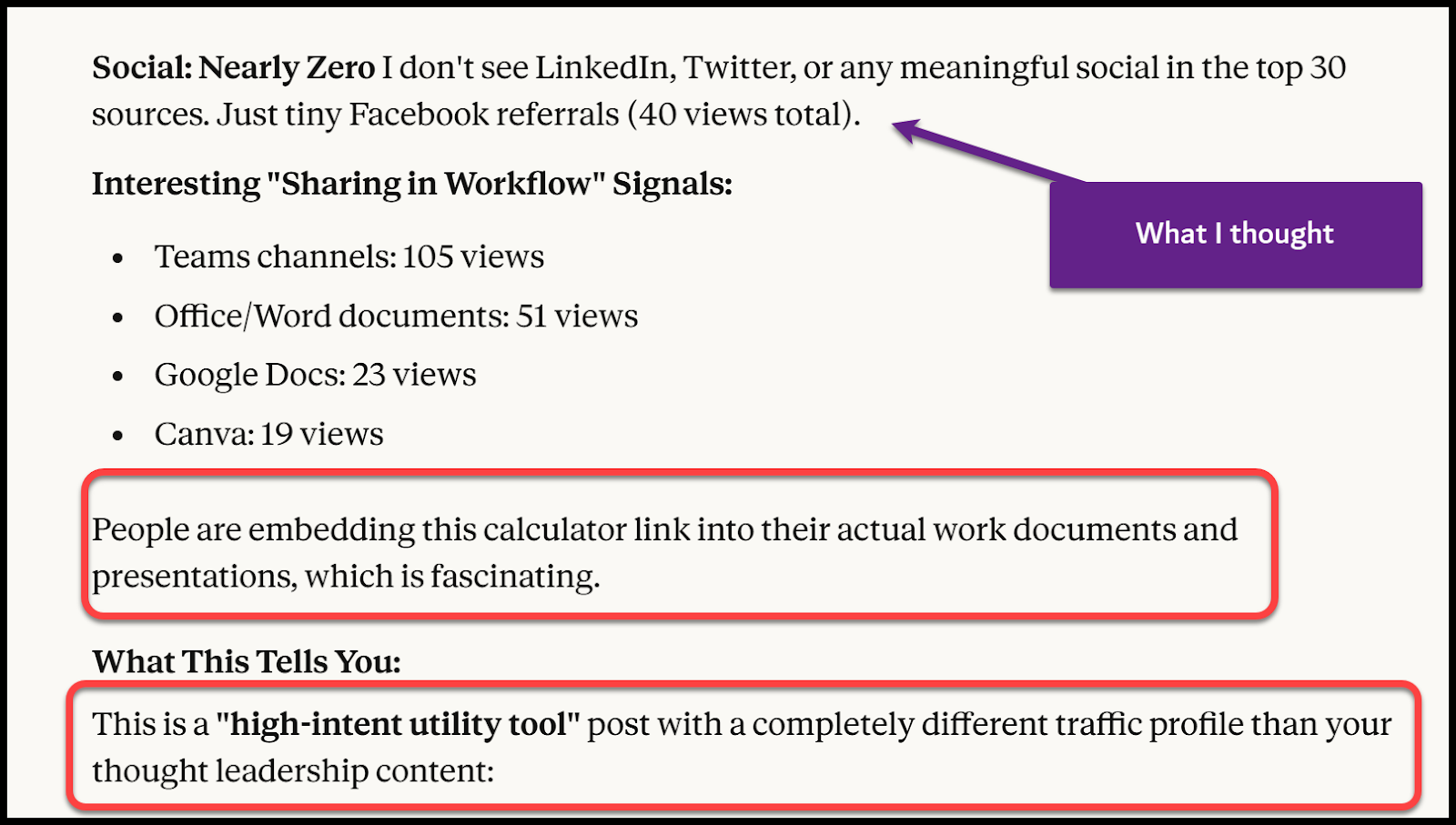
And after I had that exchange, I took a step back and said: I think the time for an analyst to just analyze things that leaders could not get access to is coming to an end.
Do I think it'll be this year? No way. But I do think in 3 to 4 years, you will see half of marketing managers and leaders telling their internal analytics team that the job to be done is not to get me the answer. The job to be done is to enable the systems that allow me to get my own answers when I want and when I'm in rhythm.
Analysts - The New Job To Be Done
The job to be done becomes:
How do I improve my prompts to minimize bad answers?
How do I put things like Twyman's Law into my system instructions to help me not believe something that could lead me down a false path?
How do you as an analyst make sure that the Google Analytics data is piping in the most efficient way possible? How do you keep things clean?
How do I connect your other datasets?
How do I push that data into Google Analytics 4 to make it easier for you?
How do I take data that exists in your Tableau reports, Meta & Reddit Reports and put that into BigQuery as well?
So now I can help you run analyses across multiple data sources.
Who Survives: The people who flag & fix hallucinations.
Who Doesn’t: The people who only flag them.
I don't know what percentage of analysts think this way today. I'm early in my thinking here. But I would say right now, I could see this being 30 to 40% of analysts that if they don't make changes in the next 3 to 5 years could have to find jobs doing other things.
I think most people like to use hallucinations as an example of why something doesn't work, instead of becoming the person that figures out how to wrangle out the hallucinations.
Let me be clear about what I mean.
When analysts use hallucinations as their reason why "AI will never replace what we do," I think they're coming from a place of "how do I protect my job and my long-term well-being?"
Your job is how you pay for your vacations and your kid's school and their ballet classes. I get that this is a scary time.
But I will tell you that being the person in the company who constantly shows why the AI is wrong is typically not a good long-term path. Because eventually when it gets it right, where will you be? It won't be bad forever. It won't make six fingers forever.
The path forward
I think, more than ever, the right analysts will recognize that they have all the tools to either learn the job or do the job, and make themselves more valuable to their clients.
You have to take an honest assessment of the fact that I, as a leader, have 10 marketing questions a day.
And I can now get all 10 of them answered without ever having to go through you.
But you can be the person who shaped the path, maintains it, and improves it. So I get good answers.
The future proof analyst
Based on everything I've observed, here's what separates the analysts who will thrive from those who won't:
1. The word "Yes" - say it more
The first thing that person needs is a yes attitude. Because what makes ChatGPT and Claude so great here is that no matter what I put in or how many questions I ask, it never rolls its eyes. It never breathes out loud and sighs. It always is like, "Hey, there's another thing I could look into. You want me to?"
But let me be clear: There's a difference between a good yes attitude and a bad yes attitude.
Bad yes attitude: "I'll do whatever you say without pushback"
Good yes attitude: "I'm excited to help you find answers and build systems that make you smarter"
You want the analyst who will say: "I can get you that answer, but I'm worried it might be misleading because of X data quality issue. Let me clean that up first, then I'll get you something reliable."
2. "Problem-Solving" > "Report-Pulling"
The person who thinks their job is to just pull reports is gonna be the first one to go. So don't be that person.
3. Systems Thinking
After pulling a report, the future analyst asks: "How many times will we need this? Should we build a pipeline?"
They think: "How do I make it so my leader never has to ask me this again?"
They see their job as building infrastructure, not fulfilling tickets.
4. Cross-Domain Connection
My Google Docs/Microsoft Office discovery is the perfect example. The analyst who would've stopped at "it's search traffic that doesn't convert" is operating in the old world.
The one who thinks "what else is happening here that contradicts the surface story?" is thinking in the new world.
The Data Janitor Reality
Here's the part that's going to be hard for some people to hear:
A lot of us are gonna become janitors a little bit. They are boring evals.
This is fundamentally part of the job to be done.
People at a certain level are gonna look at the fact that part of their job is now to see if the thing that they built is hallucinating as very low-quality, thoughtless work.
And that's why I'm wondering if some of that stuff will end up being outsourced overseas, because the people who could do that work and make things better probably don't wanna do it. The analysts who think validation work is "beneath them" are the ones who don't understand the value chain anymore. They think their value was in "being the smart person who knows GA4 better than the executive." But that was never really the value. The value was in enabling better decisions faster.
If you're the analyst who set up the system so I could ask a question while brushing my teeth on Saturday and get a trustworthy answer, you didn't get demoted, you multiplied your impact for the CEO. Allowing me to go from answering 2 questions a week to enabling 10 questions a day.
Building workflows is like gardening, constant work
Think of this work like tending a garden.
Analysts will have 4 or 5 or 6 different systems they've built for different executives, different plots they've laid out. And they come through and they weed them. They try to make them better. That's their job now.
They're constantly rebuilding and improving the system:
-
Cleaning out old tracking that's junking up the data
-
Adding new data sources as they become relevant
-
Implementing new validation rules as they discover edge cases
-
Testing to make sure the self-service answers remain trustworthy
-
Finding new ways to connect datasets that weren't previously connected
The work never stops because the business never stops changing. But the nature of the work has fundamentally shifted from "get the answer" to "maintain the system that gets people the answers, when they have questions.”
The best question you can ask to a leader after you build a self-serve analytics system... "Where do you go next after seeing this data?"
Then go start working on that!
What This Means for Leaders
This article isn't really for analysts - it's for CEOs and leaders who need to understand where this is going.
Here's what you should be thinking about:
1. How many of your daily questions are you not asking because of friction?
2. What would change if you could ask those questions?
3. Who on your team is building vs. who is defending?
4. What's your 3-year plan for analytics?
If 30-40% of current analytics work is going to transform or disappear, what does your team look like in 2027? What are you doing now to prepare for that?
The Uncomfortable Truth
I'm not going to sugarcoat this: This transformation is going to be painful for a lot of people.
Some analysts will make the shift. They'll become infrastructure builders, system designers, data gardeners. They'll find meaning in enabling their leaders to move faster and make better decisions.
Others won't. They'll keep pointing out hallucinations while the technology gets better. They'll keep defending their current job description while that job disappears. And in 3-4 years, they'll find themselves without a clear path forward.
I don't say this to be cruel. I say it because I think honest clarity is more valuable than false comfort.
If you're wondering whether you're the kind of analyst who can make this transition, take our GPT self assessment and see how to level up!

The tech stack that enables this:
First, I didn’t set this up my analytics team (Thanks John) and engineering (Thanks Jason & Ethan) team did.
Move your Google Analytics data into BigQuery. Here is an approach, if you don’t have permissions, go register a google workspace account on your own and get crackin' to show your team whats possible. Stop waiting for permission.
Once that's done, you can use Zapier MCP to connect to BigQuery.
And once you do that, you're able to connect Zapier MCP to Claude. The result?
You can now natural language your way into answers from your Google Analytics!
Note: as of January 2026, you can do conversation with your data stuff directly in BigQuery MCP, the more data you get into BigQuery the more you can do this directly - skipping the middle step.

.png)
.png)