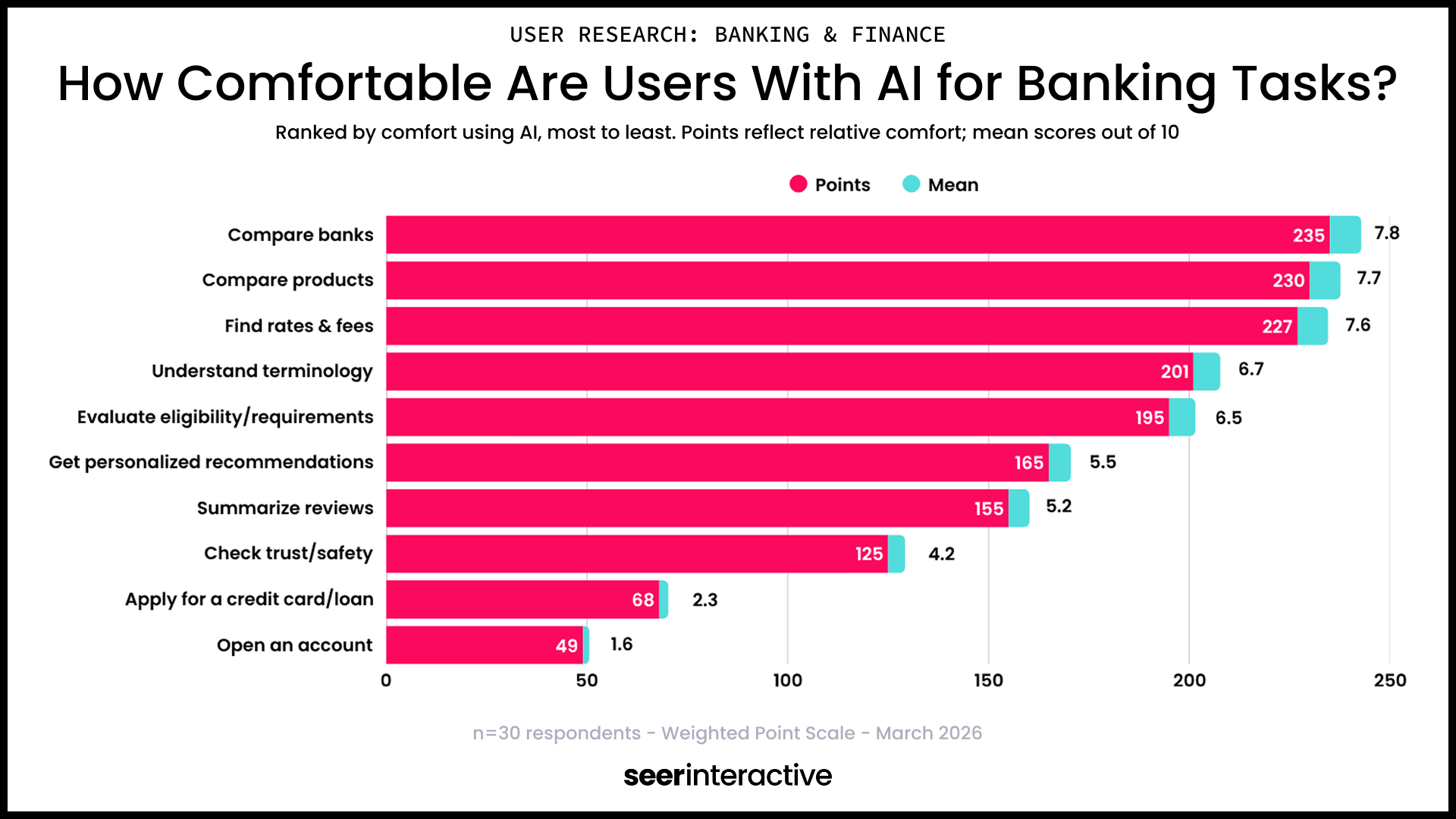
In a recent usability study our UX team completed with Outset.ai we found that users are most comfortable with tasks throughout the research and consideration phases, but conversion actions were the lowest on the list.
[These are just our initial findings, and will have more in-depth research coming soon.]
Users are comfortable looking for quantitative information with AI, like interest rates on credit cards and fees, but aren’t ready for the assistance in opening an account yet.
Higher intent, lower tolerance
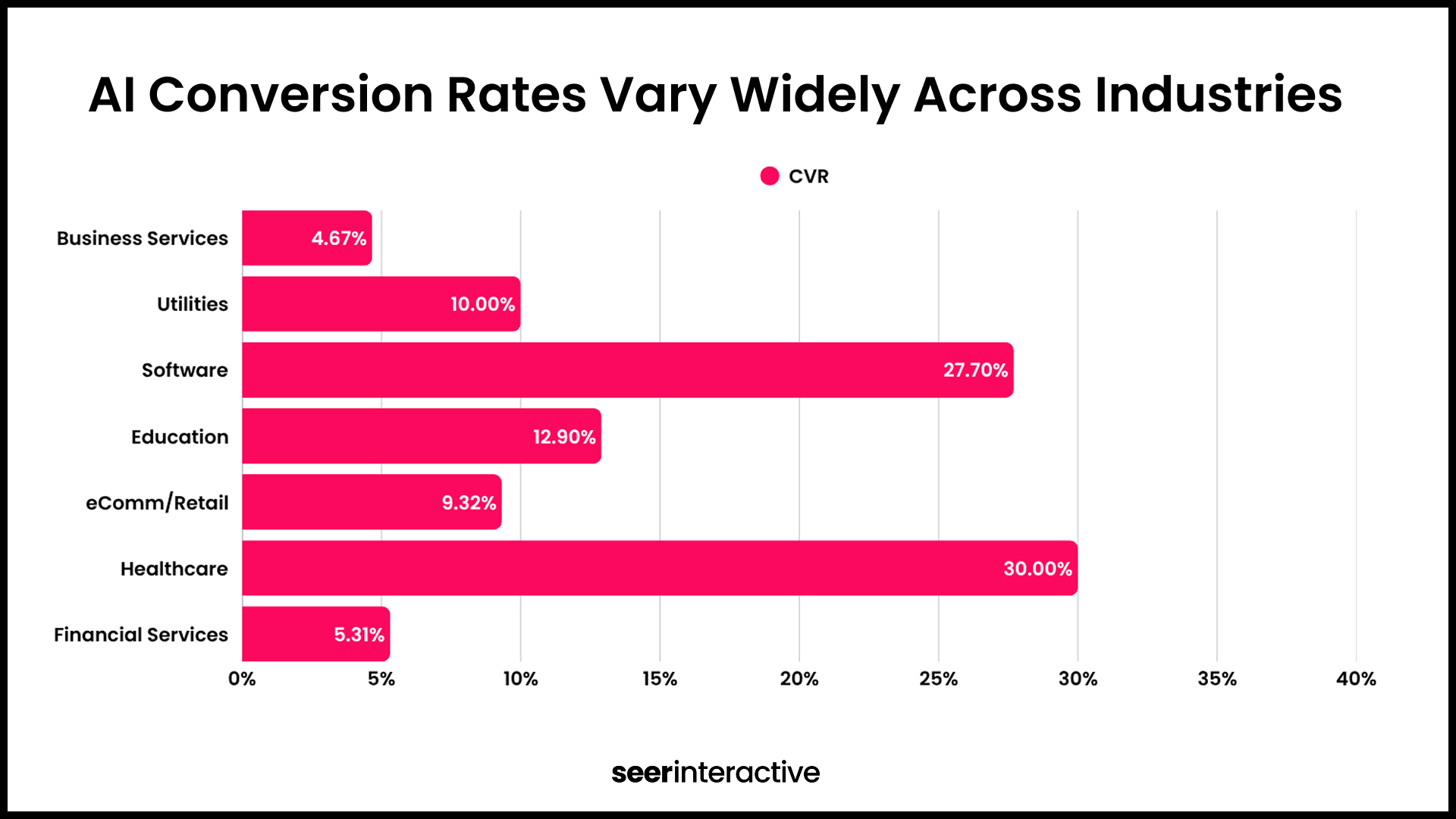
The heavy lifting that AI assists with throughout the mid-funnel has been hypothesized as a primary reason for the stronger conversion rates we’re seeing from AI-referred users compared to other channels.
As AI-powered platforms become the default tools for research and evaluation, users are increasingly forming opinions, comparing options, and narrowing their choices before they ever land on a brand website. AI is helping to compress the messy middle of the consideration phase in this new type of customer journey.
The seamless, personalized standard set by those AI platforms also doesn't stay behind when a user clicks through or seeks out your brand website. There is an expectation transfer that happens, which means they arrive on your site already calibrated to a higher UX bar. While high-intent visitors might seem like easier conversions, they're often less forgiving ones. A site that's difficult to navigate or unclear in its messaging creates a jarring contrast with the experience that preceded it. Users aren’t in exploration mode; they are in confirmation mode and may have less patience for friction. That friction may also no longer read as an inconvenience to push through, but rather as a reason to reconsider.
Your site structure is now a competitive differentiator
Let’s take a deeper dive into the financial industry’s digital channels.
A lot of financial products and services are commoditized at this point. Overall, the products and services are similar and users make their selections based on offers and rates.
Banking organizations were historically able to win visibility in this landscape through their authority - we even have a post from 2025 highlighting awareness as a key driver for their visibility on ChatGPT.
In real-time we’re seeing a shift happen
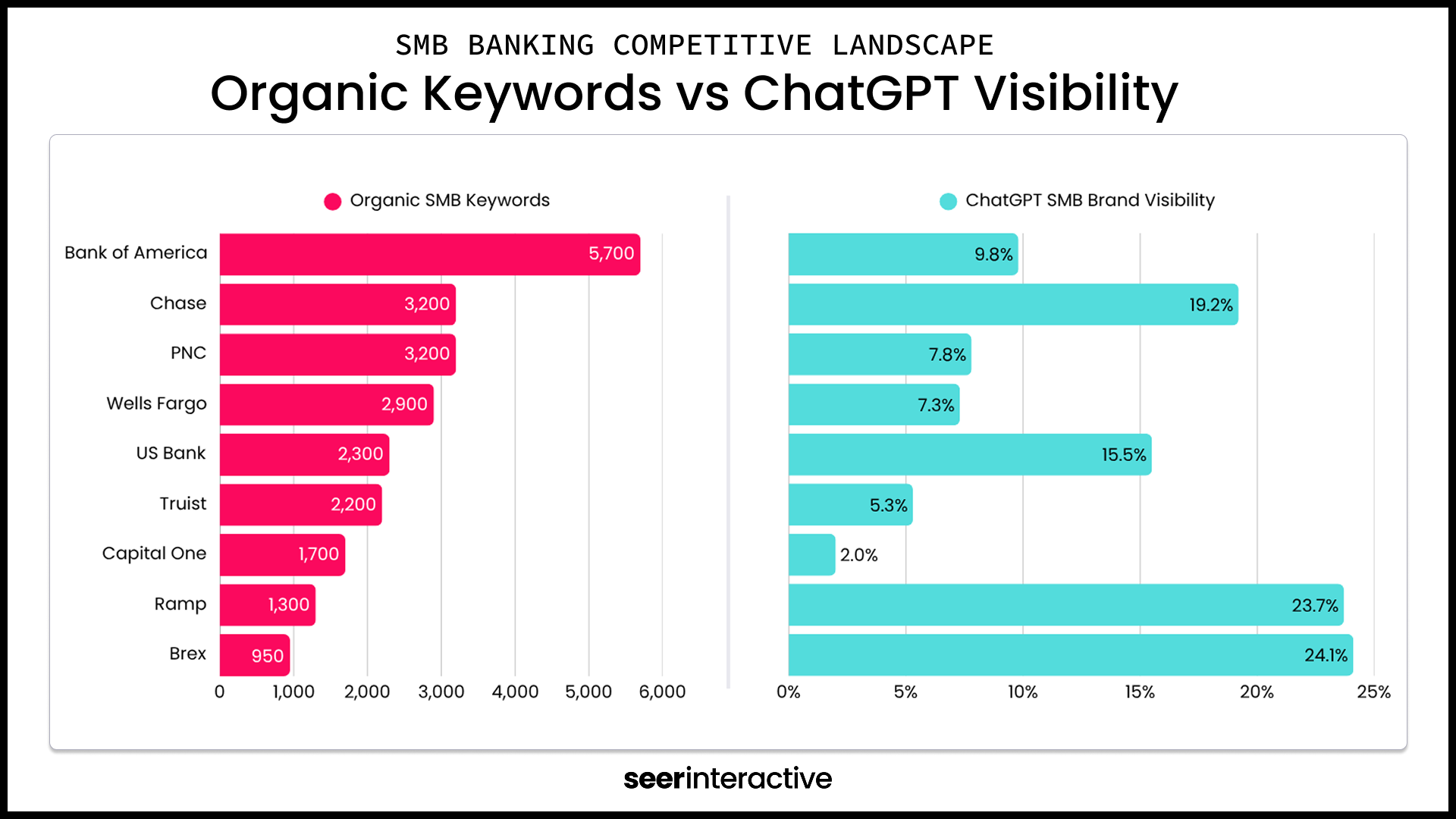
Fintechs like Ramp and Brex, which have minimal traditional visibility for small and medium-sized business banking keywords, are disproportionately punching above their weight for SMB prompts in ChatGPT.
Authority alone is no longer protecting the familiar faces of the industry.
Siloes and structure now present an issue
Organizations the size of Wells Fargo and Bank of America typically have a LOT of different ownership teams throughout the areas of their domains. Those teams have different priorities, audiences, and sometimes completely a different CMS.
Siloed teams create friction. Users feel it on-site, and AI is amplifying it. A single wrong number or confusing experience can take a brand out of consideration.
AI is still failing when users ask it to take action or help them take action. Wrong links, scam sites, missing or broken links.
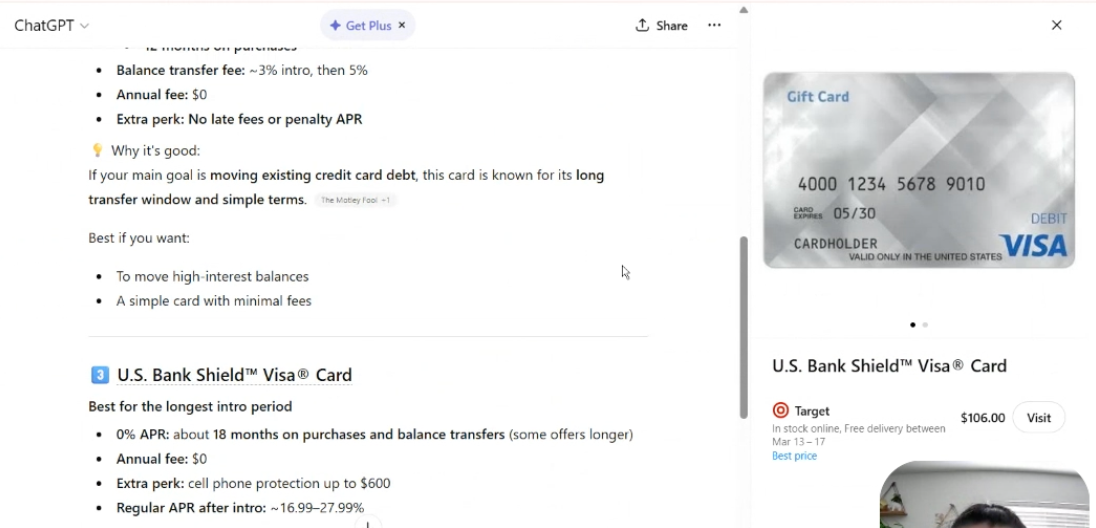
In our usability study, we found that users went to Google with brand searches or direct to brand sites to take action. We saw a user click what they thought was a link to U.S. Bank for a credit card, but instead opened a ChatGPT shopping panel to a Visa Gift card sold at Target.
U.S. Bank was off the short list for that user after that.
“I thought that was going to be a link. Ew.” - Participant quote and screenshot of their experience
Overdraft fees: An example
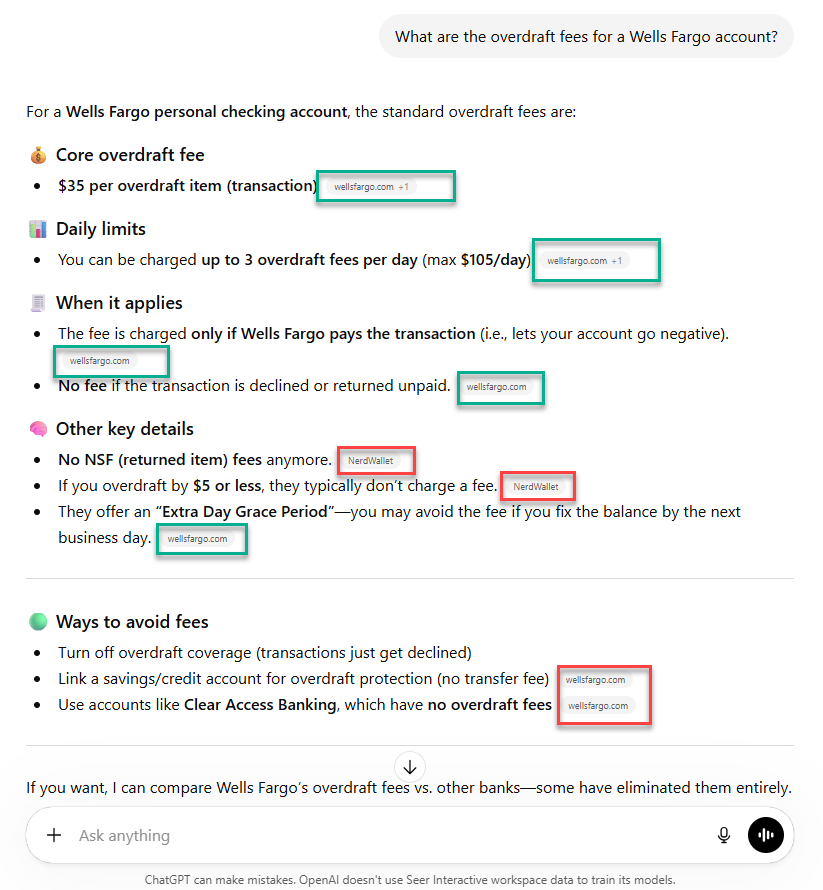
When searching in ChatGPT for ‘What are the overdraft fees of a Wells Fargo account’ and repeating the prompt for Bank of America, there were two completely different experiences.
Wells Fargo:
- Owns 77% of citations for the prompt
- Has a clear page dedicated to Overdraft Services
- Clearly states what their overdraft fee is
- Has a CTA to open an account without overdraft fees
- Solid UX for someone landing on the page
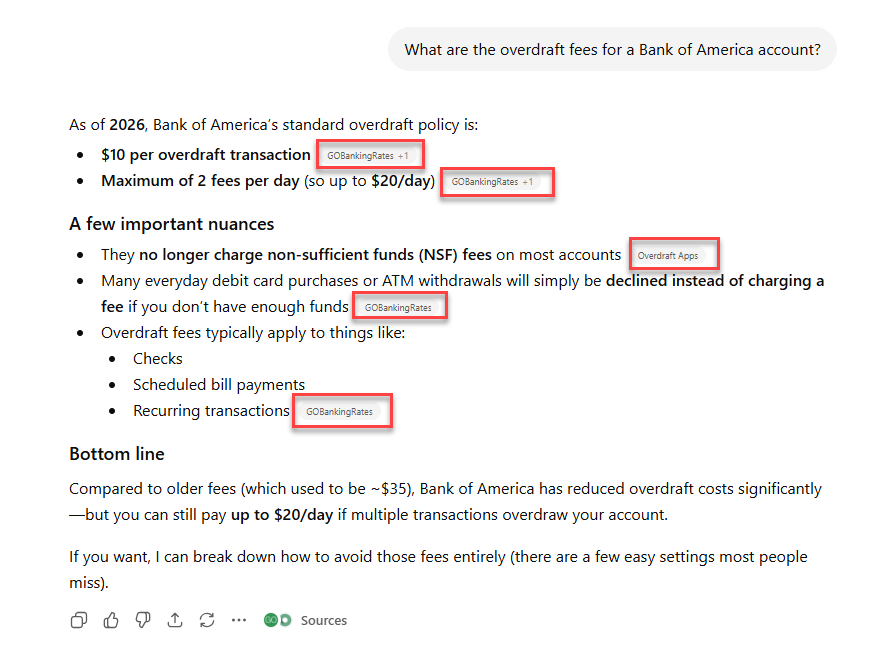
Bank of America
- Owns 0% of citations for the prompt
- Overdraft-page is clunky and hard to navigate
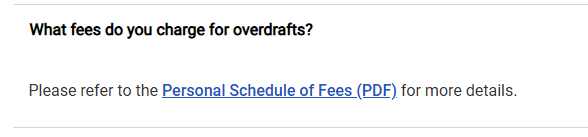
- Leads users to a 23 page PDF under the question "What fees do you charge for overdrafts" instead of clearly stating
- But it's still ranking in position 1 for "bank of america overdraft fees", so it's never seen as a problem
Since Bank of America is owning 0%, someone else has to fill the gap. Third-party sites like GOBankingRates can look unfamiliar and untrustworthy to users, present the wrong information, and customer engagement with Bank of America may be shaped by third-party content the brand does not control.
While that’s a lower-stakes prompt, the lack of clarity also impacts higher-intent searches.
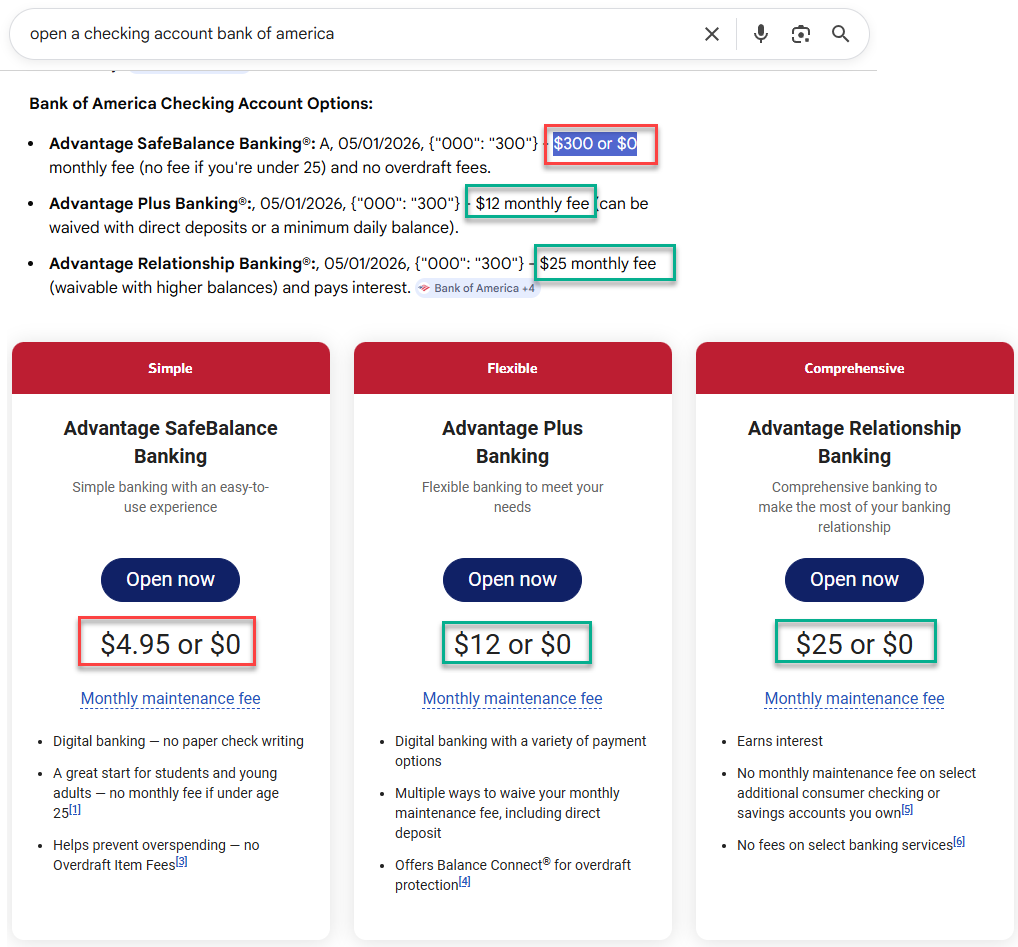
Searching “open a checking account Bank of America” shows inconsistent fee information in AIO compared to what’s on their own site.
The AI response surfaced a $300 monthly fee for Advantage Safe Balance Banking where the actual fee is $5. That kind of misinformation can completely end the conversion journey where a user at the highest-intent moment of the funnel.
43% of users said that AI was most helpful in Search & Recommendations or Financial Comparisons in our banking study. While users will ultimately leave AI to take action, AI’s information and results will help them eliminate options or even make a final selection.
AI helps users cut the noise, but you need to make sure your brand is saying the right thing.
“AI helped most by giving me accurate information and finding exactly what I was looking for [...] in terms of the rates between the banks and the features that the banks offered.” - Participant Quote
The (continued) case to monitor branded prompts
If users are most comfortable using AI to compare banks then focusing on branded prompts for optimization is likely to have the biggest impact in performance.
What information can you share about how you deliver that financial product relative to your competition?
If that information is unavailable, inconsistent, or poorly structured, you give others the opportunity to shape your brand’s narrative.
Questions to ask yourself:
- Is our information easy to read and find? This is especially important for rates, fees, and bonuses in banking.
- Does the website reflect our internal organization structure, or how users (both human & machine) look for information?
- Are we being cited in branded prompts?
- Do the linked pages make sense and have strong UX?
AI User Search Study: Banking & Finance Methodology
We conducted an AI search usability study to understand how users leverage AI when looking for new banking and finance products. We then asked about their AI use and watched as they prompted, explored, clicked, and researched, and made a decision. To recreate natural user behavior, we told users to start in their preferred AI tool, but change tools, click links, and prompt as they normally would when researching.
We extracted all 114 prompts users typed, and analyzed each interaction to evaluate how they prompted, reactions to the AI response, when they left AI, followup prompts, and what caused them to ultimately select a product.
Study Outline:
- Conducted an in-depth interview using Outset.ai as our AI moderator covering:
- How and why they use AI
- Ranking their comfort using AI for banking & finance tasks
- What they find AI most/least helpful
- Observed users as they actually prompted and interacted with AI to:
- Evaluating checking accounts
- Looking for a new credit card
- Comparing banking products
Recruiting & Platforms:
-
Moderation Platform: Outset.ai
-
Participants: 30 consumers in the USA
-
Behavior: Used AI in the last 3 months while looking for new banking or finance products
-
AI platforms used: ChatGPT, Gemini, Google AI, Copilot
-
Recruited via Prolific through Outset.ai