
Meta started rolling out a new attribution setting to advertisers. If you're running paid on Meta, you might’ve already seen it: “Incremental Attribution”.
On paper, it sounds like a marketer’s dream: Meta now claims it can show you not “just” conversions, but incremental conversions — those that, according to Meta, wouldn't have happened without your ads.
Meta says this setting compares real-world conversion behavior of exposed vs. unexposed users to estimate how many conversions were truly driven by ads.
But, how much of a difference does it actually make?
Are we talkin’ 5%, 10%? We ran the numbers across our own portfolio for April 2025, sampling over 6 accounts and $1.05M in ad spend.
🔥 You can retroactively view incremental conversions from April 1, 2025, onward by customizing your reporting columns—even if the setting wasn’t available at the time!
The result?
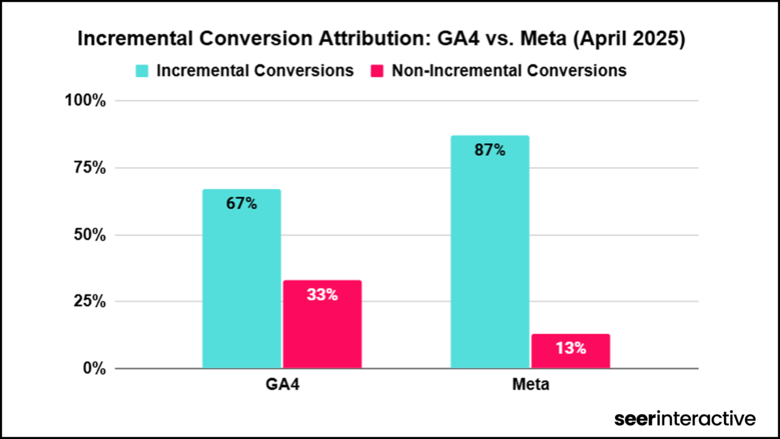
Meta reports that, on average, 87% of our team’s conversions in April were incremental.
Meaning that only 13% of conversions would have happened regardless of whether or not we ran ads on Meta.
Does your targeting strategy impact incremental conversions?
Yes. Not all segments showed the same lift.
Broad targeting and hyper-narrow segments (like retargeting) had the lowest incremental performance.
This makes sense. Broad campaigns often catch users who would’ve converted anyway, and retargeting reaches people already near the bottom of the funnel.
So where does this attribution make a difference? Refined mid-funnel audiences.
These users weren’t so broad that conversions felt inevitable, but not so narrow that we were only reinforcing existing behavior. In that middle zone, we saw the clearest incremental impact. And if you subscribe to the Meta attribution model, that’s where marketers should lean in.
What does this mean for you?
You might be asking “What about that 13%?”. Good question! Let’s break down what incremental attribution could mean for your Meta ad strategy:
- Smarter Optimization
Instead of optimizing toward people likely to convert in general, Meta may soon prioritize users who convert because of your ad, making your spend more efficient. - Less Wasted Budget
That 13% of “non-incremental” conversions may not sound like much, but it still represents potentially wasted spend. While this may result in fewer reported conversions, the setting helps eliminate noise and ensures the conversions you do see are higher quality. - Test for the Future
As targeting signals shift (due to privacy changes, competition, etc.), today’s performance might not hold. Testing now gives you a head start on what has potential to become best practice. - Deeper Learnings
By comparing standard vs. incremental optimization, you’ll better understand who your ads are truly influencing—and how to scale results without just expanding to easier wins. - More Transparent Reporting
When clients see strong Meta performance, a natural question is: "But how many of those conversions really came from the ads?" Incremental attribution can help validate ad impact with data-driven lift modeling, building confidence that your strategies are actually driving real business outcomes.
Wait! What Does GA4 Say?
Ok, it’s not all optimizations and beautiful modeling (yet), here’s where things get murky.
We cross-checked those same Meta accounts set against GA4 and... the story’s not as rosy. GA4, which typically leans more conservative in attribution, showed that only 67% of conversions were incremental — meaning that 33% of conversions would have happened regardless of whether or not we ran ads on Meta.
So what does this mean for you?
- Don’t blindly trust Meta’s numbers. Any platform reporting on its own incrementality always deserves scrutiny.
- Use this setting as a directional signal, not gospel. Think of it as one input, not the answer.
- Cross-reference with independent tools. Platforms like GA4, Triple Whale, or your own post-purchase surveys are essential to balance the narrative.
- Still, this is a step in the right direction. Meta giving any nod to incrementality is a sign of where attribution is headed.
My advice? Take it with a grain of salt.
If you're seeing high incremental %s, great. It’s always a good reminder to re-focus your ad investments on where they’re going to have the most material impact. But ask yourself: Would those same conversions have happened anyways? The truth lies somewhere between Meta, GA4, and your other data sources.
Running ads in Meta and want to grow your return? Let's chat.



.png)