
CROs have learned over the past decade that “playing it safe” is no longer a safe play. Advancements in technology, shifts in consumer behaviors, and shrinking margins have drained the efficacy from many standard playbooks. CROs have needed to be more agile and willing to experiment to succeed. But laying out the framework for experimentation, executing on those plans, and learning from the results is no cakewalk (at least historically).
Early on, testing roadmaps were cobbled together through in-person brainstorms, manual prioritization scoring exercises, and single test launches that often took weeks or months to yield results. As A/B platforms matured, we saw incremental improvements: templated test setups, drag-and-drop variant creation, and dashboards that finally made results more accessible. Yet even with these advances, core steps like hypothesis ideation, prioritization, test configuration, and analysis remained labor-intensive.
Today, LLMs and AI-driven “experiment design agents” promise to upend that inefficient process. Imagine having AI scan your entire backlog, test library, and even your website itself to recommend high-impact hypotheses. Variant copy and layout drafts can be auto-generated, ready for a quick QA review rather than back-and-forth with designers and developers.
AI agents can even dynamically adjust traffic splits or swap underperforming variants in real time, ensuring you’re always learning and adjusting efficiently. Tasks that once took hours of manual effort can now be orchestrated with a few simple prompts.
Of course, even the most sophisticated AI tools need an expert behind the wheel. Guardrails around brand voice, ethical considerations, and legal or privacy compliance remain firmly in the hands of your team. Practitioner oversight is needed to ensure that AI-generated suggestions align with broader business objectives and that every decision can be traced back to a clear goal.
Now, let’s explore how your experimentation workflow can evolve from today’s manual pipelines to a future state where AI amplifies every stage while CRO and experimentation leaders maintain the final say.
The Old Way of Experimentation
Traditional, Manual Roadmap and Test Creation
Hypothesis Development
Teams typically kicked off with in-person or virtual brainstorms, leaning on stakeholder requests, historical test summaries, and “best practice” blogs to generate ideas. These sessions often end with a long laundry list of potential tests, with discussions often driven by who spoke loudest as by data.
Test Prioritization
Once ideas were collected, they lived in spreadsheets where teams manually apply scoring frameworks. Each hypothesis got a numeric score with the highest-scoring items making it onto the roadmap.
Sequential Execution & Analysis
Roadmaps became a linear queue. Tests launch one at a time, waiting weeks for statistical significance before the next idea goes live. This “batched” approach introduced friction: engineering hand-offs, legal reviews, and analytics setup all stacked up, stretching a simple roadmap into months-long cycles.
Why the Old Workflow Wore Teams Down
Resource Constraints
Every new test was a mini-project: UX mockups, front-end coding, analytics tagging, QA cycles, and stakeholder sign-off. Many teams simply lacked the bandwidth to run more than a handful of tests per quarter.
Slow Feedback Loops
Low-traffic pages or niche audience segments could take weeks (or longer) to reach significance. During this time, market conditions or business priorities may already have shifted with insights arriving too late to act on.
Static Roadmaps
Once a quarterly slate was finalized, making mid-cycle adjustments was painful. Even if new data suggested a different direction, updating scores, decks, and timelines felt like starting from scratch. This rigidity stifled agility and often led to roadmaps that were out of date before they were complete.
How AI “Experiment Design Agents” Change All That
AI-driven design agents can now embed intelligence into each stage of your experimentation process:
- Hypothesis Generation: Agents scan past test results, on-site behavior data, and even customer-support logs to suggest high-potential hypotheses.
- Variant Creation: From headline tweaks to full-page layouts, agents can auto-draft copy or CSS variations ready for a quick QA pass.
- Dynamic Test Configuration: As data flows in, agents can adjust audience splits or swap out underperforming variants in real time—all within your existing A/B platform.
What You Gain with AI-Powered Experimentation
Speed & Scale
AI agents can spin up dozens of parallel test ideas at once.. Some prototypes even simulate user flows to pre-validate variants before live traffic hits your site.
Continuous Optimization
By leveraging multi-armed bandits or reinforcement-learning techniques, traffic is automatically reallocated toward top performers, so you spend less time waiting on test results.
Cost Efficiency
Automated drafting and setup cuts out repetitive tasks (copy edits, CSS tweaks, tagging), allowing teams to scale their experimentation throughput without proportional headcount increases.
AI Experimentation Tools Making an Impact
Analytics Tools
Most modern analytics platforms now include AI-driven, natural-language report builders allowing anyone to ask questions of their data as easily as a quick search query. In fact, 97% of analysts today leverage AI and 87% use automation to streamline reporting and surface insights. If your current tool lacks built-in chat-style analysis, consider these standout options:
1. Amplitude
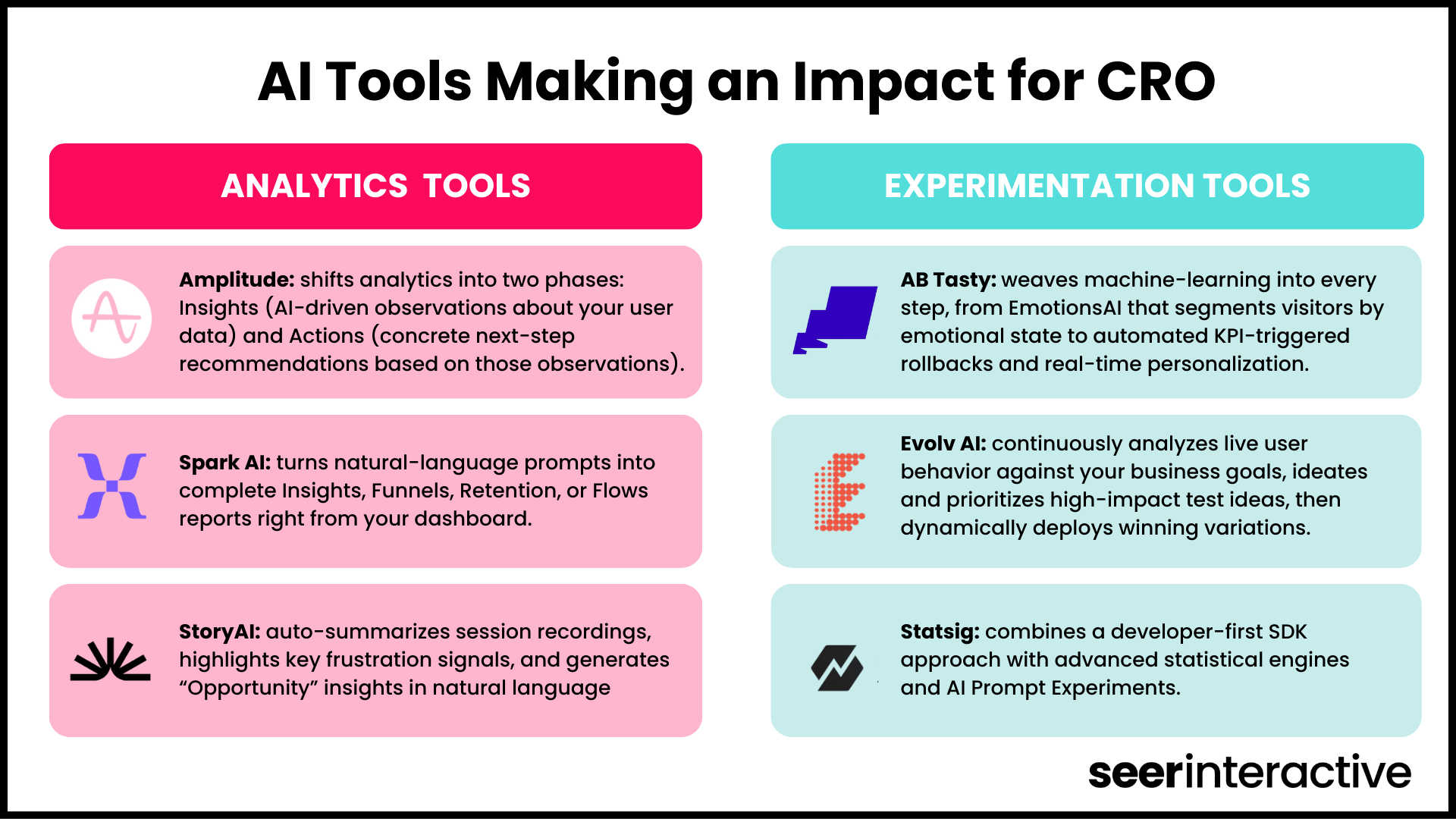
With its recent launch of “Amplitude AI Agents,” the platform shifts analytics into two key phases: Insights (AI-driven observations about your user data) and Actions (concrete next-step recommendations based on those observations). These agents run continuously, surfacing high-value behaviors and suggesting experiments to improve conversion drops.
2. Mixpanel
Spark AI turns natural-language prompts into complete Insights, Funnels, Retention, or Flows reports right from your dashboard. Ask “How did conversion rate change this month by country?” or “Show me our 7-day retention cohort,” and Spark returns the chart plus a drill-down with no coding required.
3. FullStory
StoryAI (powered by Google Gemini) auto-summarizes session recordings, highlights key frustration signals, and generates “Opportunity” insights in natural language, so you spend minutes reading AI-crafted narratives instead of hours watching replays .
Experimentation Tools
Similar to analytics platforms, the leading A/B testing and experimentation suites now embed AI-powered chatbots to guide hypothesis creation, test setup, and even variant drafting directly within their UIs like Optimizely’s AI Experiment Advisor, VWO’s AI Co-Pilot, or Kameleoon’s AI test-builder. Beyond these large players, here are three vendors that are pushing the envelope on AI-driven experimentation:
1. AB Tasty
Their AI Optimization suite weaves machine-learning into every step, from EmotionsAI that segments visitors by emotional state to automated KPI-triggered rollbacks and real-time personalization. You get AI-powered recommendations on where to test, live variant generation, and infrastructure that scales your digital experiments without extra engineering overhead.
2. Evolv AI
Evolv applies a closed-loop “Active Learning” system: AI continuously analyzes live user behavior against your business goals, ideates and prioritizes high-impact test ideas, then dynamically deploys winning variations. Their GenAI features (text paraphrasing, image generation, code previews) let you refine variants in seconds, so you move from insight to impact at unprecedented speed.
3. Statsig
Statsig combines a developer-first SDK approach with advanced statistical engines and AI Prompt Experiments. You can A/B test different GPT prompts or feature-flag configurations side-by-side, then let Statsig’s engine automatically allocate traffic and surface statistically valid winners. This is ideal for teams building and optimizing AI-driven product features.
In just a few years, we’ve gone from hand-scored spreadsheets and one-at-a-time A/B launches to AI-powered pipelines that ideate, prioritize, set up, and optimize experiments almost instantaneously. However, they will always still rely on human judgment to keep everything on brand, legally compliant, and aligned with your business goals. These agents cut cycle times, boost scale, and can drive continuous growth, but only under the eye of dedicated CRO professionals.
What’s next in the space? Will AI replace CRO practitioners and their jobs? Not likely.. But the teams that embrace the power of AI will be exponentially more efficient and effective.
Ready to learn how we're bringing CRO into the AI-age in a way that helps your brand get ahead? Let's talk.