

Wil, take me right to the KPI for long term sustainable GEO visibility!!
I’ve been thinking about how SEO KPIs will fail us in a GEO world. I’ve written about it here and here.
In that second one I talked a lot about direct traffic.
“We are living in a world where marketing analytics is more and more of a black box, my job is to try to make the black box less black.”
Adam Melson, a Seer alumni, said that to me one day on a call and it’s stuck with me ever since.
If you compare the data we had in an SEO world against the data we now have in a GEO world, the box just got way blacker.
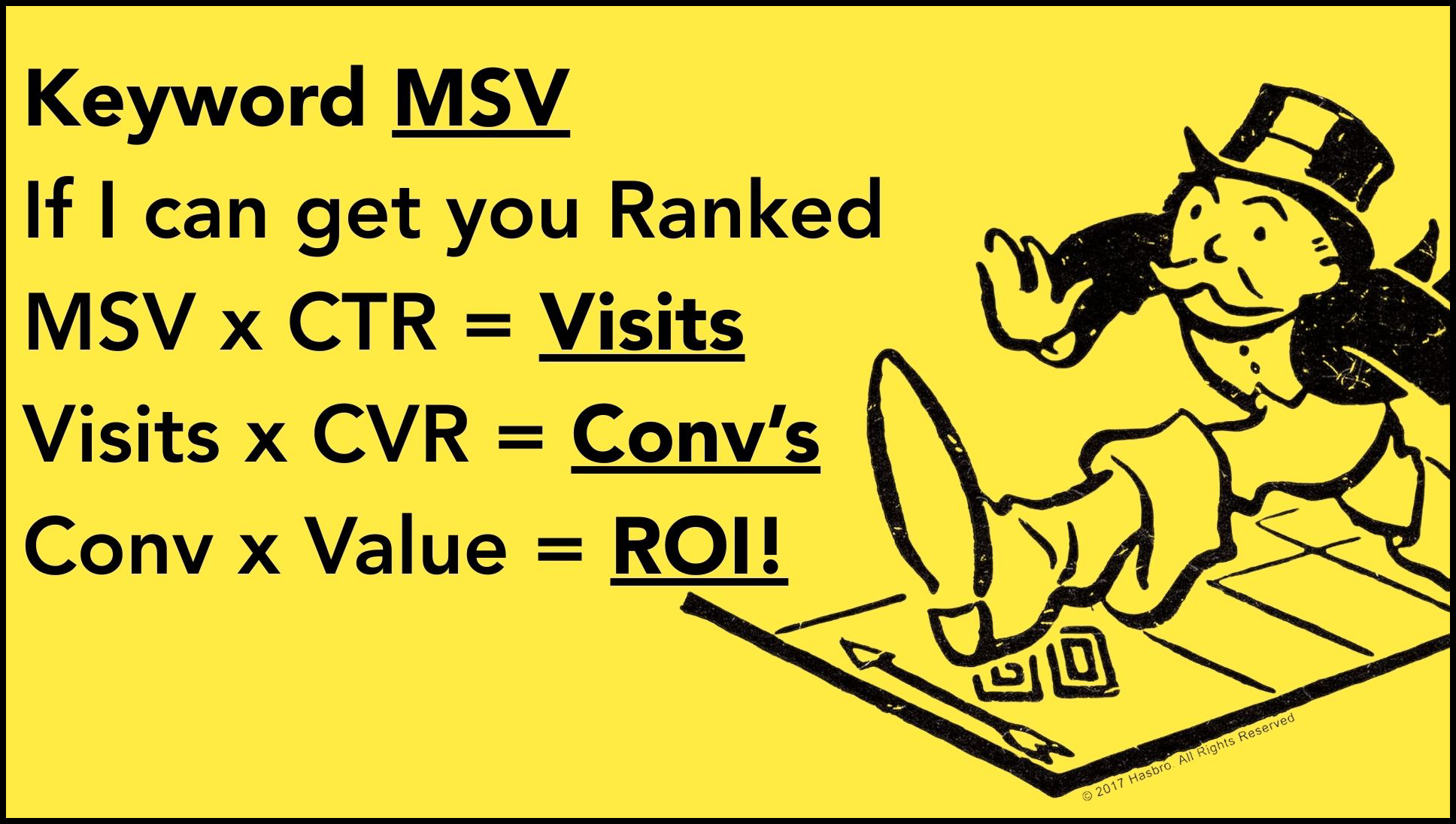
GEO isn't a performance channel.
Are you visible and NOT recommended?
Client Request: I don’t want a visibility report, I want a recommended report!
Thank god for tough but fair clients. About 6 months ago a client said that to us, and they were right.
So often visibility shows up as “did my brand show up?”, which is a yes or no.
The deal with Google was that, if you ranked, it was inferred that the algorithm thought you were “good, credible, or recommended.” If you Googled ethical jeans and Banana republic ranked, it was inferred that if you show up in the results, you do the thing.
In AI search it is completely possible to show up, and be ANTI-recommended.
Check this example out. ChatGPT said to look BEYOND Airbnb and VRBO. Meaning both those brands are visible in the prompt answer, but neither one is recommended.
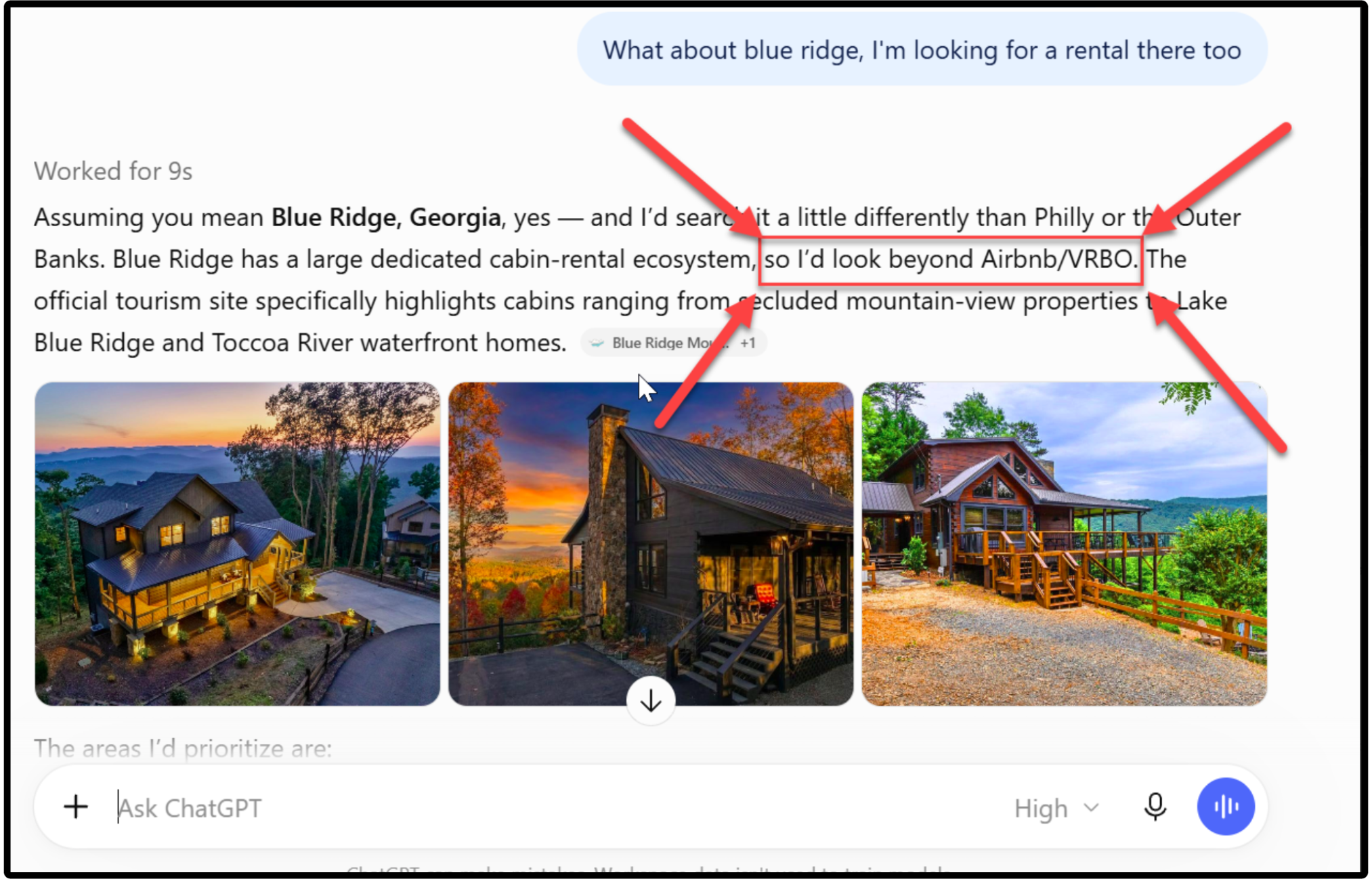
This is what I call the anti-recommendation. It’s explicit here, but it’s just another way that a KPI like visibility, without being paired with something like credibility, can lead to a false sense of “success” in your Generative Engine Optimization KPIs.
Visibility without credibility means NO profitability.
-png.png?width=1920&height=1080&name=SEO%20Week%202026%20-%20Wil%20Reynolds%20(4)-png.png)
So what is a query fan out, and why does it change how we measure GEO?
Query fan out is searching, reading, and searching again to assemble an answer.
When you put in a prompt into your favorite AI, that long query is often broken down into a series of searches. Just like you would do pre-AI, you’d Google something, read some content, ingest that content, then do more searches. That flywheel goes on and on.
AI does the same thing via what we call “query fan outs.” Then the AI takes all that content and assembles the answer for you.
As we started to see the fan outs moving from:
“Top GEO news august 2026” to “site:searchengineland.com GEO news august 2026”
and
“GEO visibility research” to “Lily Ray GEO research B2B”
(examples of query fan-outs seen below)
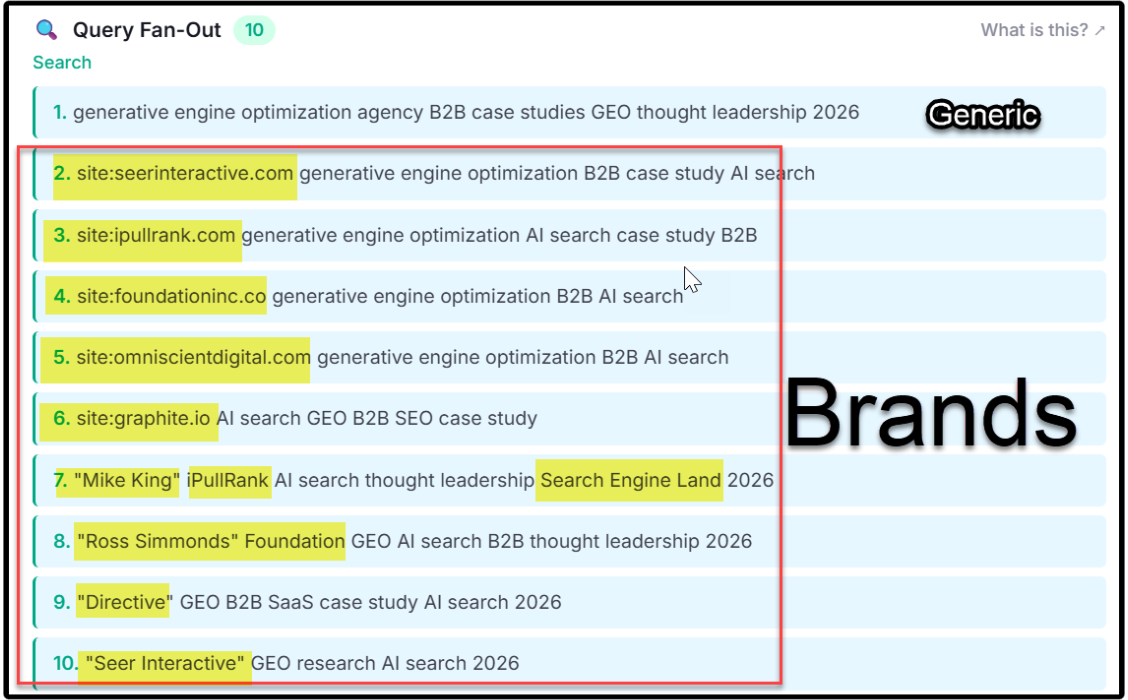
…This triggered new thinking for me about KPIs and Generative Engine Optimization. GOOD luck getting your content cited for a GEO search that includes Mike King, Ross Simmonds, or Lily Ray by name, when the AI knows to just go search their domains.
Another Example: Banana Republic ranks for “ethical jeans” in Google, but never in the AI answer(I've checked 1,000x).
If you Google “ethical jeans,” you’ll see banana republic in the top 10. Yet when you prompt an AI about ethical jeans companies, Banana Republic isn’t in the answer.
That creates a fundamental shift in how we do our jobs, and it’s an example of why SEO and GEO are indeed different. But let’s stay focused on the fan outs below:
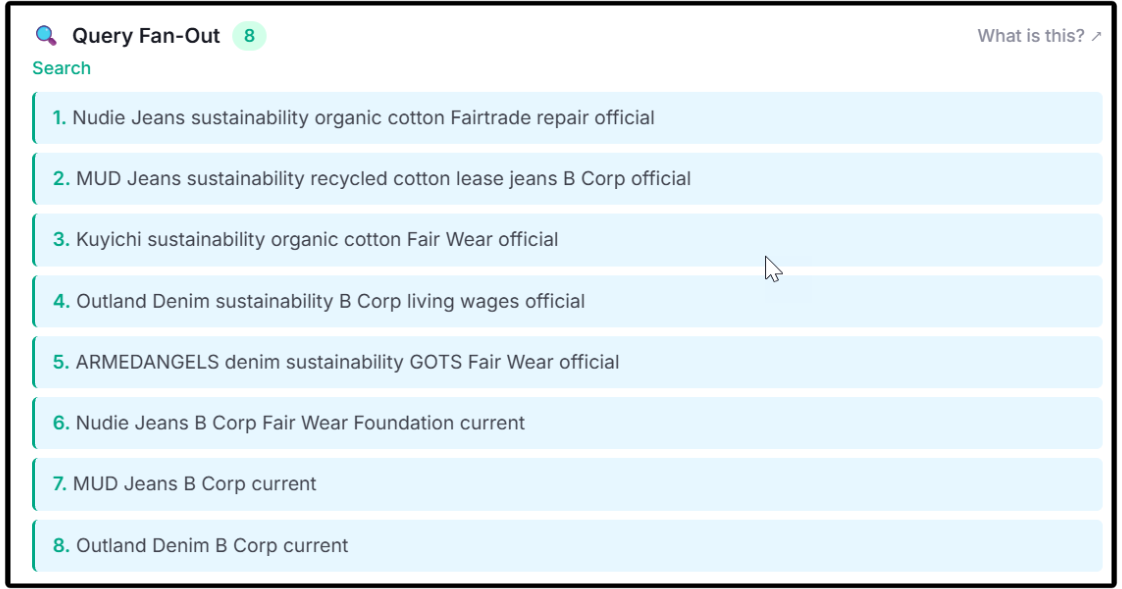
When we analyze the query fan outs you see ChatGPT already named names of ethical jeans companies in mind BEFORE the search and Banana wasn’t one of them.
In an SEO world Banana Republic had:
-
Visibility (page 1)
-
Scalability (this is an obvious scaled page)
-
Traffic
-
Conversions
-
ROI
Think about it.
They could produce pages like this for basically no cost per piece, so any conversions they got were bonus.
What Banana Republic was missing was CREDIBILITY.
AI, just like humans, has brand preferences. If I say “name a luxury hotel brand” you know them mostly through branding and advertising.
Now name a luxury watch brand. See? Maybe you've never owned one, but you probably know one.
This is “hardwiring” (as I like to call it). That luxury hotel brand is likely hardwired into your brain and the AI’s brain too. So are you tracking KPIs for brand hardwiring on prompts?
Here are 5 Generative Engine Optimization (GEO) KPIS I'm thinking of
If corporate brands and personal brands are "hardwired" into the fan outs and yours isn't, how do you improve your chances of showing up?
How do you get the brands AI already trusts to mention you?
It’s going to be hard to become a known and recommended entity if none of the currently known and trusted brands mention yours… So you gotta start with content those places love. Trade pubs have editors who choose what gets in, and they’re picky. Lily Ray or Mike King are picky about what they share. So here’s the KPI’s to do that.
GEO KPI 1: Content Humans Loved
What % of all of our content last year got meaningful traffic via humans sharing with other humans (example, for Seer Interactive I watch referral traffic from the following sources: LinkedIn, NotebookLM, Quality Blogs, etc) as an example.
If your numbers look like crap, then you can say to your c-level…
“Hey you know how you keep asking me to do 10x the content at 50% less cost? Well… that shit don’t work with journalists and real influencers in our space and they control X % of our fan outs!”
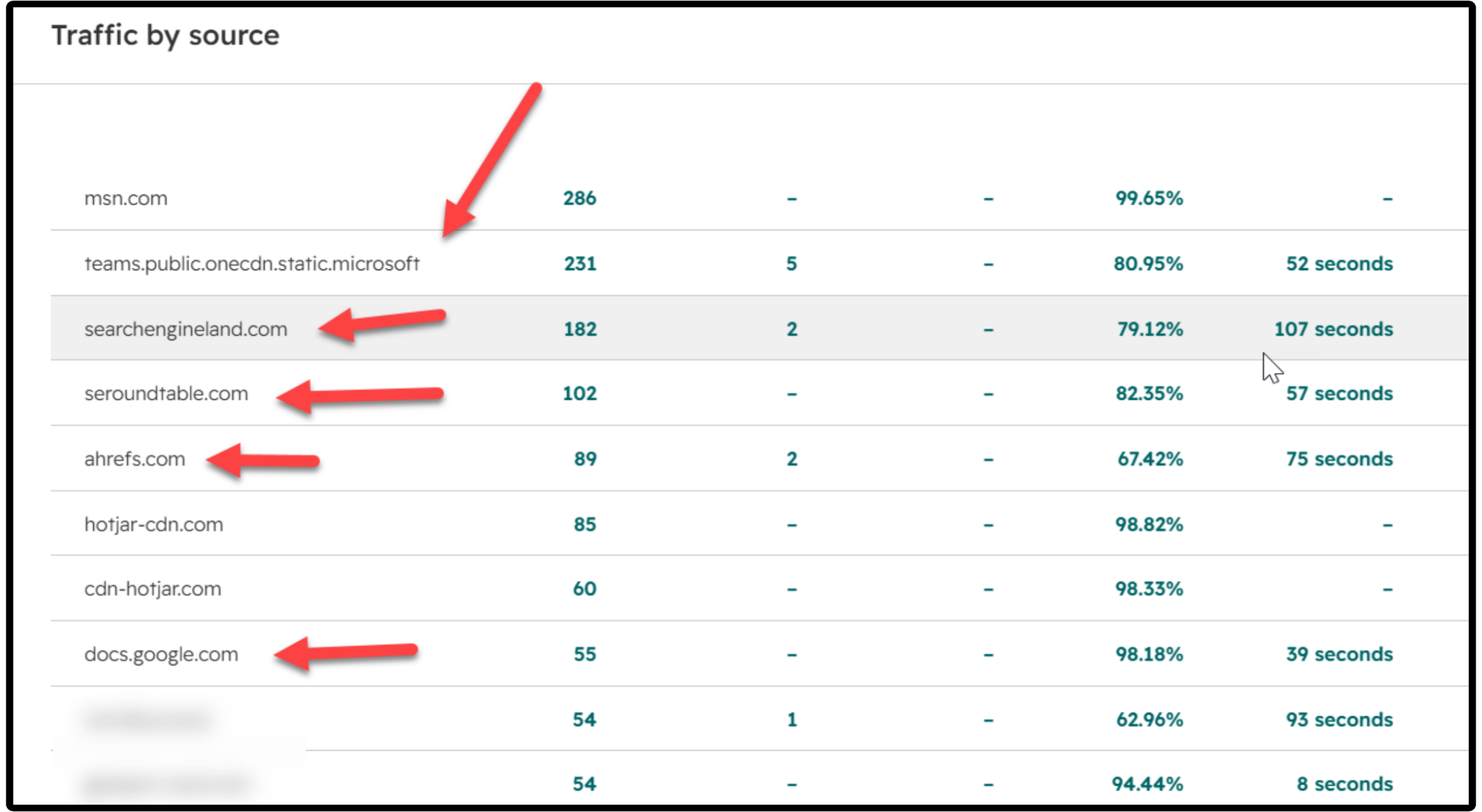
You can pull this from GA4 using this template we built. Take every URL and break down the amount of traffic coming from algorithms vs humans.
This is an example of a post coming from a human that could contribute to traffic.
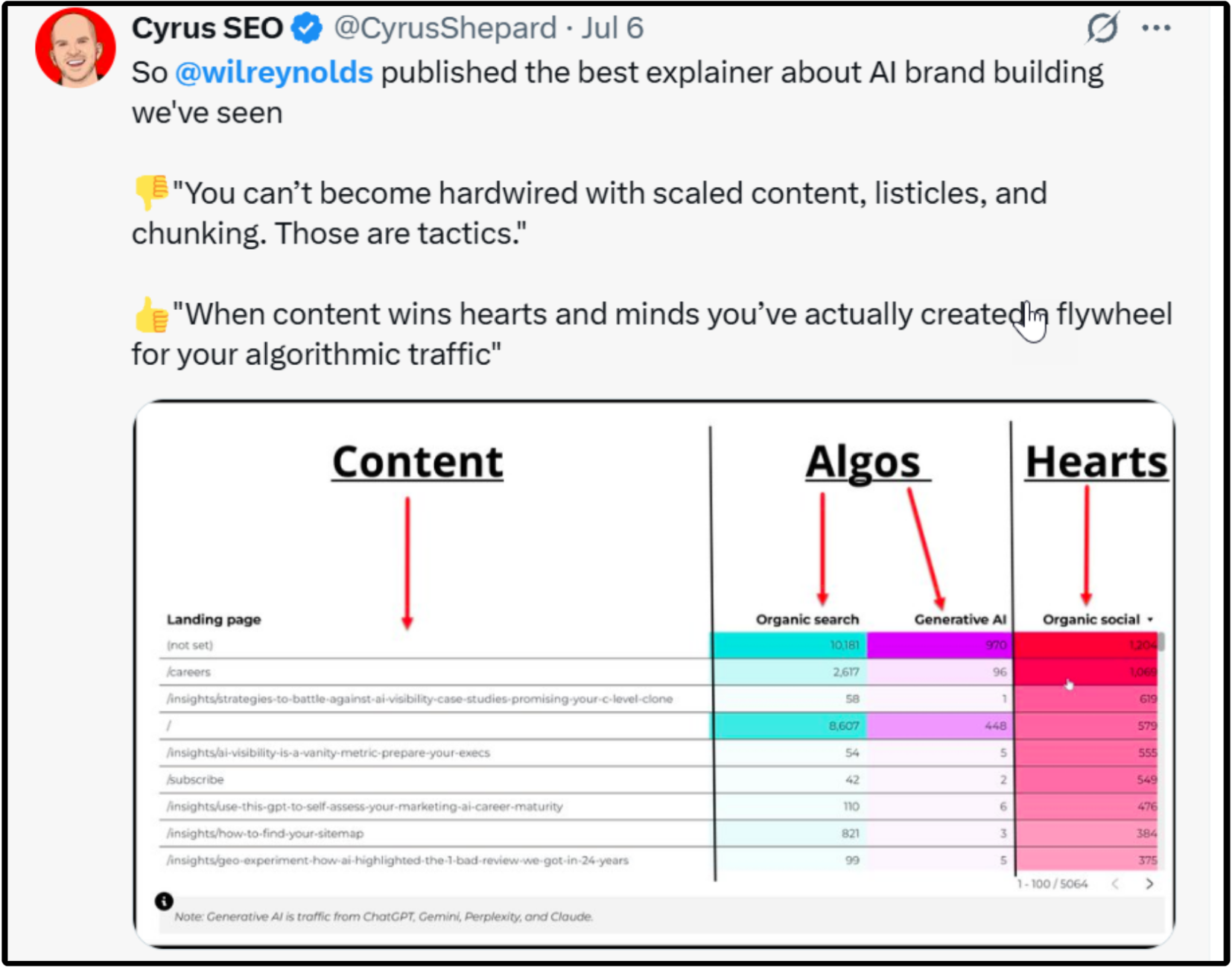
New GEO KPI #2: Mentions / Traffic by trusted trade publications
Trend this out. If Search Engine Land is a trusted publication showing up in query fan outs, is any of our content getting any mentions from them, and is that number growing or shrinking? That is a true sign of long term resilience, not these listicle hacks.
Just use a tool like Alertmouse to track if you are growing in your mentions from popular sources. You can also use GA4 to pull this information.
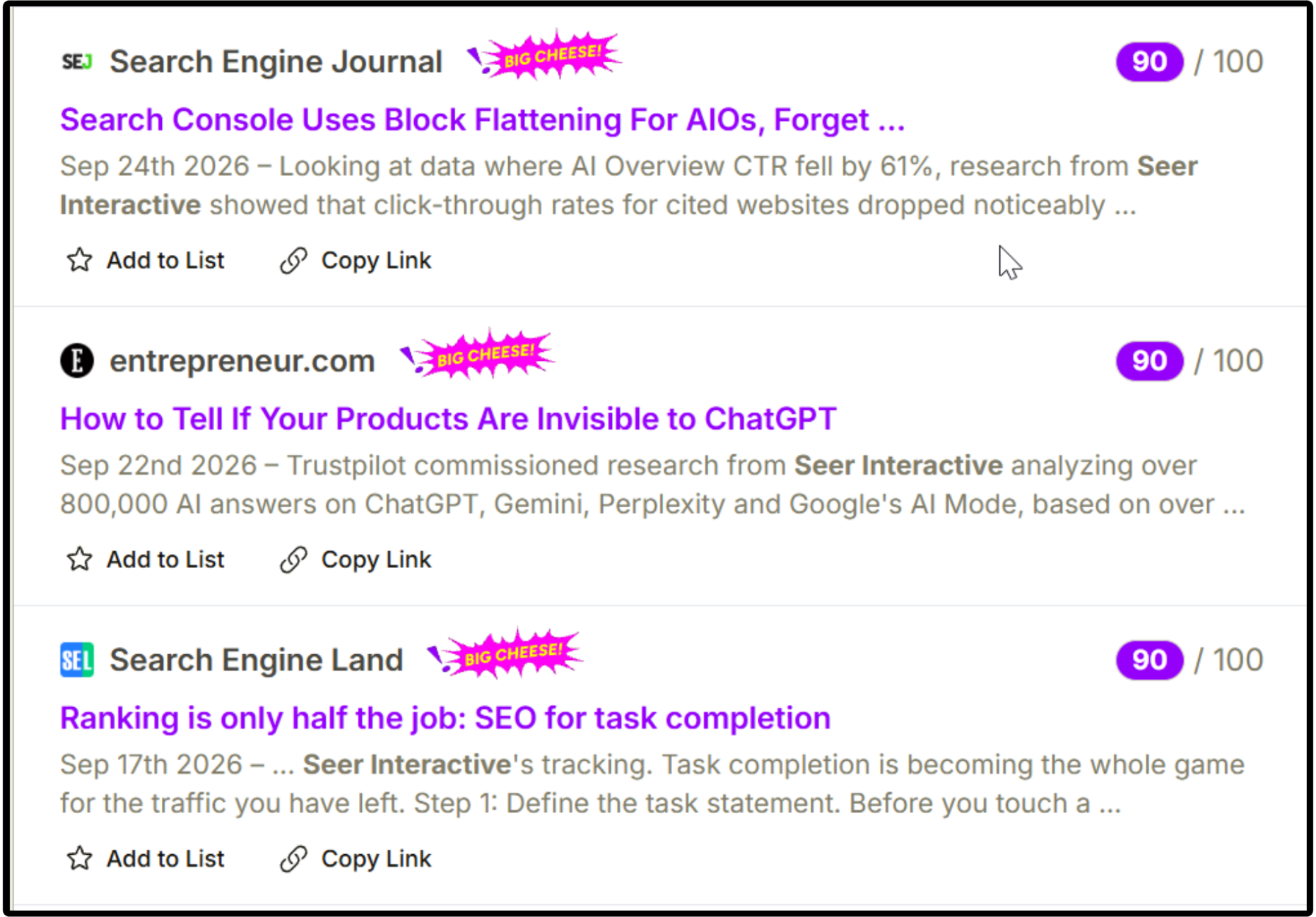
New GEO KPI #3: Mentions by influencers
You’ve already seen above that names like Lily Ray, Mike King, and Ross Simmonds carry weight in these AI streets. So if their “brands” are hardwired into the most recent AI model, then getting closer to them (in a vector sense), is a good idea.
This again is that LONG term sustainable AI visibility you can bank on over time. It’s not the whack-a-mole “ooooh Linkedin is highly cited, let me write some low quality pulse articles spun up by my AI” stuff.
How would you know if you are doing a good job of getting closer to them?
I use tools like Phantombuster (Alertmouse can do some of this with LinkedIn) to scrape down influential people’s posts, then I use AI to go looking for my name, trademarks, or influential people at my company being mentioned by those influential figures. If you eventually want to become one of those names, you have to get on their radar.
How do you measure momentum when AI answers change every time you ask?
New GEO KPI #4: Striking Distance as vectors not rankings
When I run these 10 prompts 20x each we show up on X% of them.
In SEO we all have some version of “no one is seeing us (page 2-3), but we’re close” as a metric to tell us where to spend our time and what to optimize for.
What is that for AI search?
In an SEO world, you could see your “ranking” moving from 90 -> 73 -> 42 -> 22 -> 10 over time. This helped you get a feel for whether you were on the right “scent” so to speak. In AI search, you run that prompt once or twice, and if you don’t show up it is way too easy to assume “we aren’t visible”.
You would be right that on those 2 prompts at that time, you were not. But what if you ran that prompt 50x, what if you then showed up 3x. That could be a momentum metric for your “most important” prompts. It gets expensive, I know.
But you need something to show your momentum.
Take the top 10 prompts your execs care about and run them 10x, 20x or 30x each month to show them momentum isn’t a bad idea. Just know that this is a momentum metric that shows if you are on the right scent, not a final KPI you put on your exec dashboard.
Can you show why a product you just launched isn't showing up yet?
GEO KPI #5 (a far out one): Receipts to compete
This one is a bit out there, but I am watching clients and prospects trapped in the “build a page and rank” days of Banana Republic, where if you had enough authority you could rank for stuff you “kinda” did. AI is making that harder, so I would strongly recommend considering a metric for the next time an executive asks you “Why aren’t we ranking for X thing we just launched a month ago.”
You can come back with: “I have a database of pages mentioning our new product across owned and unowned sources. Everything the media has picked up and every influencer I'm tracking all show us as enterprise, so when someone types in small business we don't have the receipts to compete…. yet.”
This is the vector distance (i.e. a difficulty metric) between the product we launched vs the topic we’re known for. My job is to shrink that distance. And that is why I am also running my striking distance KPI to know when we are gaining momentum. I’ll catch it early.
It’s almost a report that shows at any point the vectorized view of the following scraped pages:
-
Your own site (this is what we say about ourselves)
-
Your press (earned)
-
Influential publisher coverage
-
Reddit comments about our brand

.png)
.png)