TL;DR
- We realized AI platforms were relaying an inaccurate narrative about Seer Interactive, so we ran a full analysis to find out what else they were saying — and whether the info was accurate
- Of the 6 AI platforms we tracked, they averaged a 95.9% accuracy rating when they answered the prompt
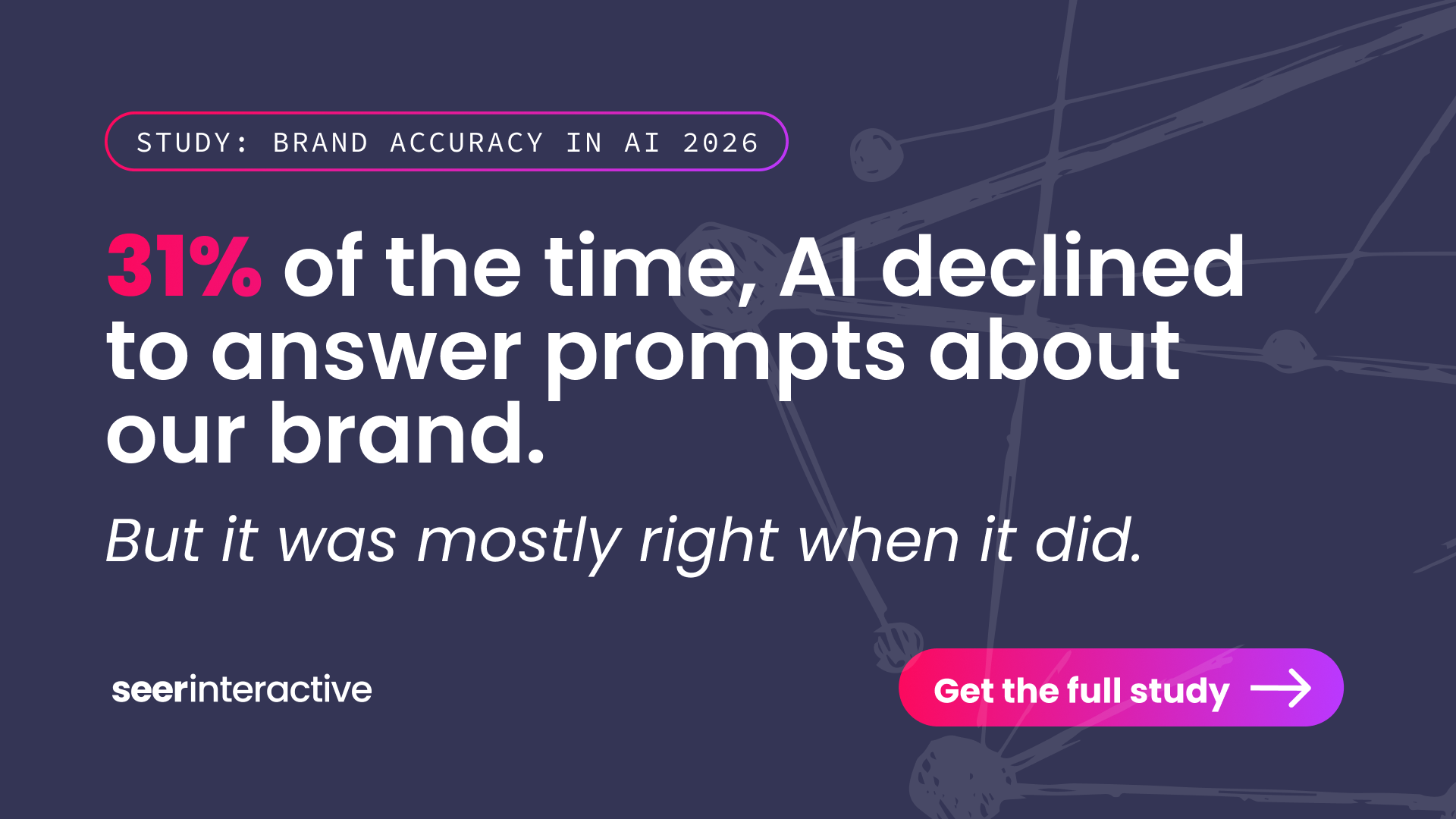
- The AI platforms were more likely to decline to answer a prompt (31% on average) than to provide an incorrect answer about Seer (3%)
- AI frequently declined to answer prompts about comparisons (80%), but had high accuracy rates for both direct (90%) and indirect (89%) prompts
- We share a framework to help brands prioritize inaccuracies in need of fixing, based on how important a claim is, whether it's an easy fix, and if it's objective or subjective
Do You Know What AI Is Saying About Your Brand?
A few months ago, we asked AI models, “what do people say about working with Seer Interactive?” Most mentioned high account manager turnover, which was a surprise to us.
The source of this claim turned out to be one negative client review from 2018 on an agency-review site. AI models gave a single comment from eight years ago more weight than dozens of positive reviews and client quotes.
After tackling that misconception and successfully changing the narrative in AI (more on how we did so in this blog), that had us wondering what else AI was saying about our brand.
Our issue wasn’t just that misinformation was being spread. It’s that we found this one by chance, which raised a bigger question: how much other misinformation was out there that we didn’t know about? We didn’t have a system in place to measure that yet.
So we launched an in-depth study to look at what AI said about our brand, how often the models made inaccurate claims, and whether we could fix these issues.
Study Methodology & Framework
To find out whether AI models were making other false claims about Seer Interactive, we asked the same branded prompts and analyzed responses from six AI models over the span of about five weeks, from May 1 to June 9, 2026.
This approach follows the brand canon framework our Chief AI Officer, Alisa Scharf, laid out to identify your brand’s critical attributes, build test prompts against them, and track accuracy daily before chasing anything else.
Here’s a snapshot of our study:
- Models we analyzed: AI Mode, AI Overviews, ChatGPT, Claude, Gemini, Perplexity
- Study duration: About 5 weeks, May 1 – June 9, 2026
- Number of prompts tracked: 1,562
- Prompt collection frequency: Daily
- Total AI responses analyzed: 28,123
To get a complete picture of how AI presented the Seer brand, we looked at 87 attributes across six categories:

This was a good first step in helping us identify what AI had to say about Seer. But we also wanted to distinguish whether a prompt was directly related to one of our attributes, indirectly related, or comparative. So we categorized each attribute based on these filter types.
Here’s an example of each:
Differentiating Accurate, Inaccurate, and Non-Responses
We used one other type of categorization for our analysis: differentiating accurate and inaccurate responses from responses that lacked any information (whether true or false). This matters because it’s better to have no brand mention than an inaccurate one (and the required fixes differ for each type).
We filtered all responses into three categories:
- Accurate: Correct responses that fully support the desired brand attribute
- Inaccurate: Responses that are outdated or wrong
- No Answer: When the AI model declines to answer
What We Found: AI Was More Likely to Not Answer than to Answer Incorrectly
Across all six platforms, the average inaccurate response rate was just 2.8%. When AI platforms actually answered a branded prompt about us, they got it right 95.9% of the time.
The bigger factor pulling down the raw accuracy numbers wasn’t the wrong answers. On average, AI platforms declined to answer branded prompts about Seer 31.2% of the time, leading to a wide gap between “didn’t answer” and “answered incorrectly”.
AI Mode posted the highest overall accuracy rate (74.2%), and Claude had the lowest of 52.6%. But as the table below shows, that difference comes down almost entirely to how often each platform chose to answer at all.
A Non-Answer Beats an Inaccurate One
From a bird’s-eye view, it seems that Claude’s raw accuracy score is the worst of all platforms. But when we looked more closely at the data, we realized almost all of that gap came from Claude declining to answer rather than giving an inaccurate claim. And ultimately, it’s better to have no brand mention than an inaccurate one.
When we analyzed only the prompts Claude actually answered, the platform had a whopping 98% accuracy rate. The other platforms performed similarly, with much higher accuracy rates if we removed the No Answer responses.
In the case of No Answers, Claude would recommend visiting the site of the brand in question with a response like this:
“I should note that my knowledge has a cutoff of early August 2025… For the most current information on Seer's team, their website (seerinteractive.com) would be the best place to check.”
We also noted that Claude commonly used the platform’s training data rather than pulling in external citations (at least within our Scrunch data set). This could lead us to believe that Claude already has a pretty accurate view of Seer Interactive in its training data compared to other AI platforms using external sources.
It’s possible that citations may lead to decreased accuracy rates, though we’d have to run further analyses to draw such a conclusion.
Comparative Prompting Showed More Non-Answers
When we analyzed accuracy across our three prompt types (Direct, Indirect, and Comparative), we found notable differences.
For Direct prompts, the AI platforms had a 90.4% accurate rate. Indirect prompts had a similar accuracy rate of 88.7%.
Comparative prompts were the total opposite. They had an accuracy rate of only 18.8%, with the AI platforms giving No Answer responses 80.3% of the time.
We asked about digital marketing agencies headquartered in Philadelphia and were given a long list of names, but Seer Interactive was noticeably absent. This was an interesting and unexpected result, considering how heavily the Seer team has invested in GEO and AI visibility. (Check out our latest AI studies to see what we’ve been up to.)
What this means: Results like this reveal the importance of regularly measuring AI brand visibility and tracking what AI prompts are (or aren’t) saying about your brand. And monitoring different prompt types tells you how much AI platforms know about you:
- Direct prompts tell you if AI knows the facts of your brand
- Indirect prompts tell you whether or not AI retains those facts when the questions are a bit looser
- Comparative prompts tell you whether your brand is on an AI platform’s radar when it looks at the broader industry
The Type of Prompt Tells You What Stage Your Buyer Is At
The way users are prompting about your brand can also shift how AI frames it in the response. This can be dependent on where users are in their journey and how closely they’re already connected to your brand.
Consider what might lead someone to type in a specific prompt type:
- Direct prompts come from people already familiar with your brand. Someone asking “does Seer do X” already knows who Seer is and has us in mind.
- Indirect prompts come from people who may be evaluating your brand. These prompts suggest the searcher is learning and still figuring out if your brand is a fit. How AI responds to these looser questions can influence whether your brand makes it to the next stage of consideration.
- Comparative prompts come from people who are early in their journey. Broad, vague questions tend to come from people who don’t know much about the industry. These types of prompts are also where AI has the most room to get your brand wrong.
Understanding Where AI Inaccuracies Come From
Now that we’ve covered the numbers, let’s talk about where our inaccuracies are actually coming from. In our experiment, we found three root causes of inaccuracies.
Training data: This means the misinformation has been integrated into the AI model itself. Training data is one of the hardest root causes to resolve, because there is no source you can trace the information back to. Updating webpages or stale resources can help, but you’ll only see the results after the latest AI model gets released.
Stale sources: A stale source can be an old directory listing, an outdated profile, an aggregator page with inaccurate information, or similar. This is a slightly easier problem to fix, because these citations are retrieved in real time by AI models. Once you update the source of outdated information, you should see AI model responses reflect those changes within days.
Own-site misread: Own-site misreads means that AI models are incorrectly interpreting your words or content. These are the easiest problems to fix, because you can easily edit the piece of content being cited and add more explicit language. Once revised, you should see the update reflected in AI responses in a few days.
Where Does AI Get Information About Your Brand, and How Much Control Do You Have?
The AI models we used to run this study pulled from over 9,000 distinct sources to describe Seer Interactive and our attributes. But there was only one source that came up every time, reaching over 35% of all citations: our own website, seerinteractive.com.
We also found about a dozen influenceable sources (through posts, profiles, comments, etc.). But that still left more than 9,000 sources we have no control over, including editorial, competitor, and forum sites.
So what can you do to take back control of your brand narrative? It varies based on the source, but here’s what we recommend:
For owned sources: Your website is the most control you have over how AI talks about your brand. Make sure you cover all relevant brand and business details, especially if you’ve found AI models sharing incorrect information (such as office locations or products/services). This is also a good moment to audit your own site for content that’s gone stale. If a page still describes older product branding, a discontinued service, or a structure that’s changed, your own website can end up being the source of the misinformation you’re trying to fix. It’s also the lever you can adjust the fastest to see changes reflected in AI models, with most updates appearing in days or weeks.
For influenceable sources: Make sure the information shown in influenceable sources is always accurate and updated. The details on these sites can quickly become outdated if you don’t keep them current, and that incorrect information may get picked up by AI models. We’d also consider Reddit an influenceable source, since it’s user-generated content and you can impact how users talk about your brand. You’ll have to play the long game, but it could be worth the effort since Reddit is commonly cited by AI platforms. Focus on trust-building marketing tactics: being seen by your desired audience, convincing them to believe what you’re saying, and getting them to choose your brand.
For sources you can’t control: There are plenty of sources you’ll never have any direct control over. While more difficult and drawn out, building a trustworthy brand will eventually trickle down to these sources you can’t control and then show up in what AI models are saying about your brand.
How to Fix It: Not All Inaccuracies Are Equal
Identifying our AI inaccuracies is the first step; the next is prioritizing what to fix. Without some sort of categorization, we would be spreading ourselves too thin and end up wasting resources.
That’s why we developed an easy framework that helps us prioritize based on how important the inaccuracy is, how easy it is to fix, and whether it’s a fact or narrative.
High-importance facts: These are the black-and-white errors that can change a lead’s mind, like saying Seer’s San Diego office is still open or listing services we don't even offer. The good news? They're also the easiest to fix, since you can usually trace them right back to the source and update it.
High-importance narratives: These are the trickiest inaccuracies to fix. Instead of a wrong fact, it's a damaging narrative, like a reputation for high turnover. These narratives are also baked into the model's training data, making it much harder for you to change. They carry a lot of weight with potential clients, but require you to play the long game to shift how AI sees your brand.
Low-importance facts: These inaccurate facts are minor, like a leadership title being slightly off. They’re worth cleaning up so you look polished, but nobody's walking away from a deal because a title was wrong. Fix it when you get to it.
Low-importance narratives: These consist of vague branding, like being called a "general digital agency." It's harmless right now, but if you leave it alone too long, that loose language can harden into a misconception you don't want stuck to your name.
To come up with the framework, we asked two questions about every inaccuracy we found:
- “Does this actually matter to someone deciding whether to hire us?” Some of the inaccuracies might genuinely change a potential client’s mind. These could range from “They don’t offer the services I need” to “They have a bad reputation.” Inaccurate answers to these questions will lose deals and cost you more the longer they exist.
- “Is this inaccuracy a fact or a narrative?” While a fact has a right answer that you can point to, like our San Diego office being closed or open, a narrative is different. “Seer has high turnover” isn’t a single fact you can look up. It’s a narrative the AI has characterized your brand based on scattered information that it reads, without a single page that you can pinpoint. You can’t edit the model’s training data after it has been released.
Ask those two questions about any inaccuracy, and you’ll land in one of the four boxes above. That's what tells you where to start and what to prioritize.
What Brands Can Do
Most high-priority problems are fixable, but it won’t happen overnight. The process of finding and fixing the inaccuracies, then waiting for the results will take weeks to months. That’s all the more reason to start today.
What can you fix right away? The easiest and fastest fixes are the ones through your owned content and profiles. This includes your own websites, profiles such as LinkedIn, and others you can edit without going through hoops and hurdles.
- On your website: Start by clarifying what your brand does and doesn't do so AI isn’t guessing about your services. Publish your truths on your site as well, for the same reason.
- On profiles you have control over: Audit aggregator websites like Clutch, ZoomInfo, and Crunchbase and check that your headcount, locations, and services are current. These are usually the stale sources AI pulls from when it gets your facts wrong.
Knowing how long different fixes will take upfront is helpful, which is why we’ve created timeline estimations by inaccuracy type.
How to Fix Brand Invisibility and Training Data Inaccuracies
Now let’s talk about the harder problems to fix: being invisible in comparisons and changing narratives baked into AI training data.
The visibility gap. Among the comparative prompts we analyzed, 80% of AI responses were categorized as No Answers. This problem won’t go away by just updating your websites or publishing more content. You have to show up where AI is grabbing the information in the first place. Industry coverage, third-party roundups, and sites like Search Engine Land or G2 are good examples of AI citation sources. To show up, you have to earn your way into the conversation via sources the model already trusts.
Training-baked narrative. Since the narrative is baked into the AI model’s training data, there is no single source you can track the inaccuracy to. The only way to truly outweigh a negative brand characterization ingrained into an AI model’s data is to publish enough authoritative content on the topic that the model reaches for your content instead of what it was previously trained on.
It’s Not One-and-Done, Which Is Why You Need a Brand Canon
Even after you fix inaccuracies, your work isn't done. Reviews, sources, and model updates keep changing, which means your accuracy signals have to be maintained.
And these efforts don’t work without a baseline. Brands can't fix what they haven't defined. Most haven't had a reason to document their truths, until now.
A brand canon is your baseline for all that is true about your brand. It’s a documented, specific, and prioritized record of what is accurate about your brand. You can use it to measure AI responses and provide the basis for a remediation strategy to combat any brand falsehoods that arise.
We’ve built a brand canon for the Seer brand, and have been working with clients to build out their canons as well. Our colleague John Lovett wrote an entire guide on how to build your canon, if you’re interested in learning more.
In an age where new versions and updates can drop at any moment, measuring your brand once will never be enough. The models will keep changing, and so will the story they tell about you. Our job, and yours, is to make sure that story is the right one.
Want help analyzing your brand’s AI visibility or building a brand canon? Let's chat about what we can achieve together.

.png)