AI LAB CASE STUDY

Do AI Models Look for Q&A Formats? Testing Information Formatting in GEO

Key takeaway: Implementing a question & answer format led to a 13.9% decrease in ChatGPT-User bot hits (despite increases for other AI bots), but had a net positive impact on presence in SERP Features, including +5,200% (+52) for one page in the month after implementation.

The Challenge

We have a Software-as-a-Service (SaaS) client in the HR space who experiences standard fluctuations in traffic due to seasonality. After analyzing their site traffic, we determined that these variations impact not just organic traffic but AI traffic as well. Our goal was to test whether and how we could improve traffic from AI bots (and offset seasonal fluctuations). We also had an overarching goal to help this client improve overall organic and AI visibility by prioritizing proven SEO tactics. 

So we asked: Could we improve AI performance by surfacing key details in H1 headings?

Industry

Type

What We Tested

We hypothesized that LLMs and AI search features are more likely to highlight pages mimicking the typical structure of AI prompts and responses. By modifying page structure to follow a Q&A format, we believed those pages would be cited and indexed more often by AI. After implementing these changes, we could strengthen our client’s visibility across AI-driven search tools.

We also knew that even if these changes didn’t correspond to an increase in AI traffic, Q&A formatting is still an SEO best practice and would have a positive net impact on site traffic.

Validation: An initial analysis of our client’s AI bot traffic revealed pages already formatted in a Q&A style saw 2x the AI bot visits compared to pages without Q&A formatting.

Strategy

To test our hypothesis, we restructured 3 pages with the Q&A format while monitoring AI bot traffic before and after the changes. Based on the results of these tests, we planned to roll out Q&A restructuring across a broader group of test pages and measure the impact on AI bot traffic as well as overall site traffic.

Results

→ -13.9% average decrease in ChatGPT bot hits across test pages

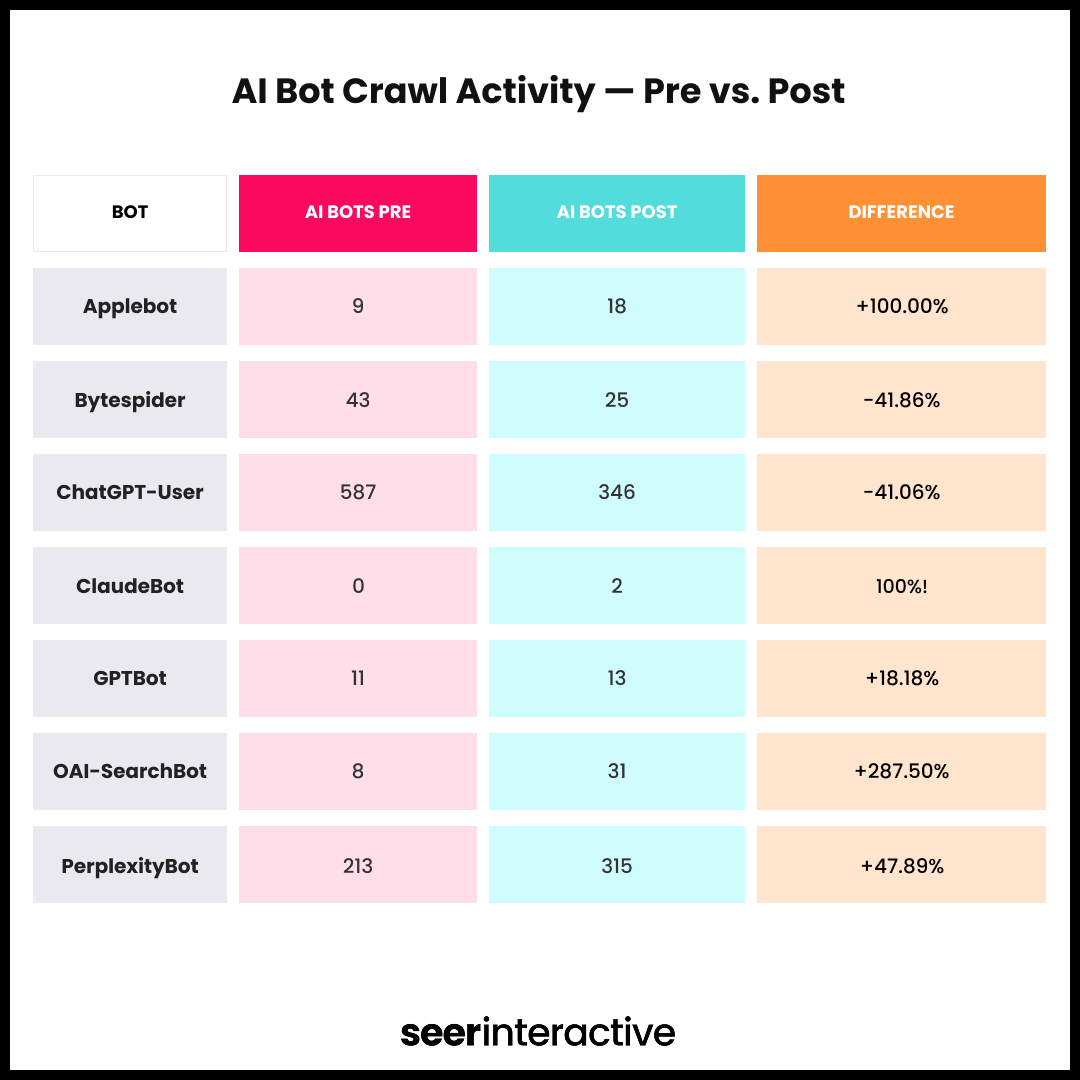
→ +287.5% increase in bot hits from OpenAI’s OAI-SearchBot

→ Net positive impact on Google SERP features presence for test pages

Early results from our test were inconclusive. Across the 3 test pages, we saw an average decline of 13.9% in ChatGPT bot hits.

However, the drop in ChatGPT-User bot activity also aligns with broader seasonal declines we’ve seen in our client’s AI-referred traffic.

We’ll need to conduct additional testing to confirm whether the Q&A formatting played a role in the decline, or if the broader seasonality trends affected our test.

While the test showed a decline in bot hits from ChatGPT, we saw increases in bot hits across other AI bots from Apple, Claude, and Perplexity.

We also saw a significant increase in hits from OpenAI’s OAI-SearchBot, which is used to index content across the web.

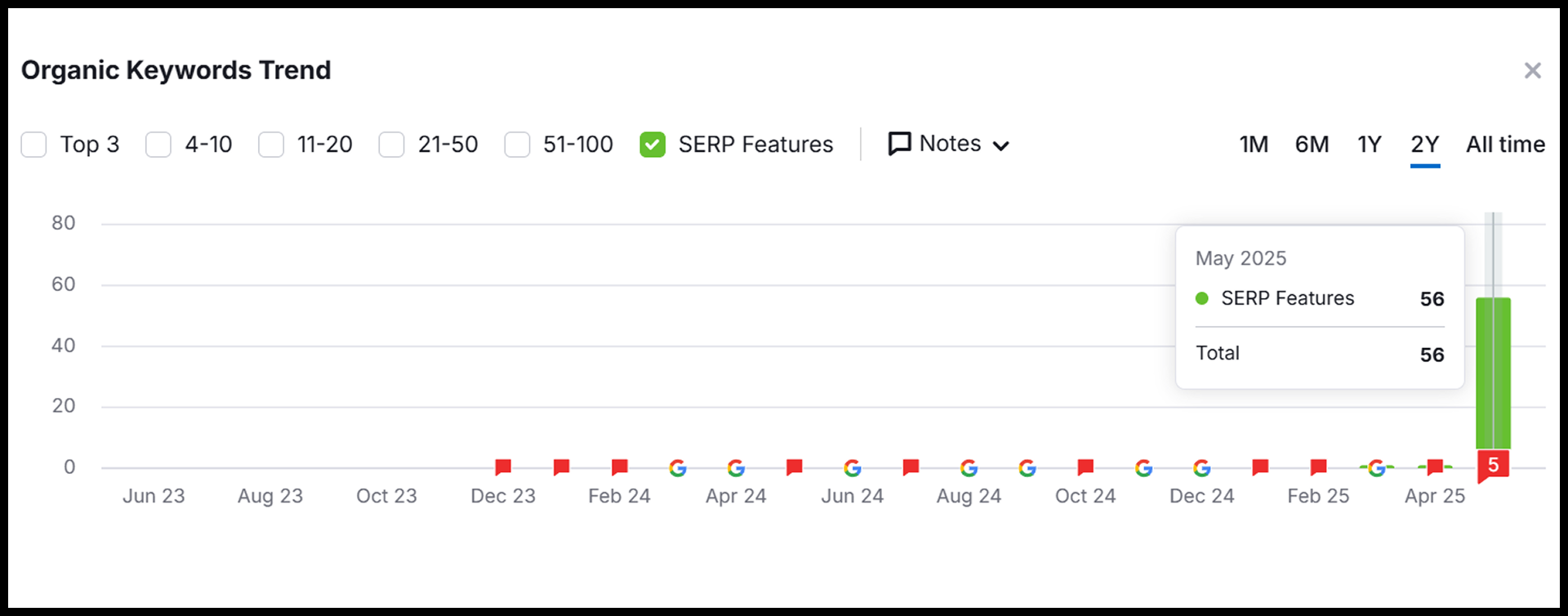
Another promising result we saw was a net positive increase across Google SERP features — with Test Page 2 showing a +5,200% increase. As shown in the chart below, Test Page 2 increased from 1 SERP Feature result to 56 in the first month after the content was reformatted. We’ve also seen organic impressions to that page increase 24% (+1,561), driven by the additional SERP visibility.
Seer-AI-case-study-QA-test-SaaS-client-2

These results show more testing is needed (and perhaps an expanded set of test pages) before we can draw conclusions about the effectiveness of Q&A formatting. That being said, our early results suggest this could still be an effective tactic to increase AI bot hits and influence organic traffic. The significant increase in Test Page 2’s SERP Features presence indicates that Q&A formatting could be a solid yet simple lever for brands looking to grow their presence in those high-visibility search features. 

Next Steps

Our next step is to expand this test across more pages and see if these patterns persist. We’ll also continue monitoring these 3 test pages to see if seasonal fluctuations continue — and whether or how those changes impact AI bot visits. In the meantime, we’re also testing how other formatting cues such as citations and FAQ schema impact AI visibility.

Beyond crawl behavior, we're exploring whether these formatting changes influence other key metrics, including actual AI visibility in model responses and citation ownership when content is referenced.

Ready to get ahead with GEO?

[Up Next]
SEO / AI / B2B

How AI-Assisted Content Accelerated Implementation and ROI for a Water Technology Leader

Check it out
SEO / B2C

Owning the Narrative: How an Automotive Giant Built Authority Through Strategic Content

Check it out

About Seer Interactive: 

Seer Interactive is at the forefront of Generative Engine Optimization (GEO). We run enterprise-scale AI search experiments and turn them into proven strategies that deliver AI visibility and business impact. We help enterprise brands navigate the shift between traditional SEO to AI visibility, building strategies that win across search engines, LLMs, and wherever your customer is looking for answers.

Our edge? Decades of thinking about how people get answers to problems, across social, SEO, Paid, and UX, now applied to AI search through live GEO experiments that deliver measurable visibility. Wil Reynolds and the Seer team have been leading the conversation on AI, SEO, and GEO since the beginning.

Seer partners with industries from SaaS and e-commerce to healthcare and banking , helping brands like American Family Insurance and Capital One adapt, move faster, and capture visibility in an AI-first world.