
AI LAB CASE STUDY

Do AI Models Prefer Fresher Content? Testing Content Recency in GEO

Key takeaway: Refreshing outdated content led to a 300% increase in AI traffic for one client, and a 54% increase in GPT-User bot hits for another.

The Challenge

As AI–driven search increases, we’re constantly evaluating how we can help our clients increase AI visibility and keep pace with competitors. We looked at data across many clients and discovered content age could be a potential factor in gaining (or losing) AI search visibility — and decided to test this further. 

One of our clients, a leading provider of Software-as-a-Service (SaaS) HR management, was experiencing  seasonal fluctuations in their AI traffic and sought to counteract those performance dips.

With another one of our clients (a travel search aggregator), we noticed high AI visibility across all key themes except for one: “discounts”. Analysis of the pages ranking for related keywords revealed content that was over three years old on average. Considering this was a core theme for our client, we needed to improve their AI presence.

So we asked: Can updating the content on older pages lead to an increase in AI traffic?

Industry

Type

Hypothesis

We noticed that AI citations were heavily skewing toward fresher content, and decided to test whether focusing on content recency would help our clients’ positioning. We hypothesized that updating our client’s older content would lead to greater AI visibility. By prioritizing the refresh of older pages on our client sites, we would be able to increase their presence in AI responses and secure better positioning over their competitors.

While we knew content recency was not a new concept in search marketing, we hypothesized that the windows of content freshness vary from one channel to another (ex. SEO to AI search).

Validation: After analyzing traffic to our Saas HR client’s site, we found that over 80% of their existing AI-driven traffic went to pages updated within the last two years — while only 3.6% of AI-referred traffic went to pages over four years old.

Strategy

To put our hypothesis to the test, we developed a similar strategy for both clients to update older pages while monitoring AI-driven sessions before and after the changes. For the SaaS HR client, we selected seven pages that hadn’t been updated in over two years, and refreshed the content to reflect current information. 

For the travel search aggregator, we identified 48 pages that were performing well organically, were based around their target topic of ‘discounts’, and had content over three years old. We then republished them with updated content and structure. 

Based on the results of our hypothesis, we planned to roll out targeted page refreshes sitewide for each client and monitor the impact on AI visibility.

Results

→ +300% increase in AI traffic to test pages for SaaS HR client

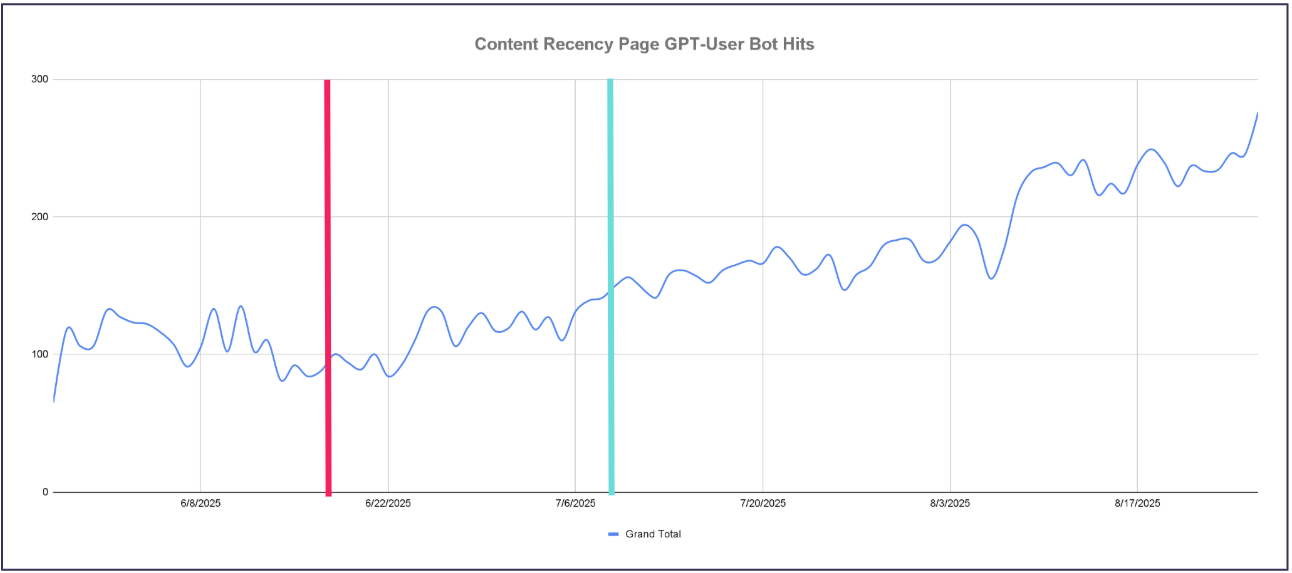
→ +54% increase in GPT-User bot hits for travel aggregator client

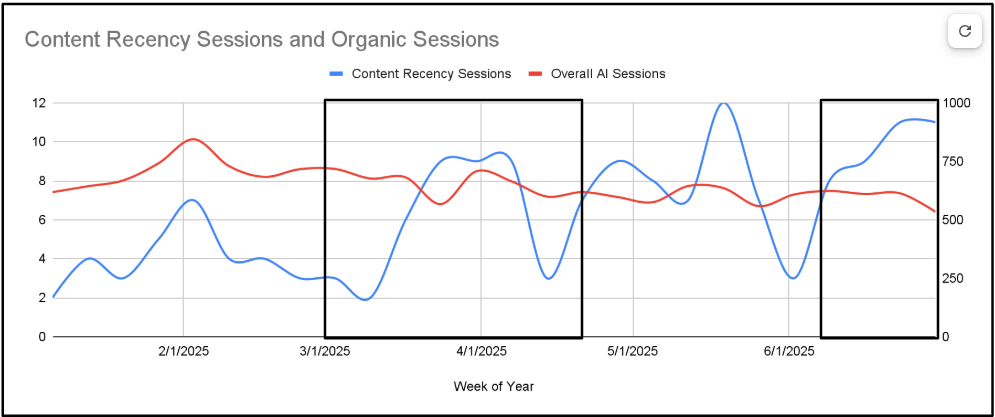
The initial test with our SaaS HR client showed a 219% increase in AI visits compared to their prior performance. When we scaled the approach across more pages, the increase grew to 300%. 

As the chart below shows, the number of sessions on test pages for the SaaS client spiked after implementation (marked by the black boxes) while overall AI-driven sessions remained stagnant.
Seer_content_regency_test

The test with our travel aggregator client also showed promising results — we saw a 54% increase in GPT-User bot hits on average. In the following chart, you can see the upward trend in GPT-User bot hits across the initial launch of the test pages (red line), a second batch of pages (blue line), and the following months.
Seer-content-recency-travel-client-results

The clear increase for both clients indicates a strong correlation between content recency and AI visibility. The impact on our SaaS HR client’s site confirms that even established brands can see significant improvements in AI-driven traffic by updating older content. 

Serving fresh content may become a reliable lever to boost AI visibility, particularly in competitive sectors and industries that prioritize content recency. (We uncovered more insights as well as different patterns in how content age affects AI visibility across different industries in our recent AI Brand Visibility and Content Recency study.)

Next Steps

Due to the successful outcome of the initial tests, our next step is to scale the recency refreshes across larger sections of both sites and monitor the longer-term impacts on AI citations. We’ve also recommended our clients conduct annual reviews of content age for key pages, and add or update information as needed to keep the content fresh. 

By continuing to validate these patterns across industries, we aim to build a clearer roadmap for how organizations can stay visible in an AI-first search environment.

Ready to get ahead with GEO?

[Up Next]
SEO / AI / B2B

How AI-Assisted Content Accelerated Implementation and ROI for a Water Technology Leader

Check it out
SEO / B2C

Owning the Narrative: How an Automotive Giant Built Authority Through Strategic Content

Check it out

About Seer Interactive: 

Seer Interactive is at the forefront of Generative Engine Optimization (GEO). We run enterprise-scale AI search experiments and turn them into proven strategies that deliver AI visibility and business impact. We help enterprise brands navigate the shift between traditional SEO to AI visibility, building strategies that win across search engines, LLMs, and wherever your customer is looking for answers.

Our edge? Decades of thinking about how people get answers to problems, across social, SEO, Paid, and UX, now applied to AI search through live GEO experiments that deliver measurable visibility. Wil Reynolds and the Seer team have been leading the conversation on AI, SEO, and GEO since the beginning.

Seer partners with industries from SaaS and e-commerce to healthcare and banking , helping brands like American Family Insurance and Capital One adapt, move faster, and capture visibility in an AI-first world.