Does having a brand presence on third-party review sites impact your visibility in AI search?
We wanted to find out. So we ran the study ourselves, analyzing 804,491 AI responses across 1,926 brands on 4 AI platforms to see whether a review profile changed how often brands showed up in AI-generated responses.
Through this research, we hoped to quantify how trust manifests in AI search ecosystems for brands with review profiles.
The short answer: It does.
Review profiles correlate with significantly higher AI citation rates across all platforms, verticals, and brand sizes. In fact, brands can increase their trustworthiness simply by setting up a profile.
Let’s dive into what we found.
Key Takeaways
Review sites are the #2 citation source in AI — and their influence grows 10–20x by the time someone is ready to buy. At the Awareness stage, review and trust sites make up a small slice of AI citations. By the Decision stage, that share has expanded dramatically. AI isn't treating reviews as background noise — it's leaning on them as a validation layer exactly when it matters most.
The barrier to entry is lower than you think. Brands with no Trustpilot profile have a median AI citation rate of 1%. Brands with even a minimal profile — as few as 1–13 reviews — jump to 53.5%. That's a 52 percentage point swing. You don't need hundreds of reviews to show up. You just need to exist on the platform.
The absence signal is real. When AI searches for a brand and finds no Trustpilot profile, it doesn't stay quiet about it. We found ChatGPT explicitly flagging missing review presence as evidence of lower trustworthiness (an absence signal) - using language like "[Brand] lacks reviews on trusted sites like Trustpilot, BBB…" Not having a profile is a negative signal.
Smaller brands face a leveling playing field. A brand with a Domain Rating of 0–15 that has a minimal Trustpilot profile achieves nearly the same citation rate as a mid-authority brand at the same tier. Organic strength matters — but a Trustpilot profile can close a significant portion of that gap.
Brands with optimized profiles are getting surfaced in their competitors' branded conversations. Fully optimized Trustpilot profiles received 9.5x more co-mentions than T0 brands — meaning AI is recommending these brands when consumers are asking about someone else. That's earned visibility in someone else's consideration set.
99.5% of Trustpilot citations arrive through organic search ranking, not because AI seeks Trustpilot out. Analyzing query fanout, we saw Trustpilot's own SEO and domain authority are doing the heavy lifting. Brands benefit from that infrastructure simply by having a profile that Trustpilot's pages can rank for.
For a downloadable report on key findings, check out Trustpilot's white paper on What is AI saying about your brand?
Part 1: Why Review Platforms Matter in AI Search
Consumers are constantly seeking product and service reviews to influence their decisions around what to buy and where to shop.
For years (decades), consumers leaned on Google searches, review sites, and social platforms like Reddit and Instagram to make those calls.
Now, that’s shifting. Consumers are increasingly turning to AI platforms like ChatGPT and Perplexity alongside traditional search to understand how legitimate and trustworthy brands are.
AI Platforms Draw from a Structured Hierarchy of Trust Signals
We know AI platforms rely on a variety of sources and signals to validate the information included in responses before presenting it to users. In past studies, we've analyzed how local factors, traditional search factors, and awareness metrics have influenced how visible brands are in AI search.
For this study, we zeroed in on how AI platforms read, weigh, and cite review content when deciding which brands to surface.
The Source Mix Shifts Dramatically by Funnel Stage
We discovered that review and trust sites are the second-highest citation source when it comes to AI responses.
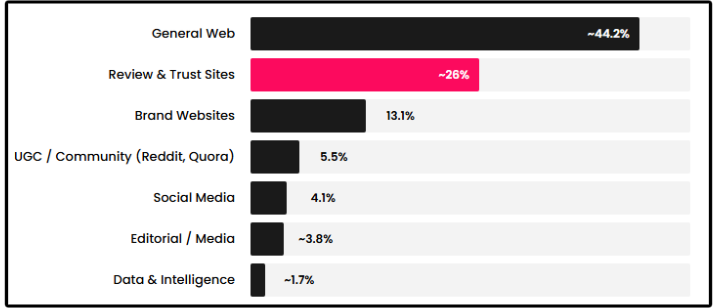
Interestingly, the percentage of citation sources shifts throughout stages of the buyer’s journey.
For example, review sites make up a much smaller piece of the pie in the Awareness stage (just 1.51%), while editorial and media sites see much higher citation rates in that stage.
| Stage | General Web | Trust + Review | UGC | Editorial | Social |
|---|---|---|---|---|---|
| Awareness | 87.25% | 1.51% | 3.90% | 6.02% | 0.83% |
| Evaluation | 75.14% | 16.24% | 4.62% | 1.91% | 1.22% |
| Intent | 65.50% | 24.27% | 7.84% | 1.24% | 0.68% |
| Aggregate | 75.96% | 14.01% | 5.45% | 3.05% | 0.91% |
Fast forward to the bottom-funnel Intent stage, and trust and review citation usage increases to 24.27%.
The assumption that reviews matter more as purchase intent increases has always been reasonable. What's new is being able to quantify exactly how much — an increase of 22pp.
Each AI Platform Has a Distinct Citation Fingerprint
We also found that citations vary across AI platforms. For this study, we analyzed ChatGPT, Google AI Mode, Gemini, and Perplexity. We found Trustpilot is the most frequently cited review website, and by sizable margins.
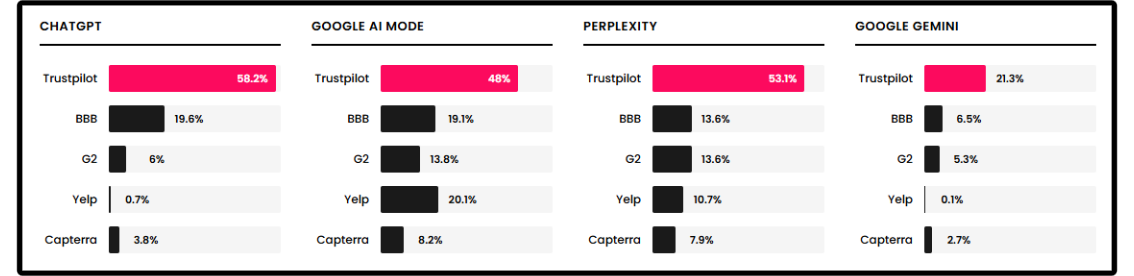
Across all four platforms, Trustpilot was more than 2x likely to be cited compared to the next highest-cited review website for our prompts analyzed.
Controlling for brand size and organic strength, ChatGPT led all four platforms with a Trustpilot citation rate of 57.9%. It's also the platform most likely to explicitly reference TrustScore data (their overall measurement of reviewer satisfaction) when citing Trustpilot. Perplexity followed at 51.9%, while Google AI Mode came in at 48.9%.
Google AI Mode showed the most diverse citation mix, pulling from Yelp and G2 more frequently than its counterparts, making it the most competitive landscape for review platform visibility.
Google Gemini had the weakest of all AI platform citations, but the low citation presence of all review sites in Gemini responses suggests a broader trend within how the platform prioritizes citation usage.
These patterns set the stage for the bigger question: does having a review profile actually change how often your brand shows up in those citations?
To answer that, here's how we structured the research.
Part 2: How a Review Profile Influences AI Citation Ownership
We analyzed 804,491 AI responses across 4 platforms, 8 verticals, and 1,926 brands. This research was conducted primarily over a window in March 2026.
Methodology
Prompt Design
We used 15,783 unique prompts spanning four funnel stages, each designed to replicate what a user would encounter when searching at that stage of the buyer's journey. We captured AI visibility, citation ownership, and source behavior across Awareness, Evaluation, Intent, and Trust/Reviews:
- Awareness: Non-branded category queries ("What are the best home security companies?")
- Evaluation: Brand comparisons ("How does [brand] compare to other [category] companies?")
- Intent: Direct consideration ("Should I choose [brand]?")
-
Trust/Reviews: Reputation signals ("Is [brand] trustworthy?" / "What are the pros and cons of [brand]?")
Brand Comparison Framework
We tracked brands across four tiers to evaluate how different levels of brand activity on Trustpilot impacted AI search performance:
- T0 (Control Group): No verified active Trustpilot profile
- T1 (Minimal): Minimal presence, low review volume
- T2 (Active): Active profile, moderate review volume
- T3 (Optimized): Actively managed profile, high review volume
To create the Tier 0 Control Group, we sourced brands with comparable benchmarks in a P10-90 percentile to avoid outliers. Data analysis included brand search volume, domain authority, backlinks, organic traffic, and other metrics via Ahrefs.
In addition, we created a much stricter Domain-Rating cohort that consisted of 206 brands in each tier to isolate the effects of Trustpilot from organic strength.
Industries Covered
Research spanned 8 verticals across both B2C and B2B categories: Money & Insurance, Shopping & Fashion, Travel & Vacation, Home Services, Health & Medical, Education & Training, Electronics & Technology, and Business Services.
Part 3: Review Profiles Can Increase Brand Visibility by 52+ PP
When we looked closely at citation variations across our tiers, we found significant differences in brand visibility between Tier 0 and Tiers 1, 2, and 3.
The T0 to T1 Gap: The Core Finding
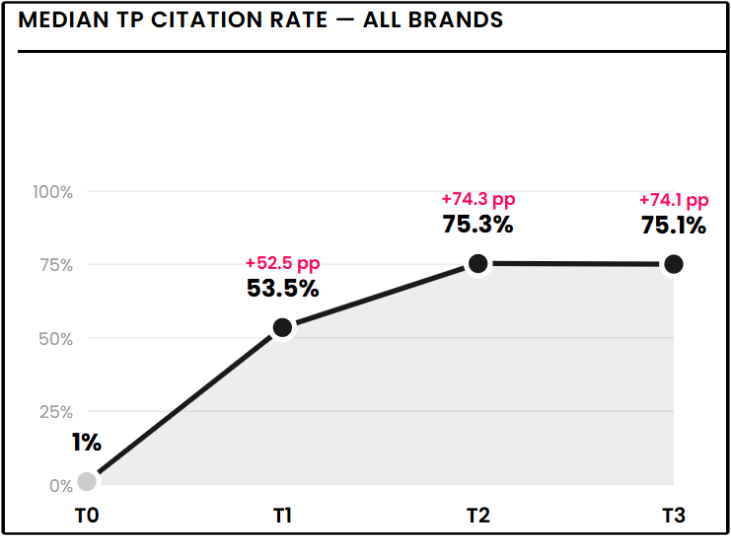
Our research showed that brand citation rate increased 52 percentage points for brands who had minimal review profiles.
Tier 0 brands (those without a verified active Trustpilot profile) had a median citation rate of 1%, while Tier 1 brands had a citation rate of 53.5%.
Even a brand with a minimal Trustpilot profile that included as few as 1-13 reviews appeared alongside a Trustpilot citation in over half of AI responses.
T0 to T1 marks the difference between being functionally invisible in AI citations that mention Trustpilot — and being consistently present.
The citation rate increases by another 25pp once a brand has an active Trustpilot profile (with a median of 81 reviews).
Trustpilot published a press release highlighting our finding that reviews can increase AI citations from 1% to 75%.
The T2 to T3 Optimization Premium
Now let’s revisit our stricter Domain-Rating cohort that we mentioned earlier, where we matched brands on domain strength to establish a level playing field.
When we applied these more rigorous benchmarks, we were able to quantify that fully optimized Trustpilot profiles (T3) outperformed active-but-not-optimized profiles (T2) by 6pp.
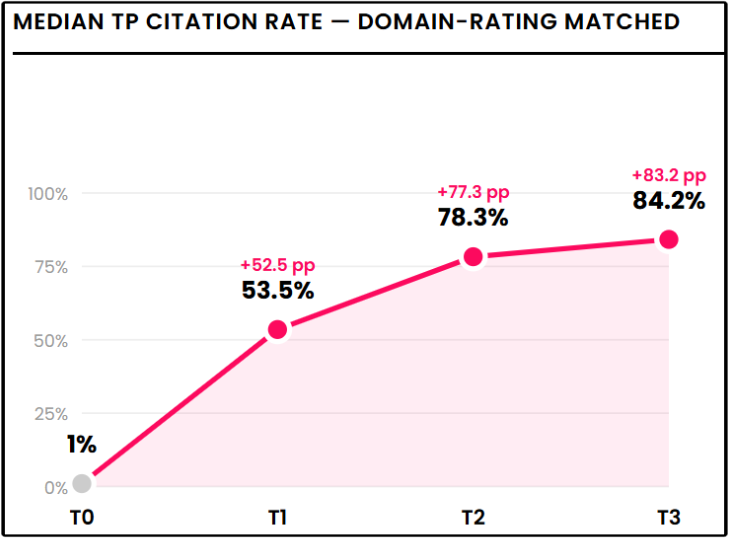
Of course it’s possible that other factors like marketing spend and audience size influenced these rates, but our data shows a measurable lift for brands who invest in a fully optimized Trustpilot profile.
Citation Rates by Industry Vertical
If you thought perhaps your industry was an outlier and exempt from the T0-to-T1 gap, think again. Our research showed the presence of this gap across every vertical we looked at.
Travel & Vacation showed the highest lift, with a 43x increase between T0 and T1. However, this difference could be attributed to the sheer quantity of unknown and lesser-known travel sites that AI platforms may view as less trustworthy.
Domain Authority Analysis: Who Benefits Most
A Trustpilot profile closes a meaningful portion of the domain authority gap between small and mid-size brands.
- A brand with a Domain Rating of 0–15 and a minimal Trustpilot profile achieves a 54.5% citation rate — nearly identical to a mid-authority brand (DR 16–35) at the same tier (52.6%). For smaller brands, Trustpilot functions as a credibility equalizer, substituting for the organic authority that larger brands have built over years.
- Mid-size brands (DR 16–55) see the strongest absolute citation rates overall, ranging from 75–81% at higher tiers. The combination of existing organic strength and an active Trustpilot profile compounds well at this level.
- For enterprise brands (DR 56+), the lift is smaller but still measurable. A fully optimized profile still outperforms a minimal one, suggesting that even at high domain authority, Trustpilot reinforces rather than replaces organic trust signals.
One nuance worth noting: ChatGPT's use of TrustScore data peaks at Tier 1 brands (14.5% of citations reference it explicitly), suggesting AI leans on that structured rating signal hardest precisely when other brand recognition signals are sparse. For low-authority brands, TrustScore may be doing more work than they realize.
Competitive Co-Mentions
We also looked at organic visibility from a competitive perspective. Specifically, the influence of Trustpilot profiles on what we’re calling “co-mentions” — scenarios where Brand A is mentioned in the prompt, and AI cites competitor Brands B and C in the response.
Here’s an example: You ask ChatGPT “What are the reviews of this shoe from Nike?” ChatGPT then responds with “Consumers rate those Nike shoes highly. You could also consider these top-rated shoes from Reebok and Adidas.”
When we analyzed co-mentions across our tiers, we found that T3 brands received 9.5x more co-mentions compared to T0 brands.
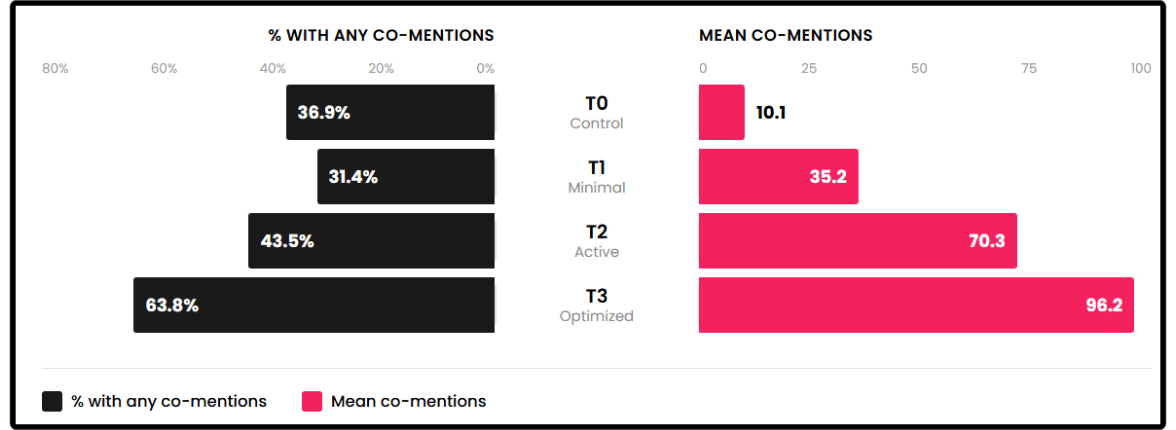
In other words, AI platforms are surfacing T3 brands when consumers ask about competitors. These co-mentions are essentially functioning as an organic competitive visibility channel.
Our hypothesis is that because fully optimized Trustpilot profiles give AI platforms stronger validation signals, those brands are more likely to be included in co-mentions.
When we took it a step further and analyzed co-mentions by vertical, the results from T0 to T3 brands varied across industries. The largest gap we found was in Electronics & Technology, with a co-mentions gap of 20x between Tier 0 and Tier 3 brands.
AI Platforms Seek Third-Party Validation from Review Sites
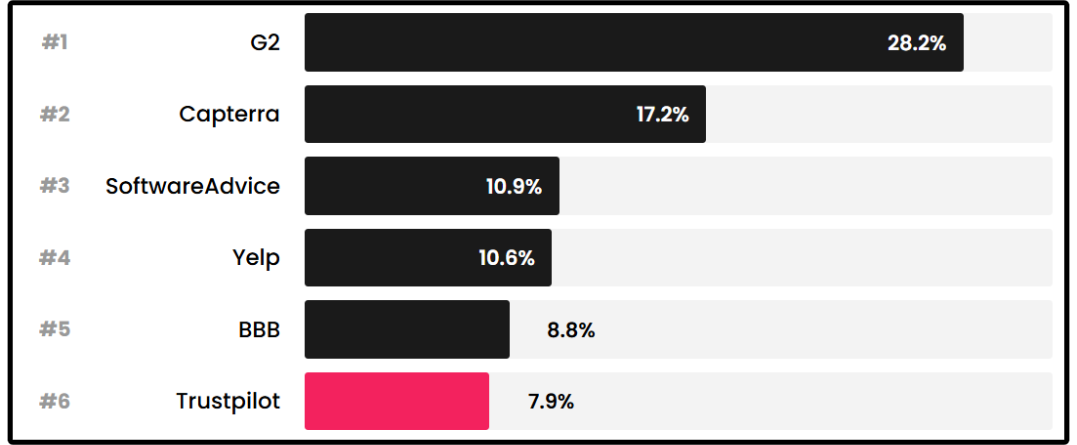
If a brand does not have a Trustpilot profile, AI platforms still seek third-party validation from whichever review sites have indexed that brand (such as G2 and Capterra).
Interestingly, even in cases where a brand lacks a Trustpilot profile, Trustpilot remains the sixth most-cited review site.
But simply having a Trustpilot profile can significantly increase a brand’s visibility: for Tier 1 brands (i.e. those with minimal presence on Trustpilot), Trustpilot jumps to becoming the top-cited review site with 45.6% of all citations.
Part 4: How AI Extracts and Uses Data from Review Sites
During our research, we wanted to better understand how AI platforms read, interpret, and paraphrase content from Trustpilot reviews. We’ve categorized this extraction into three layers:
- Layer 1: Trust Metadata
- Layer 2: Synthesized Themes
- Layer 3: Direct Paraphrasing
Three Layers of AI Extraction
Layer 1: Trust Metadata
In the ingestion layer, AI looks for mentions of branded Trustpilot content such as TrustScore and star ratings.
We found that ChatGPT used TrustScore or star ratings in 59% of responses where Trustpilot was cited (based on a cohort of over 90,000 ChatGPT responses).
Layer 2: Synthesized Themes
The interpretation layer is where AI analyzes signals that reinforce brand perception to AI users.
When Trustpilot was cited, ChatGPT synthesized the themes of brand reviews. The most common themes included:
- Customer service quality: 62.9% of citations
- Shipping and delivery: 33.5%
- Product/service quality: 33.1%
- Scam/legitimacy concerns: 30.0%
- Refund/return issues: 21.3%
Layer 3: Direct Paraphrasing
In the paraphrasing layer, AI pulls directly from Trustpilot content in its responses.
In our research, we found that 45.2% of AI responses citing Trustpilot attributed content directly to the Trustpilot site.
ChatGPT would use phrases like “On Trustpilot, the rating is…” and “Trustpilot reviews show…”
This shows the AI platforms are actually using Trustpilot as a validation source when it comes to providing trust signals for AI users.
The Echo Effect: Review Content Flows Directly into AI Narratives
Another trend we noticed was that AI narratives tend to amplify the sentiment found in Trustpilot reviews. This occurred across both positive brand reviews (high ratings, praise for the product/company) and negative reviews (low ratings, critical feedback).
We also saw a third narrative occur when no Trustpilot reviews existed, which is what we’re calling the absence signal.
- Positive amplification: AI cites positive narratives from Trustpilot reviews. One brand example is Stellar Scientific, categorized as a Tier 3 with an actively managed profile: AI cites “high overall rating (4.7/5)” and mentions reviewer praise for delivery, accuracy, and staff quality.
- Negative amplification: AI cites negative narratives from Trustpilot reviews. With Thryv — also a Tier 3 brand — AI surfaced “billing issues, contract problems, and unmet promises” originally published in negative Trustpilot reviews.
- Absence signal: AI explicitly calls out the absence of brand reviews. We saw ChatGPT do this using language like “[Brand] lacks reviews on trusted sites like Trustpilot, BBB…” In other cases, ChatGPT used language like "No independent customer reviews on Trustpilot appear to exist at this time". In several instances, it was actively citing the brand's own website while simultaneously flagging the absence of third-party review coverage. While the brand’s name was visible, the credibility wasn’t.
How Trustpilot Citations Actually Arrive: Query Fan-Out Analysis
Before AI platforms look for sources and synthesize content into a response, they typically break a user question into multiple sub-queries — or what’s known as a query fan-out — and then work to answer each sub-query.
We analyzed which sources ChatGPT was using for these query fan-outs to better understand how it was coming to the conclusion of including Trustpilot in its citations.
In our analysis, 99.5% of AI citations arrived by way of organic search rankings. AI doesn’t need to actively seek out Trustpilot content because that content is already ranking for relevant review-related queries. In fact, we found that “reviews” appeared in 60.1% of all ChatGPT fan-out queries.
This shows us that Trustpilot’s own SEO efforts and high domain authority give ChatGPT strong validation signals. As a result, brands who invest in a Trustpilot profile can reap the benefits of that trust with minimal work.
Part 5: What This Means for Your Brand
The Mutual Benefit
AI citations don’t just benefit Trustpilot — they compound for the brands being cited.
By increasing your brand’s likelihood of appearing in AI citations, you’re helping to amplify the signals you want your brand to be known for. This is categorically different from ‘visibility’; it’s automatic validation surfacing alongside your brand name.
The data from this study points to one consistent conclusion: in AI search, review presence isn't a nice-to-have, it's part of the foundation AI uses to validate brands at the moment consumers are deciding whether to trust them.
1. For brands that don't have a review profile yet, the finding was straightforward.
AI is already searching for your brand. When it finds no review presence, it notes that absence explicitly and that shapes how consumers perceive you at precisely the moment they're closest to a decision. We observed a jump from a 1% citation rate to 53.5% just by having a basic Trustpilot profile, which occurred at a remarkably low review threshold.
The barrier to entry is low, and the gap between having a profile and not having one is significant enough that it's worth treating as a priority.
2. For brands that already have a presence, the data shows that continued investment compounds.
Moving from a minimal to an active profile adds roughly 25 percentage points in added visibility through Trustpilot’s citation rate. Fully optimized Tier 3 brands are appearing in their competitors' AI-generated responses at 9.5x the rate of brands with no profile — meaning that optimization isn't just improving your own visibility, it's expanding the conversations you're part of.
3. For larger, established brands, the value shifts from visibility to narrative control.
Our domain-matched cohort shows that high-authority brands still see meaningful lift from full profile optimization. But, potentially more importantly, the themes AI surfaces about your brand are amplified from your review content.
Customer service quality, product experience, shipping reliability, etc. are the attributes AI is synthesizing and presenting to consumers at the decision stage. An optimized Trustpilot profile gives brands an active role in shaping what that narrative looks like, rather than leaving it to whatever review content happens to be indexed.
The Next Steps for Your Brand
A few practical starting points based on where you are today:
- If you don't have a profile on the top review sites like Trustpilot, claiming one is the highest-leverage action from this data set.
- If you have profiles with minimal activity, increasing your review volume is the next lever.
- If you're already active, full optimization is worth the investment, both for direct citation rates and for the competitive co-mention visibility that comes with it.
- Regardless of your brand size, ongoing measurement matters. The citation mix across platforms shifts as models update, and staying ahead of those changes requires consistent tracking.
The trust threshold is real and lower than most brands expect. The brands that cross it now aren't just improving citation rates, but building the trust infrastructure that AI is already using to decide who gets recommended.
Want help understanding brand visibility and building your AI search strategy? Reach out to the Seer team to learn more.

.png)
.png)