Tool Discrepancies? Google’s Keyword Tool vs Trends & Insights
Im hoping one of our readers can clarify an issue for both myself and the rest of the SEER team. One of the tools that we often use for our keyword research is Googles Keyword Tool. Recently, we noticed that this tool says the phrase snowboarding equipment has much higher search volume than the phrase snowboarding gear:
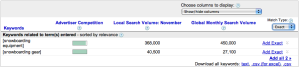
This trend holds for all 3 match types (broad, phrase, and exact).
However, when I look at either Google Trends or Google Insights, I see a different trend the lines for snowboarding gear are higher than snowboarding equipment:
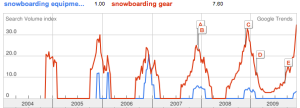
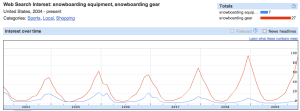
So the question is which tool is correct? Which phrase snowboarding gear or snowboarding equipment has more search volume? Ive personally spent a lot of time reading the Help for Trends and Insights, and I do understand that the graphs in Trends and Insights do not show actual volumes. I understand that the data has instead been normalized and scaled. However, I am not comfortable concluding that the discrepancy is due to normalization and scaling after looking at another example provided by Google itself.
In a 2008 blog post about Google Trends, the Google team talks about using trends to compare two phrases, vanilla ice cream and chocolate ice cream:
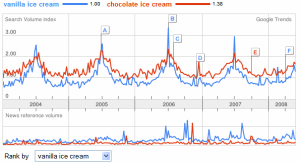
Quote: As the numbers on the top of the graph indicate, vanilla ice cream has about 30 percent less search traffic than chocolate ice cream.
After reading this statement, I started thinking that Google is saying it is OK to use Trends or Insights to make inferences about relative search volumes. However, this is what Googles Keyword tool says about the volumes for vanilla ice cream and chocolate ice cream:
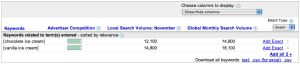
Here, vanilla ice cream seems to have higher search volume than chocolate ice cream. Again, this general trend holds for all 3 match types. If you were making decisions for your business, would you believe Google Trends and assume that “chocolate ice cream” is more popular than “vanilla ice cream” or would you believe the Keyword Tool and assume that “vanilla ice cream” is more popular?
Has anyone else noticed these types of discrepancies? Which tool do you (or would you) trust to make inferences about search volumes? Does anyone have any explanations for how several tools from Google can suggest conflicting conclusions?

Posted: 12.21.09

Mark Kennedy:
Hi Laura,
I’ve seen the same thing over the course of time and it makes you curious of how accurate any tool is and where they pull the data. My guess is that the adwords tool and Google trends may pull data from different or multiple varying sources. While I didn’t see your same results for gear vs. equipment, I was able to replicate your results for vanilla vs. chocolate.
For me, I take every keyword tool with a grain of salt. I use them as guides and not absolutes. Also, as you know, things can change with the drop of a hat. Fir example, if for some reason it’s found that vanilla ice cream causes a certain illness then those numbers go out the window for a current time frame with a huge spike in vanilla.
One thing to ask (which may be why you and I see different numbers), did the time frame you used on Google trends match the time frame the Google adwords tool is using? Sometimes I forget to change the time frame on trends and the data can be very different (especially newsworthy terms like H1N1 or the Eagles :)
In the end, when you have to make a difference between optimizing for equipment or gear and you can’t rely on the keyword tools, you’re just going to have to rely on your expertise as an SEO professional. Test, examine results, test, examine results, etc. Sometimes you’re your own best keyword tool.
divinci:
Yeah I have noticed similar discrepancies with the various *different* google tools out there.
At the moment I am more interested in SEO theory than actual practice! BUT if I owned two sites that both ranked #1 for closely related search terms – like “snowboarding gear” or “snowboarding equipment” then I am sure you would be able to use the data gleaned from them to see what tool was the most accurate.
IMHO I also think that the Adwords Keyword Tool is the one you need to concentrate on, as the guys in charge of that *must/should* have a reason for placing the “snowboarding equipment” higher than the latter term.
Say for example:
1. The trends and insights graphs for both “snowboarding gear” and “snowboarding equipment” showed that they were searched for exactly the same.
2. The keyword tool showed “snowboarding equipment” as in your image – outperforming the latter term.
Maybe with all bigG’s data, they have found that in terms of advertising / buying SB stuff, “SB gear” is searched for the same number of times as “SB equipment” – BUT a person searching for “SB gear” who wants to BUY – usually also searches for “snowboarding equipment”.
I must say that what I have written just doesnt make sense :)
Cody Gibbs:
I have no idea, but I have never really trusted the Keyword Research Tool. I see it more as a guide. Insights seems more refined, while the research tool seems to give back a lot of rounded numbers. Comparing two words, I would trust Insights more.
Laura:
@Mark – I agree, it is important to take things with a grain of salt — good advice. You are also right that the correct way to probably resolve this is test & be results focused.
@divinci & @cody – Thank you both for your comments and for reading.
Sam Diener:
I trust NEITHER. But I also think the publisher of this article is missing a very critical point. Actually – critical to the point that you might want to remove this article.
You have my email. I will share over that to avoid embarassment.
Sam
Wil Reynolds:
Hey Sam, if we missed something major its OK to let us know here. You can’t create something great if you aren’t willing to make mistakes on the way, so we’re fine with a little embarrassment if we learn from it.
Sam Diener:
Wil. Thank you for the phone conversation. We will be in touch soon.
Per my understanding, The basic assumption from this article is incorrect. (The data used in Insights/Trends is the same as in the keyword tool.) Google correlates this fact in their help section…
The Traffic Estimator (keyword tool) is designed to give you keyword search traffic and cost estimates at a glance. (The estimates are for search on Google and search partner sites only; they don’t include estimates for the number of clicks your ads might receive on placements you choose or on the rest of the Content Network……
So by this, of course trends/insights would provide different trend lines.
Happy SEOing..
Sam Diener
(Who is this guy?)
Wil Reynolds:
I think Laura’s assumption is that it appears that Google is not using the same data source for insights and adwords estimates and when they are wildly divergent in terms of their results which of the two do we believe for search volumes, Insights or The adwords tool. Both are showing search volumes. To me its still a puzzle because in the example above we got two different outcomes for the same keyword, I am hoping others chime in with their experiences as well – since I am still not entirely sure.
Sam Diener:
But let’s not forget…. google is VERY mysterious…
Mark Kennedy:
Hi Everyone,
Sam, you actually bring up a good point coming straight from Google. However, you are also bringing a 3rd tool into the mix. The traffic estimator and the Google adwords keyword tool are two different tools and trends would be the 3rd. Now as of recently, Google has combined some of the traffic estimator features in the new Google adwords keyword tool (beta), but I’m not sure if it’s perfected yet. Maybe we can consider this a 4th tool as well :)
But as you pointed out, Google states that they not only pull data from their own search engine, but the partners as well. So that could be screwing with the numbers. Maybe trends doesn’t pull that partner data.
So I think it really comes down to two questions for each keyword tool. Where do they get their data? And what time frame do they use when pulling that data? I think those two answers may be different for each tool. Kind of like how each algo is different for each search engine.
So it really comes down to using the tools as a guide, but using your testing, skills, and results to find your answer.
Laura:
@Sam – Thank you for your feedback. You are correct — insights and trends are supposed to use the same data set. My questioning was in the differences between insights/trends vs adwords traffic estimator. In my research, I actually couldn’t find anything that concretely stated that Adwords traffic estimator uses only Google traffic/partner data and that Insights/Trends uses some different data set. And while it does seem that they might use different data, my ultimate question was which set should be trusted?
David de Souza:
I would start an adwords campaign using the exact match for each and compare the number of impressions over 7 days to the various tools.
In my experience using the above method, the keyword tool seems to be more accurate.
Angel Lee Dresses:
I was so confused about the results for Tends and keyword tools so I found my self on this post.
I still feeling confused!!! hehe
Is the keyword tool more accurate then?
Amanda:
Have you tried doing a deep dive using several different keyword research tools and compared volumes across them to see what the results were? It would be interesting to see a case study on this…