

There are numerous types of links that exist on the internet. Paid, product reviews, sponsors lists, blogrolls, and we could go on till the cows come home. With Google placing so much weight on links, below are 25 ways to qualify whether the link you're pitching, buying, trading, or baiting is a quality one.
1. Does the page link out directly?
It's common for sites to run your link through a redirect. It's also common for sites to be affiliates & run it through some jumbled CJ link. If you need to be there & the price makes sense, go for it. Aside from that, we would steer clear of these redirects.
2. How many links are on the page?
Matt Cutts recently came out with a video that provides some great insight as to how many links on a page Google will digest, but typically if we see over 150-200, we'll look for a better opportunity.
3. Does PR flow through to the page you're evaluating?
PAGERANK IS NOT EVERYTHING, but it's interesting to see if Google places that measurement of value on a page. If a page does have PR, fantastic. If it doesn't, check other scoring systems like mR.
4. When was the last time that page was cached?
A quality page will be cached more frequently by Google. If you find the page you're targeting hasn't been cached in 2-3 months, it's almost guaranteed to be a less valuable link.
5. Does the site rank for the name?
If you search for the site name and it doesn't show up as the first result, unless there's a big monster company with a similar name taking first result this should be an indicator that Google might not be placing a lot of value on the site.
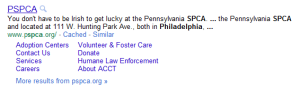
6. Does the site have sitelinks?
Having sitelinks in Google is a great way to know if the site is valuable. If you drop in the name of the site, directory, or blog and it brings back 8 sitelinks, not only does Google think the site is important, but so important that 8 other pages in the site should show up in results too.
7. Will the links be nofollowed?
We can argue about the quality & weight of a site having a great impact on links regardless if they are nofollowed or not. Still, if a site is nofollowing all of the outbound links, this is one negative point based on what Google says about how they treat nofollows. Also, you can use the SEOMoz toolbar to see which links are nofollowed on a page.
8. Is the site on topic?
There may be an opportunity to get a link on a site that has nothing to do with your own website. It could make sense if it provides a local citation or is somehow a complementary business, but an off topic website link can be less valuable vs an on topic site. This judgment may be used more for scoring a priority order for targeting links.
9. How many backlinks does the site have that you're targeting?
Getting a link from pages that have quality backlinks is important. Not only do you want to build quality links to your site, but you want the pages linking to you to be quality too. A page could have 30,000 backlinks, but if they're all internal links then the site could be less juicy than another with only a handful of external ones.
10. When was the page created?
A brand new page that compares & links to all of your competitors, but leaves your company out, would be a nice place to get a link. If I look and see it has no PR, mR, cache date or backlinks, it could appear that it's not that valuable of a linking opportunity. Pages that were just pushed live could still be a valuable opportunity that you just happened to find too quickly.
11. Are there obvious paid links on the page?
If there's a big PAID LINKS BELOW section on the page you're evaluating, you might want to skip it. Totally above board to sponsor charities, wordcamps, podcamps, but a paid links section that's 48 links long with custom anchor text for each ranging from rx meds to hipster shirts is going to get flagged & probably devalued.
12. Are there poor quality outbound links on the page?
It's a rare situation where we would look further into a page if it had gambling or xxx porn links on it. We believe it's a huge indicator of a spammy site/paid links and would not want our links touching those with a latex covered ten foot pole.
13. Can you get custom anchor text links?
While you don't want every single link you get to have the same anchor text, building up some anchor text for your important keywords is still necessary. If you're able to get custom anchor text, this could make the linking opportunity more valuable depending on your seo needs.
14. How much does the link cost?
Yes, paid links. Sponsored links. Donation links. Whatever you want to call it, most companies do it. Most companies do it in a smarter way than Overstock or J.C. Penney. If the opportunity you're looking at will require some cash or product, how much & how long is always the question. If it doesn't make sense financially then even the best paid linking opportunity isn't worthwhile.
15. Where is the linking opportunity on the page?
Link placement is something to evaluate when going through opportunities. Is it a lowly footer links? A blogroll link? A link in the content of the page? I'd take these three as a poor, better, best example.
16. How long will the link be prominent placement?
We had a client get a link from the NYTimes and go down for that keyword. The Times goes through stories so fast that an article containing your link that was one click from the homepage could be eight clicks away or archived two days later. This is the same for bloggers who knock out a post a day. Content is great, but for sites that produce a lot it could bump the page containing your link to a far off place of less importance.
17. What type of link is being offered?
There are differences between the value of a logo link, a logo link with alt text, a www.company.com link, a Company with Main Keyword link, Main Keyword link and the list could go on. Getting some type of link is (90% of the time) better than getting nothing, but something to consider when prioritizing your outreach & opportunity.
18. Doe the site rank for a term you're targeting?
The easiest way I've found to bump up for a competitive term is to get a site ranking above you for that term to link to you.
If I know I want to rank for something like Swimming Hand Paddles and a site like http://www.alleghenymountainmasters.org/Page1333.htm might be ranked ahead of me for the term, I might try to get a link on there by making my page THE authority source for everything about Swimming Hand Paddles including a fitting guide, different workouts to use them for, and how we offer a guarantee on our products for a year. They might be the only site ahead of me that isn't a competitor, so this site is probably one of the most important links I can get.
19. Will the site promote the article highlighting my link/company?
It's an added bonus when getting a link on a website if that article or your link is then highlighted in a weekly/monthly newsletter or sent out in a tweet. Any extra exposure that page can get, the more potential value & traffic it can pass. It could also help with social as a ranking factor in search.
20. Does the site require a reciprocal link?
Some reciprocal links happen naturally and that's okay. At the same time, unless there's a special relationship between your company and the site you're targeting, a reciprocal link request is one thing we won't spend time pursuing. Google lays it out in their Linking Schemes section.
21. Is the site a bad neighborhood?
There are many definitions of a bad neighborhood. Any number of the steps above like 3-6 should help you weed out bad neighborhoods. If you need a tool to help you out, you can try http://www.bad-neighborhood.com/text-link-tool.htm, but common sense should prevail.
22. Does the page you're targeting contain duplicate content?
Google has a small tolerance for some types of duplicate content, but if you drop multiple phrases in quotes and the page you're targeting doesn't show up, it might be a good idea to pass. Getting a link on a site that's almost 100% duplicate content won't hurt your site, it just isn't a good use of your time getting links on pages that will end up in omitted results.
23. Are there broken links on the page you're targeting?
If Google indexes 75 links on a page and 15 of them are broken, it doesn't make sense that Google would consider a page where 20% of the links are broken as very valuable or trusted. For a little more on broken links, check out the post that @napoleonsuarez put up a few months ago.
24. When you turn off javascript & reload the page, do all of the links still appear?
If you're evaluating getting a link in a section of a page that goes away when javascript is turned off, the engines might not be able to spider those links. Run it through at least 2 spider simulator or check the cache to see if the links are actually indexed.
25. Is the site using spammy on page tactics?
If you find the page you're thinking of targeting for a link contains white on white text, insanely long alt text image descriptions that don't match the text in the image, or "read more" dropdown that contain 70 links and more text than is on the page, these are signs that you probably want to abandon this opportunity.
The list could go on, but I think this highlights plenty of ways to pick & choose to evaluate a link. Follow me at @adammm , the rest of the SEER team from our profile page, & grab the rss feed for the SEER blog for these types of posts as well as other SEO & PPC reads.

.png)
