

April 9, 2010
301 Redirect Test: How Much Link Juice are YOU Losing?
In a recent interview conducted by Eric Enge, Matt Cutts indicated that while 301 redirects are still the preferred method for migrating between pages and sites, a certain percentage of PageRank is lost through the redirect. This disclosure has stirred the pot in the SEO community – whereas before it was assumed that a 301 would pass all of the link juice, now many are asking ‘how much is lost?’ and ‘what else can we do?’.
Given that no definitive answer has been provided about the exact percentage lost, we decided that the only way to determine the true value of a 301 was to analyze a site that had recently changed domains. Fortunately, one of our clients moved domains in the beginning of 2010 and had implemented a 301 on their old site. We managed this account before and after the switch, so data from both the old and the new sites was available for analysis. The following case quickly outlines what we’ve seen with these domains in particular, and how the 301 is functioning.
In the first graphic we can see the Open Site Explorer data for both sites. This was where we started our research because we wanted to see how an independent tool was evaluating the two domains and what type of link juice was being passed through.
While it is clear that the 301 appeared to be passing significant value through this analysis, the most important factor was how the engines were treating the redirect.
This next graphic shows the total amount of organic search traffic to the two sites – before and after the switch was made. As you can see, total traffic normalized fairly quickly once the switch was made.
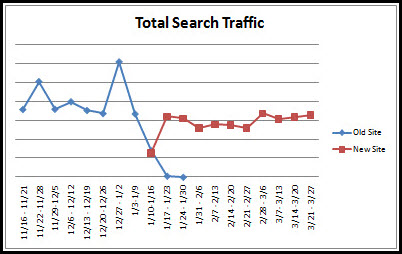
It is important to note two things about the above graphic. First, the same number of keywords were tracked for each site – keeping the KWs as a controlled variable. Second, the site being analyzed experienced a fairly significant jump in traffic around the holidays. So while this data is not ideal given the peaks in the graph, it does help demonstrate the overall results since the switch and the relative speed with which traffic stabilized.
The next graphs show the organic search traffic in Google, Yahoo!, and Bing for this site’s top keyword. For reference, this word gets approximately 550k searches on exact match per month.
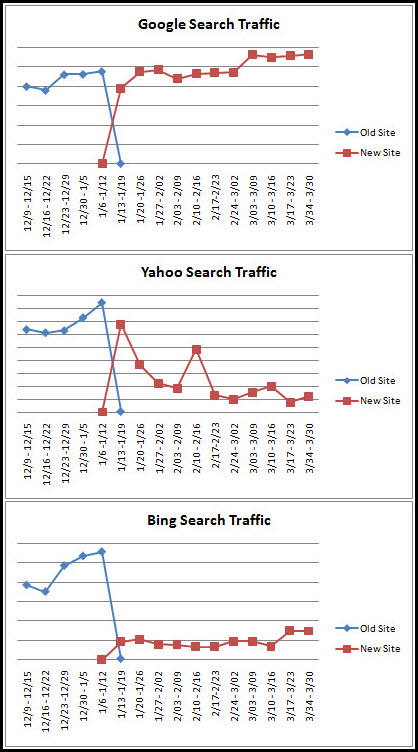
Clearly Google is passing value from the 301, and traffic numbers have actually improved since the switch. Yahoo! showed an initial spike, however traffic dropped significantly and has not returned to previous levels. Bing does not appear to be passing any significant value and traffic levels remain low.
…So what does this all mean? With this quick analysis we were able to reach the following conclusions:
- It is safe to say that 301 redirects do pass value – Our OSE analysis shows that the new domain has picked up a significant portion of the linking domains, as well as relative authority.
- In addition, we saw through our KW traffic analysis that the 301 seems to be working quite well in Google. We have not seen any substantial drop since the domain switch – and in fact, traffic has steadily increased. Whether or not there has been a measurable drop, or PageRank decay, is hard to say at this point. Our data indicates that the 301 is passing value, and our traffic numbers say the same thing – if there is some value being lost, it is not affecting the bottom line.
- The same cannot be said for Yahoo! and Bing. Our data showed that Yahoo! and Bing are not passing adequate value from the redirect and that total traffic numbers may be impacted by this drop. Although Bing has said that it can take two or three re-crawls for value to register, it does not look like the full value has been passed with the redirect. When analyzing the impact of 301s in your future campaigns keep this test in mind and be sure to check how each engine’s traffic is affected.
If you have any questions about the information provided above, please leave them below in the comments section. In addition, a great review of the entire interview with Matt Cutts (complete with helpful illustrations) can be found on the SEOMoz Blog.

44 COMMENTS
-
goodnewscowboy says:
April 9, 2010 @ 9:35 pmReally nice data Mark. Thanks for sharing this info.
I’m amazed at the Yahoo and Bing results. Who’d a thunk it could be so different.
-
Dena says:
April 10, 2010 @ 10:17 amOh my lawd Mark… These graphics were the exact things i’ve been expecting for a long while! There are so many myths about 301’s juice passing that i sometimes am frightened to 301 something at all. Thanks so much for the research
-
Robert says:
April 11, 2010 @ 4:23 amMy buisness partner wants to 301 redirect our blank.ca to http://www.blank.ca but it makes the site a mess for Safari users. The page doesn’t recognize the css file anymore.
We are in Vancouver where Mac is very popular. Market share for Safari is just under %10 worldwide… it’s gotta be twice as high here.
Is a 301 redirect to itself going to increase so much traffic that its worth totally ignoring mac users to the site? I say Hell No. If it were, why don’t we see other companies forfeiting their mac customers for some seo points. Somebody help me. -
Mark Lavoritano says:
April 12, 2010 @ 9:25 am@Brian, @Dena & @goodnews – Thanks for checking the blog and for the feedback – much appreciated. I’m glad that the information was helpful.
@Robert – Interesting question. It sounds like there could be a coding concern there. If you have any questions about passing value through the 301, feel free to reach out!
-
Darren Shaw says:
April 12, 2010 @ 10:06 amThis is some useful research Mark. It’s good to see that Google does a good job of passing the juice, and it’s surprising how poorly Yahoo and Bing handle this.
I have heard that, at least with Google, it can depend on the content. If you buy a content and PR rich domain, then 301 redirect it to a site with unrelated content, the PR will not be passed.
-
Jason says:
April 12, 2010 @ 10:35 amGreat article Mark! The graphics and final synopsis were really helpful.
-
Rob Woods says:
April 12, 2010 @ 11:13 amIn response to Robert’s comment above, you definitely have a coding issue there. We redirect our example.com URI to http://www.example.com/ and have no issues with Safari rendering. I’d say fix your CSS and redirect the URI. Right now if you have incoming links to both versions you are splitting up your link equity. I would recommend always redirecting the various versions of your home page that people might link to, to the canonical version of the URL. Coincidentally, we’re in Vancouver as well…
-
Mark Lavoritano says:
April 12, 2010 @ 2:36 pm@Jason – Thanks for reading…really appreciate the feedback.
@Darren – Good point about purchased domains. That seems like the logical next-step for a test like this. It would be very interesting to see how much value was passed through 301 of that sort…which has me thinking…
-
Jeroen van Eck says:
April 13, 2010 @ 8:43 amThe question is did you just prove that PageRank hardly gets lost when 301 redirecting for Google? Or did you just prove that PageRank plays a negligible role in ranking for keywords when your keyword relevancy is high enough?
-
terry Van Horne says:
April 13, 2010 @ 9:08 amMarc… have a few questions
were the redirects at the server level or page?
were wildcards used to redirect?I have a few thoughts on this and believe based on what some others have said even Google may vary how much juice or text is passed from site to site. Hence the varying results reported by peeps generally thought to be quite knowledgeable. The reason for the questions is to ascertain how trustworthy Google may see based on the way the redirects are implemented.
-
Wendy Piersall says:
April 13, 2010 @ 9:11 amI have seen different results based on variables not mentioned in this post.
When I moved an old site to a new domain (brand new), it took a full six months to recoup old traffic levels. So if your client moved at the beginning of 2010, there is still a chance that your traffic will nomalize in a few more months.
Additionally, I have moved content from a strong existing domain to an established domain. These redirects showed no down time at all in search traffic, and in fact Yahoo and Bing are sending more traffic to the new content vs. the old. I attribute this to two things: the fact that the new domains were already up and running and indexed, and the nature of the specific niche of the sites.
I have seen first-hand (and Matt Cutts has copped to this in the past), that search engines treat keywords in different niches on separate algorithims. So ‘work at home’ and ‘make money online’ are much more difficult to rank for than something like ‘coloring pages’ or ‘teacher worksheets’. I’m not sure if Yahoo and Bing have similar practices in place, but if the main keyword in your test gets over half a million searches, it’s safe to say it’s a pretty competitive one and may be influenced by this.
-
Andy FirstFound says:
April 13, 2010 @ 9:45 amWow. Bing really doesn’t bother with 301’s, does it?
Seriously though, great research. Thanks for putting this together, and have a Tweet on us!
-
Scott Skurnick says:
April 13, 2010 @ 10:17 amVery interesting. We moved a very large site towards the end of last year and noticed the exact same thing with Yahoo. This helps verify my assumptions.
-
Four Pillars says:
April 13, 2010 @ 10:35 amThanks for this article – I’m switching my domain in mid-May so hopefully I will have similar results.
-
Rob W says:
April 13, 2010 @ 10:37 amScott
I agree that yahoo and msn likely pass less value through a 301 but if you only moved the site around 4 months ago you may need to wait longer to see the true effects. I’m seeing those 2 engines re-indexing very slowly right now. We took a site split into numerous subdomains back to just the www subdomains last fall and while goog re-indexed fairly quickly the other two haven’t finished recognizing the 301 redirects and flushing the old URIs out of their index even 6 months later.
-
richardbaxterseo says:
April 13, 2010 @ 10:55 amI love SEO blog posts that share data and give real insight into the inner workings (and differences) between search engines. Enjoyable read, thank you!
-
pk_synths says:
April 13, 2010 @ 11:19 amNice data.
Was a domain move request submitted to Google Webmaster Tools before the domain was switched over? If so than that this could be affecting your 301 results as the domain switch request is a backend request. Could also explain why Yahoo and Bing didnt pick up on the new domain as I am not familiar with similar domain switch requests by those 2 engines.
-
Mark Simon says:
April 13, 2010 @ 12:29 pmThis is a very good post however I believe this data shows more how traffic levels are affected with switching domains and 301 redirects. It is not really going into link juice lost/passed.
I personally would like to see a graph of your domain link metrics graphed similar to how you did the traffic data. Granted this data doesn’t change as often and you may not have it.
Thanks for sharing
-
Wiep says:
April 13, 2010 @ 12:59 pmNice test, Mark!
Was the new domain a brand new one, or was it an established domain/ website too?
-
matt says:
April 13, 2010 @ 2:37 pmI’ve seen the same thing in rank data after a single page gets moved. We move some single pages to incorporate better keywords in the URL (and, more importantly, to get rid of some misleading keywords that confuse search-engine users). The old URL is 301′d to new, and all onsite links are changed to point directly to the new page. Within 2 weeks, usually faster, Google SERPs reflect the URL change. SERP rank is consistent. But Yahoo and Bing fare less well; typically, both these engines will drop the page entirely from their SERPs for up to 2 weeks. When the new URL eventually gets indexed, it ranks 5-10 places below the original. Of course rank is volatile and personalized, but this correlates strongly to the traffic data presented above.
-
James Green says:
April 13, 2010 @ 5:36 pmLove that you are looking at this in a data driven way rather than just anecdotal and especially thanks for sharing.
-
Ben Cook says:
April 14, 2010 @ 1:32 amSorry, but how are you deriving any useful conclusions from this data at all?
You don’t mention anything about whether or not you created new links, got new organic links, etc. The title is talking about how much Link Juice is passed but all but one of your graphs & data deal with traffic. As you mentioned in the post with seasonality, other things play into traffic which means that this really doesn’t prove much of anything.
There’s no where near enough control going on to isolate how much link equity is being passed. This simply shows that Google seems to transfer traffic fairly well over a three month period.
-
Ben Rush says:
April 14, 2010 @ 2:26 amGood article, but I don’t think it actually answers the question it sets out to answer particularly well. All this proves is that juice is passed (which we knew already) followed up with a fairly broad statement that it seems to be quite a lot. What is quite a lot? 50%, 60%, 70%? There is to many variables that could be factoring into this research outside of just the 301 redirect.
The piece about Bing / Yahoo however is very interesting however and would be useful to revisit again to see if this has changed (i.e., they have traditionally been slower to pick up changes / new sites, pages etc).
-
links for 2010-04-14 says:
April 14, 2010 @ 5:57 am[...] 301 Redirect Test: How Much Link Juice are YOU Losing? Given that no definitive answer has been provided about the exact percentage lost, we decided that the only way to determine the true value of a 301 was to analyze a site that had recently changed domains. Fortunately, one of our clients moved domains in the beginning of 2010 and had implemented a 301 on their old site. We managed this account before and after the switch, so data from both the old and the new sites was available for analysis. The following case quickly outlines what we’ve seen with these domains in particular, and how the 301 is functioning. (tags: 301 bing google linkbaiting links onpage redirect seo yahoo) [...]
-
301 Redirect; hoeveel linkwaarde verlies je? » netnotion.nl says:
April 14, 2010 @ 6:06 am[...] was voor Seer Interactive aanleiding om een klein onderzoek te doen naar de doorgifte van linkjuice/pagerank na 301 redirects. Hierbij werd onderzocht of de [...]
-
seo agentur says:
April 14, 2010 @ 7:07 am….I have seen first-hand (and Matt Cutts has copped to this in the past), that search engines treat keywords in different niches on separate algorithims……
that´s exactly what is was thinking first when reading this article! no doubt good analysis, but might vary from niche to niche. in order to have reliable results, tests should cover at least a couple of different niches and branches and therein also multiple sites, just to make sure…
-
wil reynolds says:
April 14, 2010 @ 8:38 amMark, you have big shoes to fill for blog post #2!!
@skizzo, I agree that the title might have actually been off a bit, because it really is more of a shoot out between how google, yahoo, and bing treat 301’s instead of the link juice lost.
-
g13 media says:
April 14, 2010 @ 9:30 amNice article Mark surprised MSN isn’t accepting the 301, wow. This really sucks because one will lose traffic if you change domain names.
-
Mark says:
April 14, 2010 @ 9:31 am@terry Van Horne – Yes the redirects were done on the server level and I believe wildcards were used. Thanks for checking in!
@Wendy – Good point about the keyword niches. You are right that the search volume for KW may have impacted this test.
@richardbaxterseo – Thanks for the kind words – glad you liked the post!
@pk_synths – Yes the domain move was submitted to GWT. I agree that this could have affected our results. However, the fact that Yahoo and Bing do not have a similar process does not explain why they are not picking the site up, but the fact that we can point Google in the right direction may help explain why Google picked it up so fast.
@James Green – Thanks for checking the blog, appreciate the feedback.
@Ben Cook – Thanks for your feedback. I agree that this test was not a ‘perfect’ one, and the variables (ie seasonality) definitely could have impacted our results – However, we did make a point to highlight what value we were seeing from an independent tool, and how that was translating to the engines – and specifically how it impacted our traffic results. Although data like this is not all that common, I am hopeful that we may be able to analyze something similar with more controls. (and we’ll definitely be keeping an eye on this site to see if/when things change).
@Ben Rush – Thank you for the feedback. I’m not sure we’ll ever know the true percentage lost, but from this test we can see that Google looks like it is leaking less value than either Yahoo or Bing – which is definitely valuable data. I also agree about the variables in the test, however because we were working with real data, and not a test set, we were somewhat tied to the numbers and the lack of control – definitely something we will consider the next time around though!
-
Kenichi Suzuki says:
April 14, 2010 @ 1:13 pmGreat analysis.
Would you let me introduce the article to my blog readers with translation? I’m a Japanese webmaster. Most of them are not able to understand your story in English(I am). -
Branko says:
April 15, 2010 @ 2:04 amYour Title is highly misleading. You cannot measure how much link juice you are passing, losing or gaining, unless you work at Google. As Ben pointed out, the only valuable takeaway from the results you are showing is that it takes longer for Yahoo and Bing to 301 your site to a new URL.
The results from the independent tool (SEOMoz) are a product of an algorithm that is based on certain assumptions. those assumptions could be better than your or my assumptions as they are based on a much larger set of data than we can put our hands on, but they are still assumptions that may have nothing to do with the way link juice/authority/relevancy are passed throughout the web.
It is nice though to see data/observation-based posts. They do stand out from the background noise of opinions that everyone has and some deem important enough to put on a blog post.
-
Directory Sieve says:
April 15, 2010 @ 3:37 amnice analysis, i have done 301 redirects myself on my niche sites but never analyzed so deeply. however, i have never seen a rise in google organic traffic after the re-direction, actually its always a near about 20% decrease. Yahoo though drops a lot on search traffic but i have seen it come up after a long time. Unfortunately the sites that i did the re-direct did not received much traffic from bing so i don’t have any bing stats.
From your graphs, it looks like bing dose not values or even registers a 301 re-direct which is a pretty bad thing to do, surely many will lose faith in the bing search engine if Microsoft fails to add the value of 301 in bing algorithm
-
» Are 301 redirects a good thing? 301 redirects might be not so good for SEO after all? - State of Search says:
April 15, 2010 @ 5:21 am[...] a practical case Mark Lavoritano proved that moving domains had no significant impact on the search traffic Google generated. However the search traffic from Yahoo! And Bing decreased dramatically. So while Google is telling [...]
-
Live from Pubcon South: Link Building | Search Marketing Sage says:
April 15, 2010 @ 3:58 pm[...] also mentioned the fallacy of 301 redirects. Seer did a blog post about this topic this week. Interestingly, Bing and Yahoo suffered more with 301 redirects than did [...]
-
Weekly Search & Social News: 04/20/2010 | Search Engine Journal says:
April 20, 2010 @ 10:01 am[...] 301 Redirect Test: How Much Link Juice are YOU Losing? – as with other studies, it seems that Google does a MUCH better job of handling them compared to Bing/Yahoo. Interestingly, this is a topic we’ve been talking about a LOT over the last few weeks. Definitely an interesting read. [...]
-
La rassegna della settimana (15): Nuovo Google Places e piattaforma social by Microsoft | TSW Blog says:
April 23, 2010 @ 4:39 am[...] Case history di una migrazione di dominio. Quanto link juice si perde con i redirect 301? [...]
-
Nancy Hutchins says:
May 5, 2010 @ 9:49 amI’m glad I found your article. I’m not a SEO pro by any stretch, but recently did a 301 re-direct from my old site and have been wondering about the effects. This is reassuring news. Thanks.
-
Shiraz says:
June 15, 2010 @ 7:24 amhmmm, well… it’s nice… I was really curious about the link juice and the backlinks passing on to the new redirected domain…. thanksssssssss
-
Azzam says:
July 1, 2010 @ 4:06 pmI was truly concerned on this subject since I have a PR5 site with 200,000+ backlinks that I want to do a 301 redirect for and just do not want to lose any of the backlinks or PR5.
thanks, will keep on researching.
-
10 simple ways to do a 301 redirect and not lose PR juice says:
July 1, 2010 @ 4:41 pm[...] there has been an actual test carried out by Seer Interactive that has some positive news.
-
Sorry Bing, You’re No Google – 5 BIG Issues Bing Needs to Fix Before the Switch | Seer Interactive SEO Blog says:
July 2, 2010 @ 12:07 pm[...] accurately following multiple redirects. Whichever the reason, after @marklavoritano pushed out his 301 redirect post we know there are big [...]
-
301 Redirects and Link Juice says:
July 4, 2010 @ 11:01 pm[...] expecting the search engine to recognize that move. According to an recently published article by Seer Interactive, Google may recognize a 301 redirect immediately, though take up to approximately 2 weeks to [...]
-
301 Redirects – Is there any loss of Link Juice?Dave Kuhn | Dave Kuhn says:
July 20, 2010 @ 11:28 pm[...] expecting the search engine to recognize that move. According to an recently published article by Seer Interactive, Google may recognize a 301 redirect immediately, though take up to approximately 2 weeks to [...]
-
301 Redirect Test How Much Link Juice Are You Losing * Marketing Resources * Marketing Articles * Bethesda Emedia Marketing Resource Library | Bethesda Emedia Marketing Library says:
August 2, 2010 @ 4:28 pm[...] Redirect Test: How Much Link Juice Are You Losing? by Mark Lavoritano, SEER Interactive [...]
SEARCH OUR BLOG:
RECENT POSTS:
- How to Increase Your PPC ROI w/ Modified Broad Match
- Take Advantage of Google Tag’s 30 Day Free Trial
- Stop Giving Away Your Twitter Traffic in Google Analytics!
- How are they beating you? Quick SEO Analysis Tools – Part 1
- Sitelinks: What Can They Do For Your Metrics?
- Detect Hacking attempts with Google Analytics
- The 17 commandments of setting expectations in SEO (interview)
- Bing Updates Webmaster Tools for the Worse
- Are Seller Rating Extensions A 5-Star Feature?
- 5 Traits of Successful Internet Marketers
CATEGORIES:
ARCHIVES:
- August 2010
- July 2010
- June 2010
- May 2010
- April 2010
- March 2010
- February 2010
- January 2010
- December 2009
- November 2009
- October 2009
- September 2009
- August 2009
- July 2009
- June 2009
- May 2009
- April 2009
- March 2009
- February 2009
- January 2009
- December 2008
- November 2008
- October 2008
- September 2008
- August 2008
- July 2008
- June 2008
- May 2008
- April 2008
- March 2008
- February 2008
- January 2008
- December 2007
- November 2007
- October 2007
- September 2007
- August 2007
- July 2007
- June 2007
- May 2007
- April 2007
- March 2007
- February 2007
- January 2007
- November 2006
- October 2006
- September 2006
- August 2006