A new approach: How to Pick a SEM/SEO company using Linkedin & Twitter
The topic of how to pick an SEO company has been well covered by SEOmoz, Google, and us (with a Vinny Chase video) on how to pick an SEM/SEO company.
Today I want to give you a more concrete (and maybe self serving) way of how I would pick a search company, boiled down into a few steps. So, throw away the RFPs and stop looking at the client list, and DEFINTELY don’t look at topseos.com rankings…here’s a new way to evaluate the company’s passion for search.
People passionate about search are:
If I were you I’d want those kinds of people working on my project…here’s how to find a company that has that passion.
STEP 1 – Twitter – Do the SEM/SEO strategists have twitter accounts?
Look for the company’s senior strategists profiles on twitter – Heck, do they even have a freaking twitter account? You’d be amazed, I was, let me give you some examples…
I am not going to name names, but I quickly looked up 5 senior search friends (senior = 6+ years search experience) at agencies who get BIG clients and are in the Philly/NYC/DC region…most of them did not have a Twitter account (or I couldn’t find it, which is just as bad). One had an account with 3 posts in a year yet she is a director of SEO! Are you freaking kidding me? Here we have senior search strategists, in companies who land BIG clients, not on twitter? In this industry especially, I don’t know how you can do that.
Lets contrast that to some newer peeps:
Take Napoleon Suarez a person who interned with us, blew us away and has been working here ever since – look at his activity

Not only is he following people, people are following him, a lot of them in fact. He’s a 1.5 year SEO yet he would run circles around several of the “senior” search strategists above.
Sam Crocker is a good friend, who got his first SEO job around Jan 2010 – here we are a year later, look at his profile:

Use the SEER most tenured peeps as an example – Crystal Anderson, Bonnie Schwartz, Adam Melson, Rachael Gerson, and Me. Look at the profiles, they are LITTERED with SEO posts, analytics posts, SEM posts b/c we really are deep int this stuff. You want to find an organization where the passion for the work flows from the top and infects everyone.
I recommend that you also look at who a company’s team members @ messages go to on twitter…often you’ll see them interacting with, RT’ing, etc with industry vets…you want people on your search team who are networked – it will help them help you!
STEP 2 – Twitter as a research & networking tool
If they actually have a twitter account with some activity…don’t worry about how “internet famous” they are – follow/followed ratios don’t mean a ton when picking a firm. You do want to look at who do they follow…do they follow some of Google’s official profiles to get the news as it breaks for Google Retail, Google Local, here’s the list? Do they follow industry specialists? Do they follow random accounts too? (Why is following random accounts important? Simple…you want someone who has interests other than SEO/SEM) Being out there in the world, helps you get new ideas.
You can easily look at someone’s account, here’s my pal Ross Hudgens as an example – followers are easy to see:

Lets remember the role that twitter plays for many search professionals:
Those three reasons alone should make you think when picking a search firm/consultant/in-house…if the senior people don’t have twitter accounts (or very sparse ones, or ones with nothing about the industry) then you gotta start asking questions like:
1 – how are THEY learning?
2 – if they don’t see value in networking & learning, then how likely are they to be emphasizing that to their team?
3 – how are they staying on top of trends?
4 – how can they even advise you on how twitter helps SEO, if they don’t even have an active account?
5 – If they don’t have a twitter account, then you KNOW they probably don’t know squat about the new stuff like Panda, Farmer, +1, etc.
Ask yourself, is that the SEO company or SEO consultant you want working on your account
STEP 3 – Linkedin to Keep them honest
Agencies love to lie, they love to lie about their clients and they love to lie about how big they are, so turn to Linkedin to get the real deal…
First get the employee count, this will tell you whats up:
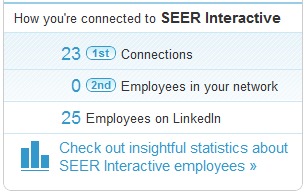
But it doesn’t tell the whole story, stacking my company full of 10 interns and me, is technically an 11 person company, but do YOU want a ton of interns working on your baby, with one overworked person at the helm?
Use Linkedin to see intern to staff ratio here’s how to search for titles for current jobs (no those folks are not interns at SEER):
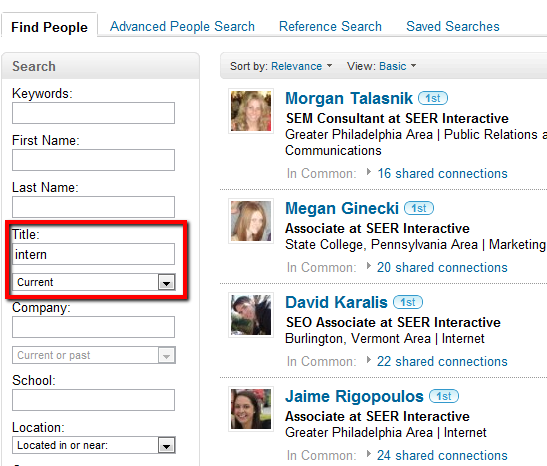
I’m not saying interns are a bad thing, 1/2 our staff are interns turned into full timers, but you just want to do some digging beyond just number of employees.
STEP 4 – Use Linkedin to determine the sales to team ratio
This matters because all search firms are growing, the question is are they growing because they are great at sales, or are they growing because they are great at SEARCH and their clients refer them often? You can find this out…
Here is an example of a sizable SEO firm with high sales/employee ratio – out of 62 employees on Linkedin, 33% are sales / marketing – this could skew high since seo & sem people are marketers:
Compare that to Distilled

or SEER where the ratios are lower.
.
While that is NOT a disqualifier, if your agency is getting a ton of referrals – they probably don’t need a sizable sales staff, thats just my opinion. Remember smaller firms may have a higher ratio, so don’t disqualify a quality firm because they are small and have 1 of 5 members on sales.
STEP 5 – Use Followerwonk to see who they follow
Do people at said company follow the industry leading information sources? How will you know?
You can use followerwonk to put in sources of search marketing news or leadership, the key is the account can’t follow a ton of people back or it skews the research. You’ll get a venn diagram and in the example below, where I used search engine watch, search engine land and matt cutts – I can see the overlap between all three or just two of the accounts, which I can then see if my account person is following them. (Note: I would fail this test, I stopped following news sources on twitter). But it is still one way to check up.

I hope this new pivot on an oft discussed topic, I hope it helps anyone looking for an SEO or SEM agency, its a tough industry to sort through.
Posted: 04.02.11

Minchala:
I’ve used the company growth chart and Departures list to get a gauge of the health of companies i’ve interviewed with before. I think its just as useful in this application as well. Particularly with departures, when i see blocks of people moving laterally thats more of a bad sign than folks moving up in title and on to bigger corporations where it seems to speak more to ambition than commentary on the company they left behind. Know what i mean?
As usual, great stuff!
Adrian Drysdale:
It’s a valid point. If I was a customer I would want the person doing my site to be an active member of the SEO community.
Mark C:
Isn’t Jing the best screenshot capture tool :)
Anyways, yeah nice post, interesting info. There is of course a correlation between followers and the information you provide, just make sure you target your niche target!
Tim Croteau:
As much as I appreciate the idea of doing quality homework before choosing an SEO firm, I’m going to have to disagree with the first step here (which unfortunately knocks out a few of the others). I know plenty of great search folks who don’t tweet, if only for the fact that they’re busy BEING great search folks. Their time is spent researching, analyzing keywords, following up with clients, preparing reports, reviewing google analytics….
Too many “SEO” firms are happy to print a screenshot from google, email it to their clients once a month and collect a check. I’d be happier to know my search guys and girls don’t have time to Tweet because they’re busy giving their clients top-shelf service, and dispelling the myth of “set it and forget it” SEO.
Tim Croteau:
…reviewing the post again, I guess I should say that I agree completely with your initial “people who are passionate about search” bullets – I just don’t agree with your means of seeing them fulfilled! :)
I want my SEO pro doing all that stuff too; I just don’t think there’s a necessary relationship between those bullets and whether or not he/she’s a pro-tweeter.
Wil Reynolds:
Thanks everyone for the comments, Tim – if you were looking for an SEO firm, how could you tell that the company you are hiring has passion for SEO? I’d love to get some more ideas to add..
R.B.:
Great post, but I think it’s a bit wrong telling that there is no other way of getting news from the industry except Twitter. It’s the fastest way, that’s certain, but if you have subscription on all major SEO websites, eventually all news will get to you.
All in all, extremely useful article, I think I will add another feed to my reader :))
Tim Croteau:
Hi Wil,
There are so many less time-intense channels than Twitter (which again, is my only real sticking point here). I’d look to blog posts and how the agency talks about their services on their website. I’d want to learn about their approach through whitepapers and eBooks, etc. Cranking out a solid whitepaper or blog post once a week or month is a lot easier to fit in the schedule of a committed, busy SEO team than the constant presence required to be relevant on Twitter.
My bottom line: Passion certainly needs to be there, but Twitter is just one of so many channels we can harness to promote our passion for what we do. To rule out someone for not using that single channel seems short-sighted.
Wil Reynolds:
RB – Totally agree buddy, I think with RSS and newsletters you can totally keep up, the hard part is that if you use RSS its hard to know whats popular vs. what is not, and sometimes you can’t read everything in your reader. That is the “follower” part of what I was saying…you don’t need to be on twitter tweeting all the time, but you should be following the new sources.
Thanks for the kind words bro.
Tim – Blog posts, 100% agree with you, its another great way to see passion…If someone is writing regularly that is a good sign. Twitter is an interesting sticking point though…I think twitter really helps you segment and speed up whats getting hot in your industry, better than anything else out there.
I think that being on twitter is still key though for someone evaluating your team…if my team was working all day on client stuff and not being on twitter there is a good chance that they might be so busy working on my method of doing SEO that they miss out on new ways being tweeted about. I hated Twitter for that same reason you meantiond though buddy: http://www.seerinteractive.com/blog/rant-twitter-ettiquitean-addiction-that-can-make-people-hate-you/2007/12/18/
There has to be a balance indeed!
Dana Lookadoo:
Oh, the love-hate relationship of Twitter. It’s often hard to find the get-work-done/need-to-stay-current balance.
However, SEO’s must understand the power of Twitter and its influence in SEO as well. We have to be on Twitter in order to know best practices for how to use Twitter. Our clients benefit.
Followerwonk? How do you find these tools? Love it! Let me guess, on Twitter!
Joanna Butler:
Great blog post Wil! Actually I think this highlights how skills as an SEO are synonymous with skills as a stalker/detective! Haha! We’re very good at looking up the footprints online of anyone/thing, not just brands…
I totally agree with your way of finding passionate SEOs on Twitter, but as the commenters above have said, it’s not always as simple as “if they’re not on Twitter talking SEO they’re not a good choice”. Actually I know a lot of people who shy away from any kind of online profile, or if they’re on Twitter, choose not to tweet about anything related to SEO because they simply don’t want to be in the limelight at all. Noone would know they’re the legends they really are – shame for the rest of us, but not for them since they’re busy getting stuck in and just getting on with it :)
I’d also argue that SEOs who have more of a physical (IRL!) presence, especially with their clients, are even better than those who rely on purely digital means to communicate important matters. BUT, if they are on Twitter, I do agree with the signs you can look for IF the SEO chooses to talk SEO publicly – someone who’s dedicated to the work will often tweet about it or related ventures outside work hours and be constantly problem solving and have a natural thirst for knowledge and understanding of all things related to their pasttime – qualities you’d look for in any career.
Love the LinkedIn research though – I personally think LinkedIn is undervalued and (ignoring their subdomain and canonical clashes as the moment) they’re doing some great stuff to the platform.
Keep it up Wil – love your blogs :)
Kristian:
It will be interesting to see how SEO companies react to the news that Twitter is looking likely to implement Facebook-styled brand pages in the future.
http://www.brandrepublic.com/news/1063812/twitter-offer-brands-facebook-style-pages/
Hopefully it will allow for multiple Twitter accounts to be linked to a page; allowing employees to opt-in tweets to their companies feed.
Also Follower Wonk must be the strangest tool name I’ve seen in a while.
Wil Reynolds:
@Dana, that tool was all will critchlow, I got it from him :)
@joanna – thank you! And I definitely know that the twitter thing is not all encompassing, I did try to stress senior staffers, you know the people who drive strategy. But I definitely know that there are other ways, its just that you can’t measure how many newsletters / blogs the senior strategists read on a day to day basis, you know?
Its also not even about how many people they follow or how many tweets they post (IMHO) even if they are on there listening, thats a good sign, b/c you can at least see who they listen. to. As for linkedin…I couldn’t agree more…lets keep that between us :)
Adrian Drysdale:
Here is the way I look at it. Do you want the mechanic with the garage, greasy hands, on the front line. Or the guy in a suit that sits back and watches everyone? Who would you rather fix your car?
Wil Reynolds:
@adrian, you just summed up my entire post in 2 sentences. Its funny – use that example and we all know who we’d pick.
Eppie Vojt:
Wil – I love the use of LinkedIn to get a more accurate picture of the makeup of small businesses, especially in tech-related fields. Very smart way to gain some additional insight.
I’m also glad to see the clarification on the importance of a Twitter profile in your reply to Joanna. I’m beyond passionate about search and web development but I consider myself to be pretty bad at Twitter. I use it more like a feed reader — on good days, I check it in the morning, at lunch, and at the end of the day. Some days, I’m too busy to get to it. The way I use Twitter, it’s hard to be super interactive… I’m just not on it enough. That doesn’t invalidate my passion, however.
Beyond that, many people prefer their social experience to be *real* social. I’d rather interact with people at a meetup than on Twitter, since that type of interaction allows much greater depth. I’m just not built for 140 characters.
Along those lines, I think meetup.com is a great “passion detector.” If you go to Google and type: ‘site:meetup.com “eppie vojt”‘ you’d see a bunch of industry-related meetup groups I’ve attended. If it’s a company looking to hire an SEO firm, they can identify the company’s principals and employees and perform this query on them. If I were hiring a firm to do SEO work, I’d feel a lot better about a group of people who were spending their free time improving their craft than a group who just punch the time-clock. Topical meetup = passion.
Thanks for the thought-provoking post and the really good bits about LinkedIn.
Vincent Ammirato:
I see your blog itself as a “meta-example” with regards to thought leadership/education. Top SEOs share their knowledge. Take a look at what Danny Dover just did with his latest book (SEO Secrets). He spilled his beans…all of them.
A great marketer once opened up and showed me virtually everything he was doing to market his business. I brusquely asked him why he would so willingly show me his secrets. He told me that knowledge isn’t even half his formula for success, it was passion and effort that carried the day.
SEOs that play subterfuge and hide their secret sauce from the world are a dying breed. Knowledge of our field is spreading. Passionate SEOs are always testing and pushing the envelope. One great way to identify these thought leaders is to see what you can learn from them without a formal relationship in place.
As always, thanks for sharing.
Justin Freid:
Wil, I agree with your point about looking for someone who is passionate about search. I’d even go a little bit farther and research how active those top level managers are on LinkedIn. Are they just out there promoting their business through groups or are they answering questions and providing knowledge? Heck, you could even check out Quora.
One item that I believe helps your and Seer’s reputation that you didn’t mention is your plethora of SEO videos on Youtube. Doing some research on potential SEO companies on Youtube/Google Video search can give you an idea if the company is respected as a thought leader.
Jaan Kanellis:
Great tips. I manage http://www.semcompare.com and it is a great way to find trusted SEO’s.
LC:
I wouldn’t be so quick to knock the interns. I know what you meant and where you were going with it, but I have to say I know a lot of people fresh out of college who are more intelligent and quick to learn and strategic than people I’ve worked for who have years of ‘experience’. It comes down to the individual you’re paired with, not their title.
Wil Reynolds:
Glad you got the gist! We hire a ton of interns here, I just think its weird when someone has a company where a substantial portion of the “staff” are temporary workers. Actually after hiring some outside experienced help, I decided to hire a bunch of interns, test em out and if they are awesome elevate them into full time, I am actually seeing much better success raising people up the “SEER way” then trying to re-train new ways of thinking.
Sandra Hennessy:
Great article, not sure Irish businesses will use twitter as a method of identifying their SEO company but if so I am covered.